Note: This novel was WINNER of the first John Leonard Prize this year, awarded by the National Book Critics Circle to a debut work of note in any genre. It was also chosen one of the Top Ten Books of 2013 by Publishers Weekly.
“You know the saying, ‘As the son inherits from the father, so the father inherits from the son’? The Feds have made it official policy. There is a campaign to disappear not only suspected insurgents but their relatives as well. The idea being that you are less likely to go into the woods with the rebels if you know that your house will burn and your family will disappear…It’s part of the new hearts and minds strategy.”
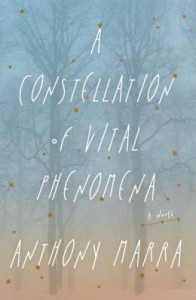 Set in Chechnya between 1994 and 2004, and moving back and forth through history and the lives of the main characters, Anthony Marra’s brilliant debut novel focuses on the threats to the life of an eight-year-old child, the daughter of a man seized and forcibly “disappeared,” and those who are determined to protect her, even at the cost of their own lives. In 2004, Haava, around whom the action revolves, is ordered by Dokka, her father, to run with her suitcase of “souvenirs” into the woods and hide, as soon as he sees soldiers coming toward their house. The house and all its contents are then burned by soldiers, and Dokka is taken, “the duct tape strip across his mouth wrinkled with his muted screams.” Rescued from the woods by Akhmed, a neighbor and failed physician (who would rather be an artist), Haava leaves the village of Eldar that night with Akhmed, hoping to reach the hospital in Volchansk, miles away. There Akhmed hopes to persuade a doctor he knows to care for Haava. As they leave the village, they pass some of the forty-one portraits on weather-proofed plywood which Akhmed painted two years ago and distributed throughout the community to memorialize the forty-one villagers who disappeared forever during a single day that year.
Though Akhmed had planned to return home to his sick wife, the doctor he approaches with Haava finds out that he is a physician, and though he finished at the bottom of his class, she makes a deal with him that she will let Haava stay with her if he will work in the hospital – all the other physicians have fled. Soon Akhmed is amputating limbs, caring for the dying, and operating without enough supplies, medications, equipment, and even body bags, and usually without electricity, returning home whenever he can to his wife Ula, who has been confined to bed for several years with complications from lupus and dementia. Haava, having witnessed the horrors of her father’s disappearance and the burning of her house, now witnesses in the hospital the bloody horrors resulting from the warfare, and the often vain attempts of the doctor to fix the broken bodies.
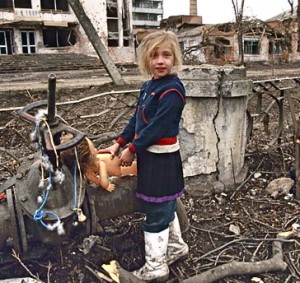
A child plays in Grozny. Photo by Malcolm Linton/Liaison/Getty Images, Grozny 1995
Gradually, the reader comes to know almost a dozen characters so well drawn that it is impossible not to care about them. Stoic to the point of coldness, at times, these are the survivors of two grisly wars, the First and Second Chechen wars between Russia and rebels from Chechnya, originally a war by rebels for independence from Russia following the dissolution of the Soviet Union in 1991, but now a war with religious overtones for the rebels, and desperation for the Russians who need the resources – and oil pipeline – through Chechnya. The Russians will stop at nothing to reach their goals, including the killing of whole families on the word of an informer if he says that one member of the family is aiding the rebels. People are starving, cold, and without any resources of their own. Sonja, the hospital doctor who had been living in London when the war broke out, has recently returned to Chechnya, desperate to find her missing sister Natasha, from whom she has heard nothing for months, and as the narrative moves back and forth, both sisters and their former lives become real.
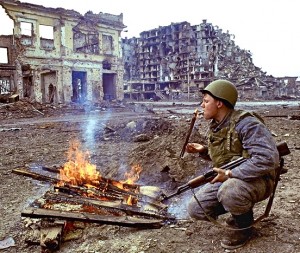
Soldier, Grozny, 1995
Khassan Geshilov, a historian who has written over three thousand pages of a “complete history of Chechnya,” further illustrates how far the Russians have gone to ensure that Chechnya will remain part of their territories. Khassan, a neighbor of Haava, Dokka and Akhmed, finds that he cannot keep up with the changes in Russian policy, and ultimately history, as fast as they are occurring. He constantly has to revise and rewrite his history, and he is losing ground. It is his son Ramzan who is informing on so many of the disappeared, though Ramzan rationalizes it by reminding himself that he is able to get food and the insulin his father needs as payment for his information, in addition to drugs which make his own conflicted life bearable.
Haava, Dokka, Akhmed, Sonja, Natasha, Khassan, Ramzan, their spouses, lovers, and families come fully alive here as individuals, even as they also exemplify broader aspects of life in Chechnya during the horrors of the two wars. The action in Haava’s life in 2004 takes place during only five days, but the book achieves almost epic status in the depth of its pictures of life in Chechnya and its past history. The novel’s opening suggests this will be a story of parents and children and the sacrifices they are willing to make for each other, but that is only the introduction to many, much broader themes. The flashbacks each of the characters makes to a past life show the importance of memory as a way of understanding and/or making peace with the reality of the present. Khassan, a generation older than Akhmed, wants to be forgotten. “There is something miraculous in the way the years wash away your evidence, first you, then your friends and family, then the descendants who remember your face, until you aren’t even a memory, you’re only carbon, no greater than our atoms, and time will divide them as well.” Yet Khassan feels it is very important for Haava to remember her father Dokka, and he ensures that she will remember him. Akhmed feels that the forty-one people who vanished from the village in a single day must be remembered, and he keeps their memories alive through the weather-proofed portraits he creates and posts in the village.
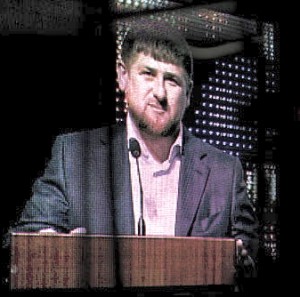
President Ramzan Khadyrov controversial President of Chechnya, speaks on TV. He assumed office in 2007 at age 30 and remains in office. Photo by Mikhail Galustov/Laif/Redux
As the various characters react differently to their memories and their desires to be remembered by others, they remind us of the effects of guilt and innocence in determining our own desires to remain alive in the memories of others. For all the characters, however, the idea of what is right connects with the theme of what they are willing or not willing to do to ensure their own lives during times of war, and how effective they may be in accepting their sometimes selfish actions, both in the short-term and in terms of the memories others may have of them after their deaths. Ultimately, author Marra touches on the same themes that one sees in other epics of war and peace, with life reduced to its most elemental parts: “Life: a constellation of vital phenomena – organization, irritability, movement, growth, reproduction, adaptation.”
ALSO by Marra: THE TSAR OF LOVE AND TECHNO
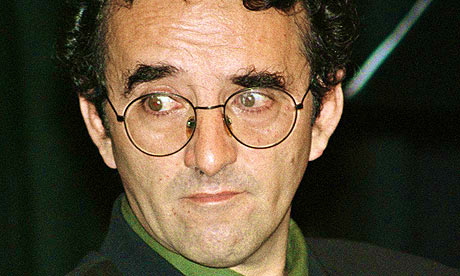
Photos, in order: The author’s photo appears on http://www.wpg.be/
A child in Grozny, 1995 photo by Malcolm Linton/Liaison/Getty Images may be found in http://www.nytimes.com
A soldier in Grozny may be found here: http://m.wikitravel.org/
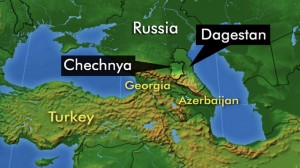
The map of Chechnya is from http://abcnews.go.com/
The TV photo of President Ramzan Khadryov, by Mikhail Galustov/Laif/Redux, appears on http://content.time.com/



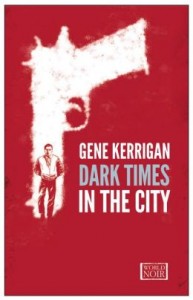 In his fourth dark crime novel to be published by Europa Editions, Irish author Gene Kerrigan continues his string of successful mysteries depicting the hopelessness among those in contemporary Dublin whose chances to escape their dreary lives vanished when the Irish economic “bubble” burst. Now, as Kerrigan depicts it, a successful life for those living on the fringes consists of making compromises with crooks of all types – developers, real estate moguls, extortionists, drug dealers, hired thugs, organized crime, and even the police. Life is uncertain; the ability of good people to avoid being swept up in neighborhood crime is limited; and their goals in life are mainly to survive from day to day. Danny Callahan is having a particularly hard time. Convicted ten years ago of killing mob leader Big Brendan Tucker in a premeditated murder (later reduced to manslaughter as the jury’s way of saying the victim “was a scumbag anyway”), Danny has been out of prison for only seven months, staying clean and working as a driver for his friend Novak, who runs a pub, a transport firm, and a specialty bread store. Divorced by the love of his life while he was in prison, Danny is alone, making do until he can figure out a future direction for his life.
 From this point on, Kerrigan focuses on this initial event as a symptom of the much larger crime scene in Dublin, and in Callahan’s neighborhood of Glencara, in particular. Though four other public gang executions have occurred in Dublin in the past month, with drugs thought to be at the heart of the problem, Walter’s crime of informing is much more serious, and Danny Callahan is no longer going to be able to remain anonymous. Lar Mackendrick, one of the two major mob bosses, who has ordered the hit on Walter, is now looking for Callahan, wondering about his involvement with the police and how much he knows. The police also want Callahan for questioning about events in the pub, and even worse, the other major mob boss, Frank Turner, brother of the man Callahan killed, wants Callahan dead for his past sins. The two foiled assassins, Karl Prowse and Robbie Nugent, working their first job for Mackendrick, are determined to do whatever is necessary to get back into the good graces of Lar Mackendrick, and they are ready to kill Callahan for his interference. Hints of a gang war are growing stronger throughout the city.

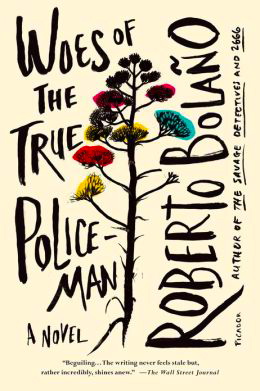 Many readers will argue that this work is not a novel at all. Certainly it does not adhere to the traditional expectations of a novel, no matter how flexible the reader is with definitions. Begun at the end of the 1980s and still unfinished at the time of author Roberto Bolano’s death in 2003, at the age of fifty, The Woes of the True Policeman was always a work in progress, one on which the author continued to work for fifteen years. Many parts of it, including some of the characters, eventually found their way into other works by Bolano, specifically, The Savage Detectives and his monumental 2666. But though it is “an unfinished novel, [it is] not an incomplete one,” according to the author of the Prologue, “because what mattered to its author was working on it, not completing it…Reality as it was understood until the nineteenth century has been replaced as reference point [here] by a visionary, oneiric, fevered, fragmentary, and even provisional form of writing.”