“Death loves other people. It’s not concerned solely with itself. It collects names, faces, human destinies, and gladly reads them. Fine, I thought, I will write about myself. And throw in a little about them; let everything be saccharine and romanticized, in the pastel shades of their underwear. But when I got down to writing, it became clear that I didn’t know how to write sappy stories. I wrote how I thought, and my thoughts were explosive.” From “Day Trip to Durmitor.”
 Though the thoughts in this quotation belong to the main character of “Day Trip to Durmitor,” a writer, they could just as easily be those of the author, Asja Bakić, whose thoughts, as shown in this debut collection of stories, are, indeed, “explosive.” In what is the most excitingly creative and unusual group of stories I have read in many years, Bosnian author Asja Bakić not only captured my attention totally, but kept it through several readings of her ten stories – so much so that I could sit down and reread the entire collection right now and still find new ideas and new sparkle to enliven my day and my reading life. Translator Jennifer Zoble obviously plays a strong role, too, in making these stories feel bright, lively, often humorous, always ironic, and bursting with life, however different Bakić’s characters may be from anything a reader has encountered before. Zoble’s contribution is so smooth and feels so comfortable that it is as if she is channeling the author in a direct line to the reader. It is no surprise to discover that Zoble, the translator, is also an author, and Bakić, the author, is also a translator. Together they provide a perfect match for these unique stories.

Bosnian author Asja Bakić, who now lives in Croatia. This is her debut work.
In Bakić’s first story, “Day Trip to Durmitor,” for example, a young woman is greeted by identical twin secretaries, Tristesa and Zubrowska, immediately after her own death, and she is astonished that the afterlife is completely different from what she expected. There is no “pervasive melancholy” shown by the two secretaries “who could only be distinguished by the color of their underwear. When the speaker wants to know where God is, she is rebuked, told that she “can’t champion atheism and then play cards with the Lord when you die.” In other words, “God slipped in the tub.” Soon the speaker finds that her head is growing. Before long, it resembles an expensive egg from the era of Czar Nicholas II. The twins want her to use her increased brain size to write a book of stories, and if they like them, they will then guide her on to “Phase II.”

When the author in the first story goes to Ozren on a school overnight at the age of six, she terrifies her classmates with her night-time stories of witches and monsters.
Writing about herself and the writing life, the speaker gets to work on her assignment, remembering how her creative life started with an overnight school trip to Ozren, a mountain in northern Bosnia, when she was six. She loved making the other girls scream when they were on the verge of sleep by telling stories about witches and monsters. The speaker now recognizes that “literature is the primary link between life and death,” and that the twins are collecting the best writing of all time about death, hoping to use the manuscripts for a big ceremonial fire that will “allow the dead to walk among the living.” When the speaker is magically sucked out of the celestial place where she has been writing, she lands on earth at Devil’s Lake Durmitor in Montenegro and sees her own reflection – as a non-human. The sudden ending, like the endings of other stories in the collection, leave the reader wanting more, anxious to keep reading to see if some of the answers to the obvious questions will be revealed.

Devil’s Lake Durmitor, in Montenegro is where the main character lands when she finishes her stories for the “secretaries” of the afterworld.
Bakić, with so much content within her writing, avoids the easy labeling so common to other stories that involve the supernatural, fantasy worlds, and science fiction. She does not belong to any of those genre, despite the superficialities her work may share with them. Bakić keeps her intellectual focus on the philosophical aspects, but she also allows her seemingly limitless energy and spirit free rein, her abundant humor and sense of irony adding a sense of fun to what might otherwise feel like very “serious” reading. Where else might one be reading a story about the afterlife in which the main character and a male friend argue about ancient Greek philosopher Heraclitus just before the speaker is whisked from the room and lands on earth as a whole new life form?

Zola’s THE BELLY OF PARIS is a book that the starving people on earth do not want burned. Its descriptions of food are so vibrant that they have kept the hungry alive with their imagery.
A long list of other topics and plot twists keep the reader engrossed and fascinated by the author’s approach to life and writing. Hidden treasure, the sexual preoccupations of children, a grandfather’s collection of pornography, a well-digger who is a forest monster, a body covered in lichen, and a speaker who is also a murderer all appear in this collection. A robot who comes to life, a character with the same name as the author, who has been cloned four times, and people who live with a green spirit add further interest. Literary references add depth to some stories. A writer who regards herself as Medea appears, and a starving, impoverished family who plans to “go West” – to Senegal – is forced to burn their books to stay alive, though the children particularly fear the burning of Zola’s book The Belly of Paris, because the description of foods in that book has helped them through some of their hungriest times.

Writers on earth who continue to write and support a free press are exiled to Mars and their work is destroyed.
The final story involves a person who is in exile on Mars but who returns to her home on earth secretly for a few days to reconnect. Those on Mars are writers who are being erased from earth’s historical record, and books themselves are illegal. Authors can be saved from exile only if they promise never to write another word. All of the earth’s literature, regarded as “refuse,” has been shipped to the Red Planet, and writing has been proclaimed the greatest evil to have befallen humankind.” Worst of all, the most rabid anti-literature zealots on earth are the same people who were once the world’s most passionate readers. Occasionally, the new residents of Mars are able to persuade smugglers from earth to bring in some special requests, paying them in books. Then the speaker finds a book called Mars, which tells what happens to earth in the future, involving a magic “curved” substance and an anti-literary spirit there. Life on Mars, lacking the Moon and its phases, which the speaker regards as responsible for “the entire weight of my humanity, my volatility, and mutable nature,” not to mention her literary creativity, means that Mars, with its two tiny moons, is not a substitute for earth. The author leaves all resolution hanging here, a suitable ending for a collection which is a never-ending source of inspiration, excitement, and thoughtful commentary about today’s world, both real and literary – a collection which truly deserves the label of “unique.”
Photos. The author’s photo appears on http://www.media.ba/bs/
The picture of Ozren, where the main character goes on a school trip and terrifies her schoolmates with the stories of witches and monsters, is from https://mapcarta.com/
The Devil’s Lake Durmitor in Montenegro may be found on https://www.pinterest.com
The artwork for Emile Zola’s The Belly of Paris appears on the Oxford University Classics edition of Zola’s book, available on Amazon and other book sites
Life on Mars, as shown in this novel, is depicted here: https://fsmedia.imgix.net/
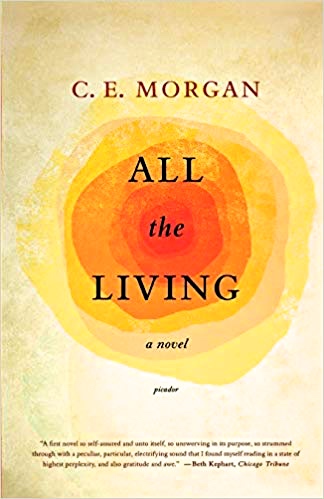 In this assured and evocative debut novel set in rural Kentucky, author C. E. Morgan comes closer to conveying the essence of life, as she sees it, than do most other novelists with generations more experience. Writing about an area in which she lived, Morgan recreates the bare bones lives of subsistence farmers who are irrevocably tied to the land, a land which is sometimes fickle in its ability to sustain those who so lovingly tend it. Interminably long days and aching physical labor are not always rewarded here, and despair is often the prevailing mood of whole communities when droughts or floods play havoc with man’s efforts. Yet each spring offers new opportunities and hope as the resilient farmers renew their back-breaking connection to the land once again.



 With an opening as dramatic as this one by author Laila Lalami, any reader could be excused for thinking that this novel might be a well-described, classic whodunit. While the novel does contain a search for the culprit in what appears to be an intentional, hit-and-run killing of an immigrant who has just closed up his cafe and walked across the parking lot to his car, it would do this intense, character-based novel a disservice to reduce it to such a cliched summary. The reader soon learns that at the moment when Driss Guerraoui is killed by a car, his daughter Nora is at a bistro in Oakland drinking champagne to celebrate her roommate’s success as a composer. Nora herself is hoping for similar success. When the phone call from home interrupts their celebration, she cannot believe the news, but somehow “a bag is packed,” and she drives from Oakland home to the Mojave, dreaming up alternative explanations for the news – maybe the body was misidentified, maybe the hospital mixed up some records. When she arrives at home, it is difficult for her to believe that her father is not there in the house. He still feels present “in the half-empty packet of Marlboros on the windowsill, the frayed slippers under the coffee table, the tooth marks on the pencil that stuck out from the book of crossword puzzles.” The armchair where he usually sits “still bore the imprint of his body.” She is puzzled by the questions being asked by the detective who arrives, and she has no interest in whether her father used drugs, had money troubles, gambled, or had any enemies. She wants to know who was driving, how they hit him, why they fled.


 In her first novel to be translated into English, Yuko Tsushima (1947 – 2016), an author who has won every prize imaginable in her native Japan, shows the spirit which has made her work so honored in her own country. A divorced, single mother whose own father, a writer, died when she was a year old, author Tsushima grew up with her mother, was educated, married, had a child, divorced, and then learned, first-hand, what it was like to be the sole bread-winner in a society which rewarded men far more often than women. Independent and determined, Tsushima challenged the social norms and achieved great renown for her writing, often using her own experiences as starting points for her stories and novels. This novel, published originally in 1978 – 1979, focuses on a married mother seeking a divorce. The unnamed main character and her daughter, only two years old as the novel opens, face very real problems with day-to-day life, in addition to agonizing emotional problems which the woman ignorantly creates for herself and her child. Focused on her own emotional needs, she has shared so little one-on-one time with her child that she does not recognize that the child, who, at age two, is not much older than a baby, has very real and important needs, too. Seeming to believe that if she herself gets what she wants and finds some happiness that her attitude will also spill over and make her two-year-old happy, she is, throughout the novel, closed off from her child, whose whole life is spent with her grandmother (the speaker’s mother), in daycare, or with her own mother on Sundays, her mother’s one day of “time off” from her full-time job.



 With this opening paragraph, author Tanguy Viel is off and running with a propulsive story which never lets down and never quits until the last possible moment, when its ending comes as a relief or an irony to the involved reader. Set in Finistere, a depressed waterfront community in Brittany in the late 1990s, a man stands before a judge, trying to explain how and why he has killed another man aboard that man’s own Merry Fisher boat, and then returned home to await the inevitable arrival of the local police a few hours later. When he sees them arriving, he cannot help but admit that he “wouldn’t have done anything different…I would have done the same thing, heaved Antoine Lazenec overboard the same way and brought the boat back in the same way, following the channel to the yacht harbor while respecting the green and red buoys like railroad signals…” The killer, Martial Kermeur, is anxious to set the record straight, and he is impressed that this judge is “thirty, at most” and really seems to want to hear him out. In descriptive and involving prose, Kermeur describes his thoughts – “no they weren’t thoughts, images maybe…still whirling around…as if I were a cormorant aloft on a shifting breeze, scanning the sea for a tiny shadow or glint that would justify my diving to catch something, anything, so long as it was a place to begin….” And then suddenly, he sees the whole picture and begins: “It’s about a run-of-the-mill swindle, Your Honor, that’s all.”