“Desperation comes…there must be a hundred tourists right now who have filed police reports in Casablanca about stolen goods. You are just another one of them. Not distinguishable in any way…You hear the lie coming out of your mouth before you have time to think it through: “I’m a writer for the New York Times,’ you say. ‘I’m doing a travel story on Casablanca. I really don’t want to have to include this.’ ”
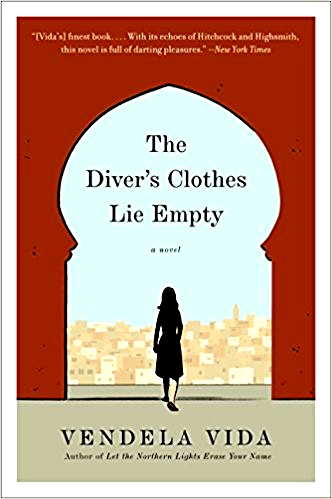 Light-hearted, full of fun, and set in exotic Casablanca, this novel by Vendela Vida may be just the thing to provide smiles and delighted “ah-ha” moments for anyone looking for a break. At the same time, it is a book which develops many variations on the theme of identity, all of which, while not exactly realistic, are still plausible and easy to envision in one’s own life under especially stressful conditions. With a smile in her voice, the author introduces an unnamed main character whose imaginative ruminations, spur-of-the-moment decisions, and panicked thoughts as she sees her life falling apart become those of the reader. Using the often unpopular second person point of view in which every thought and action which takes place is described as belonging to “you,” thereby drawing in the reader, the author introduces her main character in a time of great stress. The reader does not know, at first, why the main character has decided to come to Casablanca or what she plans to do there, but once she arrives at her hotel and signs in, she discovers that someone has stolen her backpack while she has been pre-occupied. Missing are her laptop, wallet, credit cards, all her cash, her camera, and toiletries.

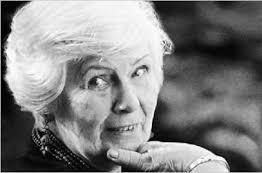
Author Vendela Vida
A video camera has pictures of the theft taking place, though the speaker herself has to instruct the hotel employees how to retrieve the images from it. The head of security recognizes the thief, supposedly a doctor there for a medical conference, but at the same time, he has not even asked her her name. When she gets to a distant police station to report the theft, it is after 5:00, and she will have to wait until the following day. Not surprisingly, she begins to wonder if the hotel staff is in on the theft and how high up the conspiracy might go. Fearing that she might be in danger, she decides to change hotels but will need ID and a credit card. She is in luck. The police chief calls her to his office and tells her that they have found a backpack with a wallet and credit cards. Though the backpack does not belong to her, the police imply that this is the best they’ll be able to do, so she takes what they have found and discovers that the credit cards have not been canceled. They will enable her to change to a different hotel immediately – with a completely new identity.

Check-in desk at the hotel in Casablanca.
As she is walking toward the hotel, she sees a film being made there. The American actress who is the star greatly resembles the main character, at least from a distance. This main character has always had a less than perfect complexion, which she tries to hide with makeup, but she is hired to be a stand-in for the lead actress. The fact that she will be able to use stage makeup and a wig enables even more outrageous experimentation with who she is. When she meets the star, the main character drops hints about her past in the US, about her family, her relationships, and about her failed marriage. Several very funny scenes here beg to be made into a film, and when the speaker is invited to see a Patti Smith concert, she gets to experience what it is like to be trailed by paparazzi.

Patti Smith performing at a concert which the main character attends.
Photography, with its ability to capture images of life, becomes a subplot here, adding to the video, movie film, stories and names (real and invented), past history, and the manipulation of personal appearance, as the author examines every possible aspect of personal identity in this one woman’s life. During her appearance as a stand-in for the star of the film, the main character has an important moment of revelation and begins to feel “something that approximates joy.” She recognizes that “the film will come out, and though no one will know that you were in the backseat of this car, that you are the one whose scarfed profile appears in the distance, you will know. You will have existed. You will have proof that you were here.”

Rumi, a 13th century Turkish poet, whose poem made a difference in the main character’s life.
Other symbolic images also appear, one of which leads to the title. The main character always loved swimming, but she became a competitive diver instead, explaining, “There’s a reason why you finally arrived at diving as your competitive sport. With diving your face was virtually unseen. It was all about the shape your body made in the distance as you dropped from a high board and disappeared deep into the water. By the time you came up for air, the judges had determined their score. It had nothing to do with your face.” Later, the speaker picks up a book of poems by Rumi, in English translation, and chooses a poem at random, “The Diver’s Clothes Lying Empty,” the first stanza of which reads, “You’re sitting here with us, but you’re also out walking/ in a field at dawn. You are yourself/ the animal we hunt when you come with us on the hunt./ You’re in your body like a plant is solid in the ground,/ yet you’re wind. You’re the diver’s clothes/lying empty on the beach. You’re the fish,” an apt description.

American novelist Paul Bowles (1910 – 1999), who lived in Casablanca and elsewhere in Morocco for much of his life.
The novel speeds along on the strength of the comic scenes, combined with enough thought-provoking thematic material to keep the reader engaged. Though this is not a highly literary novel like those of Paul Bowles, an American who lived and wrote in and around Casablanca for most of his life, it is great fun, and it does bring together many iconic scenes which lead the reader to question the multitude of issues involved in our daily lives which test who we are and where we are going. The conclusion, which will disappoint some readers, leaves much to the imagination, refusing to provide the reader with easy answers to questions which the main character has not yet faced. Some readers may also wonder about the author’s own name, whether it is a pen name, and whether it has any possible connections to the content. “Vendela” means “sell it” in Spanish. “Vida” means “life.” Author Vendela Vida has certainly sold this reader on the lives and identities lived and imagined throughout this very funny novel, despite her reliance on the dreaded second person point of view, which ultimately adds yet another level of identity to her story – that of the reader.
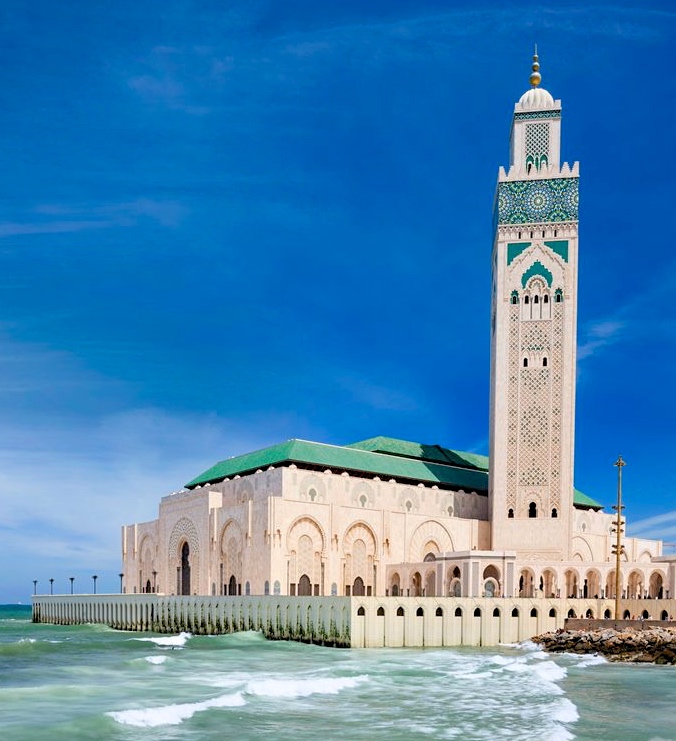
The Hassan II Mosque on the Mediterranean led to new insights for the main character.
Photos. The author’s photo is from https://www.kcrw.com/
The check-in desk at a Casablanca hotel: http://agazaclick.com/
The main character sees Patti Smith in concert, and learns first-hand about the problems of the paparazzi. https://en.wikipedia.org
Rumi, a 13th century Turkish poet, wrote a poem called “The Diver’s Clothes Lying Empty,” a poem which offers lessons to the main character. https://mavloiman.files.wordpress.com/
American novelist Paul Bowles, who lived much of his adult life in Casablanca and other places in Morocco. https://en.wikipedia.org/
The Hassan II Mosque led the main character to some new insights into her own family life. https://www.pinterest.com/
 In this big, entertaining can’t-put-it-downer set in Corsica, best-selling French author Michel Bussi tells the story surrounding a terrible car accident which claimed the lives of three people in 1989 – the mother, father, and adored older brother of fifteen-year-old Clotilde Idrissi. Though she was injured, Clotilde survived the accident when the car her father was driving careened off a cliff, but she was so traumatized in the accident’s aftermath that she has never set foot on Corsica since then. Now, twenty-seven years have passed, and Clotilde has finally returned to the island from France with her husband Franck and her teenage daughter Valentine (Valou), hoping to resolve her residual fears and her questions about the accident. With impeccable pacing, author Bussi alternates the two time periods in successive chapters, creating in the odd-numbered chapters a vibrant narrative told by Clotilde as a fifteen-year-old vacationing on Corsica, and in the even-numbered chapters, creating a parallel narrative told by the now forty-two-year-old Clotilde as she returns to the island. Older, more sophisticated, but still curious, she is anxious to put to rest the questions she still has about the accident. An additional narrator provides a ghost-like third voice here, asking questions and providing commentary on the contents of a personal journal, believed lost, that Clotilde was writing on the day of the accident.










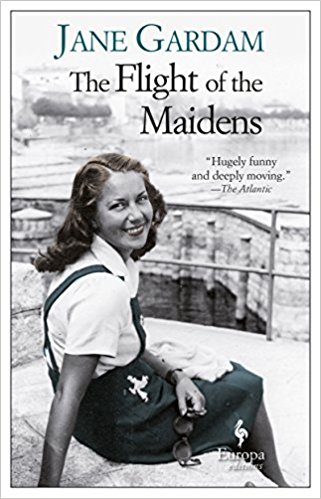 Each new book by Jane Gardam is an homage to her own love of ink. Though a small number of other fine authors may come close to her in terms of prizes, awards, and even titles bestowed by Queen Elizabeth, Jane Gardam stands out among them for the sheer joy of writing which is so obvious in her novels. In The Flight of the Maidens, Jane Gardam is clearly having fun, and no matter how beautifully crafted her characters, how clever her use of irony, how accurate and often unique her descriptions, and how much empathy she may show for those who are having problems coping with the uncertainties of life, it is the “smile” which appears in her work which many of us love and celebrate. The Flight of the Maidens, written originally in 2000 and recently republished by Europa Editions, begins in 1946, as Britain begins its recovery after World War II, a time in which women’s issues began to become better recognized.