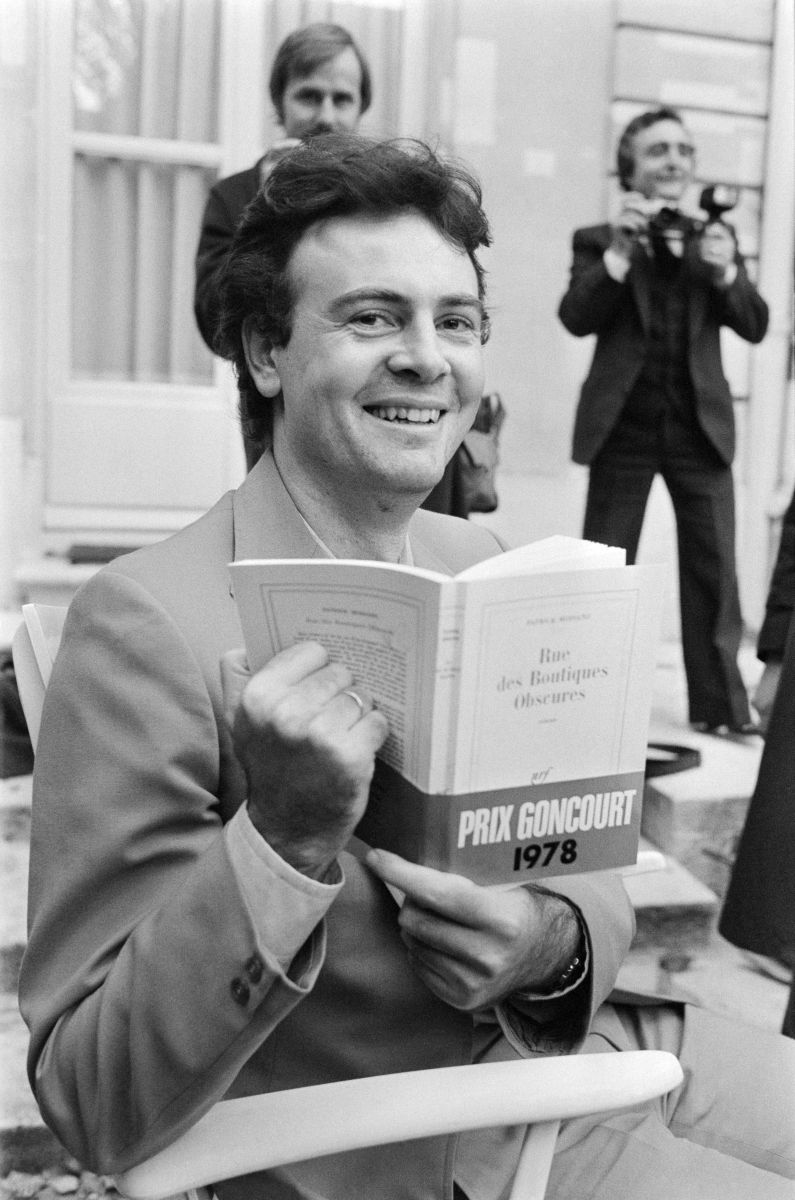
Note: French author Patrick Modiano wrote this novel, his second, when he was twenty – three. In 2014, at the age of seventy-one, he was WINNER of the Nobel Prize for Literature.
“July is the fireworks season. A whole world, on the brink of extinction, was sending up one last flurry of sparks beneath the foliage and the paper lanterns. People jostled each other, they spoke in loud voices, laughed, pinched each other nervously. You could hear glasses breaking, car doors slamming. The exodus was beginning…Smoke rises from the chimneys: people are burning their old papers before absconding. They don’t want to be weighed down by useless baggage.”—Paris, as the Occupation begins in earnest.
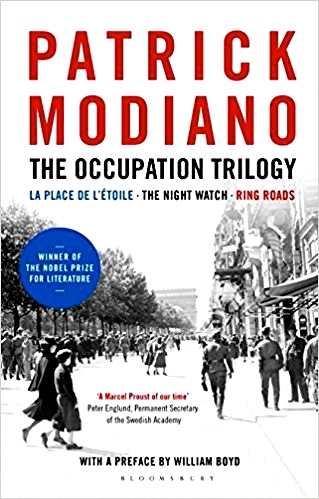 Set in that fraught period between the German occupation of France during World War II and the liberation which came much later, Patrick Modiano’s second novel, written in 1969, when he was just twenty-three years old, incorporates as his main character a young man who is at a total loss about what to do with his life. Describing himself as someone who “started out a pure and innocent soul,” he admits that his “innocence got lost along the way.” The people who are in contact with him now are criminals and former policemen, including an official now known as the Khedive, who have opened a “detective agency” from which they are collecting protection money. The Khedive, who still has important contacts throughout the police department, has high hopes himself of eventually becoming “Monsieur le Prefet de Police.” The young man known only as “Swing Troubadour,” does dirty work for this group, sometimes referred to as The Night Watch, while earning a huge salary for his work. Possessing a warrant card and a gun license, the young man is ordered to infiltrate a “ring” of enemies and destroy it.
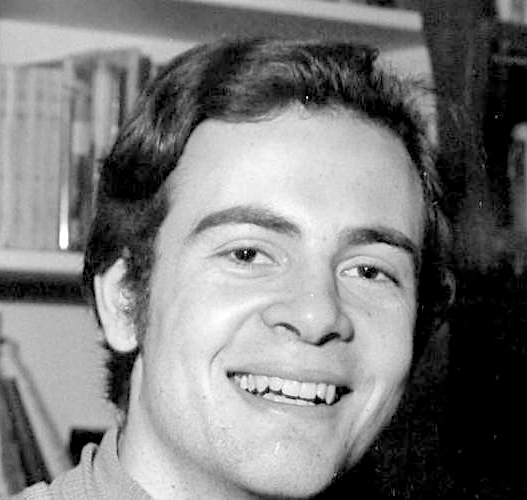
Young Patrick Modiano published his second book when he was twenty-three.
“My life has been littered with so many broken promises, so many appointments I did not keep,” the boy says, “that becoming a model traitor seemed like child’s play…all those faces seen for one last time before darkness engulfs them.” Recognizing himself as an informer, he also believes that he will become a killer if the Khedive and his partners ask it of him, that “[his] particular disposition was well-suited to double-dealing and…to treason, [with] not enough moral fiber to be a hero.” His primary job for the Khedive and his collaborators is now the infiltration of another group operating in Paris, especially learning their addresses so they can be apprehended. This group, part of the Resistance, would like the boy to work for them, too, and its organizer, known as the Lieutenant, is an older man whom the boy actually likes. Caught in the middle, and expected to betray both groups, the boy decides to do whatever he can to stay alive as long as possible, keeping the Khedive satisfied with certain information, while deliberately avoiding giving him specific information about the Lieutenant and is group.

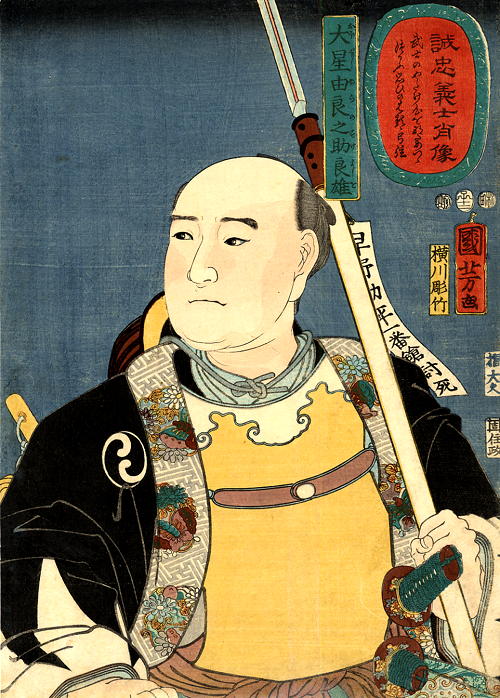
The Khedive is extremely proud of his Spahi officer’s uniform which he sees as parallel to the uniform of the chief of police.
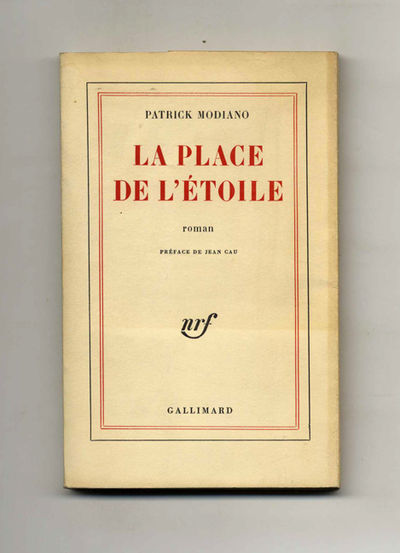
Though Modiano’s style here is more controlled, much less frantic, than it was in La Place de L’Etoile, written just the previous year, his use of a real plot here is still subject to quick changes of focus, time, and place. Living in an elegant house which he and the Khedive’s group have appropriated from a wealthy man who has escaped from France, the boy, Swing Troubadour, has helped sell off artwork, engaged in theft, committed beatings, and even participated in murder for “The Night Watch.” He has engaged in trafficking of all kinds, yet he still seems to maintain a kind of innocence as he “adopts” a couple of “waifs,” an old blind man, Coco Latour, and the young girl, Esmeralda, who takes care of the old man. He regards the rival Lieutenant, who is working hard to clean Paris of gangs like the Khedive’s, as a man with “courage, composure, and elegance” in the face of his tasks and their dangers. The boy rightfully blames himself for much of the bloodshed, and as he thinks off and on of the blind Coco Latour and the young girl Esmeralda, he also recognizes that “If I had not set down [their] names, there would be no trace of their time on this earth.” He longs to be able to escape Paris and his problems there and get to Lausanne and neutral territory where he and they would have nothing to fear.

As he considers his own possible fate, the boy goes into a bar and sees the photo of Pola Negri behind the bar. “Pola Negri cannot help me,” he decides.
As he becomes more and more aware of what his own fate is likely to be, he looks for respite in his surroundings, wandering around Paris, visiting clubs and theaters, and enjoying the nightlife which still exists. Impressionistic and vivid descriptions bring the ambience alive as the boy tries to fit himself comfortably into this environment, and he does not hesitate to share his feelings with the reader. On one occasion, he even admits that he “might have been thinking of Jesus; in fact, [he] was thinking of Judas Iscariot. A much misunderstood man. It had taken great humility and courage to take upon himself mankind’s disgrace. To die of it. Alone. Like a big boy. Judas, my elder brother…We expected little of our fellow man, of ourselves, or of any savior. Will I have the strength to follow you to the bitter end?” In the meantime, the rush of civilians to leave Paris goes on as everyone hopes to save his own skin.

Walking around Paris, the boy contemplates the bleak sadness of the Lido, believing that “they” will make him do the dirtiest jobs before they finally kill him off.
Again, time is flexible here, as the author flashes back and forward without warning, as Modiano plays games which allow him to keep the reader unsure about reality. Near the end, time suddenly flashes back without any warning, and we see how the boy first made the acquaintance of the Lieutenant from the Resistance, and how and why that group regards the Khedive and his partners as they do. Long passages of internal monologue add some depth to the characterizations and bring to life some of the choices the young Swing Troubadour has made and may make in the future. Gradually, he becomes more human, at one point even imagining Hitler sleeping and sucking his thumb: “He yaps, like a dreaming dog. He curls up, steadily growing smaller until he fits in the palm of my hand….” The conclusion, when it finally arrives is suggested, rather than described in full, leaving the reader with mixed feelings. The rapid-fire narrative and its attendant flashes back and forth come to an end, not through any specific action, but because the author has decided that the highly flawed Swing Troubadour, who has touched the lives of his readers in some ways, now needs to travel the rest of the narrative on his own. His “biographer,” the author, has done the best he can with the information he was provided by this boy/man in the course of the novel. The rest is up to us.
ALSO by Modiano, reviewed here: AFTER THE CIRCUS, DORA BRUDER, FAMILY RECORD, HONEYMOON, IN THE CAFE OF LOST YOUTH, LA PLACE de L’ETOILE (Book 1 of the OCCUPATION TRILOGY), (with Louis Malle–LACOMBE LUCIEN, a screenplay, LITTLE JEWEL, THE OCCUPATION TRILOGY (LA PLACE DE L’ETOILE, THE NIGHT WATCH, AND RING ROADS), PARIS NOCTURNE, PEDIGREE: A Memoir, RING ROADS (Book III of the OCCUPATION TRILOGY), SLEEP OF MEMORY, SO YOU DON’T GET LOST IN THE NEIGHBORHOOD, SUCH FINE BOYS, SUNDAYS IN AUGUST, SUSPENDED SENTENCES, VILLA TRISTE, YOUNG ONCE
Photos. The author’s photo is from http://www.sudouest.fr
The Khedive was very proud of the portrait of him wearing his Spahi uniform with all his decorations. Becoming Le Prefet de Police would be appropriate for him, he believes. https://upload.wikimedia.org/
A photo of actress Pola Negri was behind the bar when the boy entered looking for some comfort for his problems. http://www.mymovies.it/biografia/?a=13836
The boy saw the Lido as a place of “bleak sadness.” https://www.pinterest.com/webeco33/cabaret-le-lido/
 With this startling, futuristic title story, debut author Lesley Nneka Arimah wakes up her reader and signifies that this is no “ordinary” collection. The stories in this book make so many creative leaps into new worlds that in many ways the author actually defies the limits of her genre. Born in the UK, Arimah grew up in Nigeria, following her father in his work abroad and acquiring such varied experiences of life that she has escaped the cultural limitations which so often root a writer’s work firmly in one place. The multicultural Arimah finds, appreciates, and focuses on the elements which make people from different places and times react differently to seemingly similar sets of circumstances, creating stories which are full of surprises and unexpected twists. Within these stories, however, she also recognizes the seemingly universal problems and habits which can often limit and determine a character’s personal outcomes. As she explores life from many points of view, her own vision, often dark, creates in the reader the urge to re-read, re-explore, and re-imagine both her work and the settings in which her characters live, to come to know them better and, perhaps, understand what makes many of her conclusions so surprising.



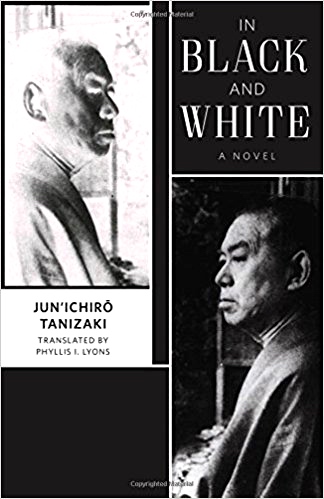 When I saw a reference to this novel by Junichiro Tanizaki as a “new translation,” my attention was pricked, especially when it was described as a book which had been “hidden in plain sight” for over eighty years – a book which even most literary scholars had not heard of until now. As a fan of Tanizaki, I was thrilled by the chance to read an unknown book from 1928 by an author I have always found intriguing – a book which, in translation, would be making history on a world stage. Tanizaki’s well known ability to communicate fully with a broad spectrum of readers, from mystery fans to literary critics, convinced me that this book would connect with readers, and I was not disappointed. In Black and White, a murder mystery set in the late 1920s, provides plenty of excitement, both real and psychological, while also offering some unusual and creative thematic twists on the connections between fiction, reality, and the writing life and its consequences. Here the main character, Mizuno, a writer like Tanizaki, is hired to write a serialized novel for a Japanese newspaper, a task he must begin immediately, and for which he must continue writing every day without major revisions and without allowing the story to fall apart. His eventual story is one in which Mizuno, the writer, chooses one of his “real-life” acquaintances, Cojima, another writer, to be the model for his victim in the fictional murder mystery. Giving him a similar but false name – Codama – within the story, Mizuno then arranges for the fictional Codama, to be murdered as part of the story.

 Despite its cartoon caricature of Supreme Court Justice Ruth Bader Ginsburg working the resistance tubes on the cover of this book, The RBG Workout is no joke – Justice Ginsburg has been working with Bryant Johnson, her personal trainer and author of this book, for almost twenty years, and she credits him for much of her bodily recovery and her dramatically increased strength after two bouts of cancer during that time. She works out with Johnson for an hour, twice a week, has increased her bone density in the process, and, according to Johnson, “she’s graduated from doing push-ups against a wall to push-ups on her knees, to full-on standard push-ups the way I learned them in basic training for the Army. In fact, she’s gotten so strong that we’ve recently added ‘planks’ to her routine.” Johnson’s success has become so widely known and the public has become so interested in his program that Justice Ginsburg not only agreed to his writing this book about his regimen for her but also wrote the Foreword for this book.


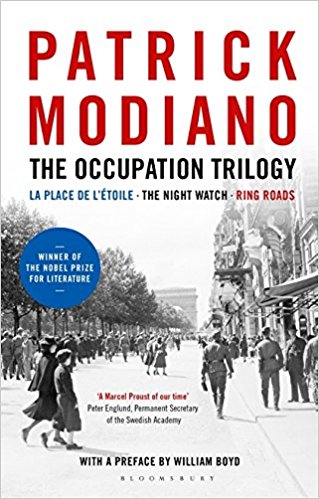 When Patrick Modiano won the Nobel Prize for Literature in 2014, he had been a huge literary success in his native France and throughout Europe for decades. Almost none of his novels were available in English, however. US and UK publishers immediately accepted the challenge to provide translations in English, especially when the sudden popularity of these novels in England and the United States created a completely new literary market. Most of Modiano’s writing is now available, but until recently, Modiano’s debut novel, written when he was just twenty-two years old, was unobtainable in English. With Bloomsbury’s publication of The Occupation Trilogy – one volume containing Modiano’s first three novels: La Place de l’Etoile, his debut novel, written when he was twenty-two; The Night Watch, written when he was twenty-three; and Ring Roads when he was twenty-six – those novels are now available in both hardback and paperback. For readers who have become fans of Modiano, this trilogy will answer many questions about Modiano’s early life and career, expanding what readers have already gleaned from his other semi-autobiographical novels about his unconventional upbringing and his alienation from his parents.