Note: Jose Eduardo Agualusa was WINNER of the International Dublin Literary Award (formerly the IMPAC Dublin Award) for this novel in 2017.
“Ludovica Fernandes Mano died in Luanda…in the early hours of 5 October 2010. She was eighty-five years old. Sabalu Estevao Capitango gave me copies of ten notebooks in which Ludo had been writing her diary, dating from the first years of the twenty-eight during which she had shut herself away. I also had access to the diaries that followed her release, as well as to a huge collection of photographs…and the charcoal pictures on the walls of her apartment. They helped me, I believe, to understand her.”—from the author’s Foreword.
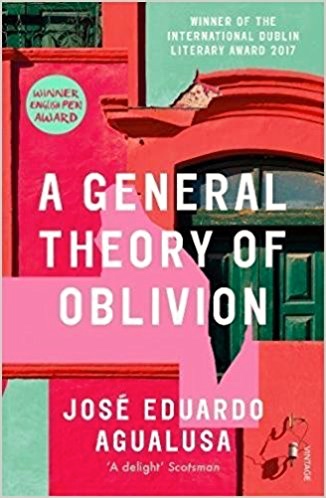 Set in the immediate aftermath of Angolan independence in 1975, after that country’s long-time rule by Portuguese colonists, this novel by Angolan author Jose Eduardo Agualusa reflects the conflicts involved as the country sets up a new government under the Marxists and Leninists who had helped during the revolution, aided by the Soviet Union and Cuba. The war for independence from Portugal is now over, and many who fought in that war are getting ready to fight anew against the one-party Leninist state which has taken its place and now threatens to nationalize all private businesses. Ludovica Fernandes Mano, the fifty-year-old main character and speaker, has been living in Luanda with her sister Odete and brother-in-law Orlando, who works in the diamond trade, and they have begun to fear the future and their roles in Angola. Originally from Portugal, these residents have found that all allegiances and alliances are now in question, and no one knows, for sure, whom they can trust. Threats are being made by unknown players. One morning, without warning, Ludo wakes to find herself suddenly alone in the family’s comfortable apartment. Her sister and brother-in-law have used the cover of night to escape the country, leaving her behind. Ludo, always timid, “never liked having to face the sky. While still only a little girl, she was horrified by open spaces,” and the only really close relationship she seems to have is with her albino German Shepherd dog named Phantom.
 When someone who claims to be from the Portuguese army comes to the apartment demanding “the stones,” for which, he says, he will release her captive sister, Ludo takes surprisingly forceful action, and she does it alone. Using materials left behind the apartment to build a swimming pool, she bricks up and plasters over the entire entrance to her apartment. Once she has finished, she closes herself in and does not leave for twenty-eight years. Growing vegetables for food, she traps and removes chickens from the balcony of the apartment below her, aiming to catch both a rooster and a hen so that she can have her own flock and their eggs. She catches pigeons, using sparkling diamonds as a lure, and she burns nearly all the furniture for heat. As the years pass, she slowly diminishes the number of books in the library. She spends much time, of course, looking out the window, and she is particularly sad that she is no longer being entertained by a monkey which she has named Che Guevara. When she finally finds him again, she is surprised that he is “watching her with light, wondering eyes. She had never seen such an intensely human look in the eyes of any man,” an irony in keeping with the themes and style of the novel. Eventually, she runs out of notebooks after her years of writing, and she finds herself losing her eyesight. She decides to write on the walls of the apartment in charcoal.

From the balcony of Ludo’s apartment, she can see the beaches of Ilha Promontory in Luanda
Numerous characters make repeated appearances here, and as the long, unfamiliar names, and occasionally nicknames, are often difficult to remember, some readers may want to keep a character list. Part of this need is connected to the ambiguity of time here, which adds to the sense of immediacy and the mood of this novel, though it can be a bit frustrating at times. Dates are rarely included, and narrative episodes are not in chronological order. Che Guevara, the monkey, is mentioned for the first time in an italicized musing by Ludo, but he is not identified as a monkey at that time. Sixteen pages later, he appears again, with no reference to the fact that he has been mentioned before. Jeremias Carrasco is mentioned early, a mercenary “in the pay of American imperialism.” Thirty pages later, he is mentioned again when he is recovering from being shot, with no previous context included. Little Chief, a fairly major character, appears in several places in the book, but, again, the episodes are not in chronological order, and the character’s past history is not mentioned. Fortunately, Agualusa, provides a big surprise at the end of the novel – all the characters reappear here and their connections to each other suddenly become clear, regardless of all the time lapses.

Kuvale herdsmen. Today the Kuvale number about 5000 people. Though they were spared most of the warfare of the past 30 years, they occupy a vast area, and suffer from “food poverty.” They are unable to trade their oxen for corn.
Agualusa is an often-enchanting author. Though he pretends that this is a true story, and stresses at the end of the Foreword that this is fiction, he writes his novel as if he really is borrowing directly from Ludo’s diary and directly inhabiting the mind of his “fictional” speaker. His voice quickly becomes hers, and as the action begins, and becomes increasingly real, the reader willingly follows along, allowing Ludo’s voice to lead the way, no matter where it goes and no matter how much a reader might legitimately question details and their “realism.” Ludo, all alone in her apartment for over a quarter of a century, has plenty of time to contemplate Big Issues. As she does this, while also living her life, the narrative swirls, twists backward, then throws itself forward, filled with impressions, memories, and ideas. Having chosen to live apart from the real world, Ludo has essentially disappeared from the earth, and it is no surprise that much of her mental energy is concerned with other disappearances and the memories and the forgetting that are associated with them. Realism and real life become underlying themes of the whole novel, perhaps ironically, since the novel – fiction – deals with real subjects yet much of what we are expected to believe about Ludo is patently unrealistic.

Click to enlarge.
When Ludo’s time in the sealed apartment finally comes to an end, she muses, “I was happy in this home, on those afternoons when the sun came into the kitchen to pay a visit. I would sit down at the table. Phantom would come over and rest his head in my lap. / If I still had the space, the charcoal, and available walls, I could compose a great work about forgetting: a general theory of oblivion.” Ironically, this quotation comes in the middle of the book, long before she goes free, another huge irony on several levels, suggesting once again that Agualusa is reading her diaries and her written musings and then conveying them to us, his/her readers. Surprising novel with unusual energy.

One of the disappearances which Ludo considers is that of an American Airlines 727, unoccupied, which vanished from Luanda’s airport on May 25, 2003. No trace has been found.
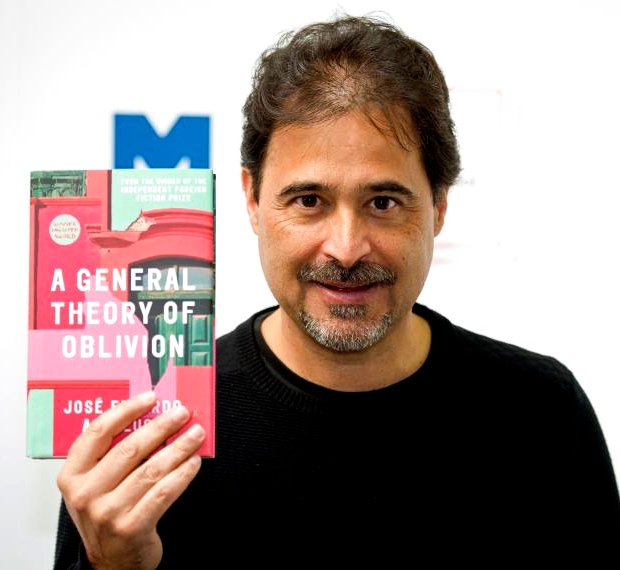
Photos, in order: The author’s photo appears on http://www.newsweek.com/
The beautiful Ilha Promontory and its beaches are visible from Ludo’s balcony. http://www.embajadadeangola.com
The Kuvale herdsmen have escaped most of the bloodshed of the war against the Portuguese and the war for democratic choice, but they suffer from ‘food poverty,” because they cannot trade their oxen for corn. http://www.gnn.iway.na/
The map of Angola in the south of Africa is from https://www.britannica.com/place/Angola/images-videos
One of the “disappearances” which Ludo considers is that of an American Airlines plane, with no passengers, which vanished on May 25, 2003, thought to have been stolen, and never seen to this day. https://commons.wikimedia.org/
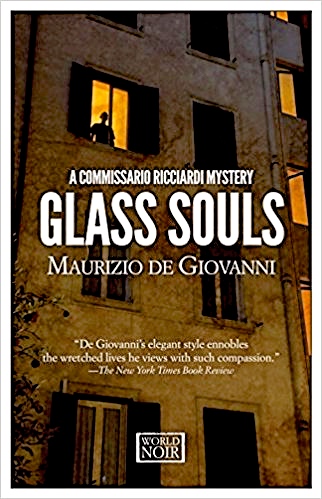 Just when you might think Maurizio de Giovanni’s Neapolitan mystery series cannot get much better, he outdoes himself, building on everything he has been doing in the past seven novels in this series and creating this one, his best so far. Further developing the most delightful aspects of his characters and their relationships to date, he expands them in complex ways which I suspect every fan will celebrate. Here main character Commissario Ricciardi, who works in the Public Safety Division of the Royal Police Headquarters in Naples in the 1930s, during the reign of Benito Mussolini, continues to live up to his beliefs in true and equal justice, regardless of class. Though he is known professionally as Commissario Ricciardi, he is, in his private life, Baron Luigi Alfredo Ricciardi di Malomonte, a nobleman in his early thirties, whose parents died when he was young and who was brought up by his “Tata” Rosa, an old woman hired by his family to work for them. Like his deceased mother, he has inherited the ability to “hear” the last words of anyone who has been murdered, and he is totally dedicated to helping the victims of crime find rest for their tormented souls. He often associates with members of the political and social elite, their families, and those who control much of the economic and social life of the city, but he is painfully shy, uncertain about his inner identity.



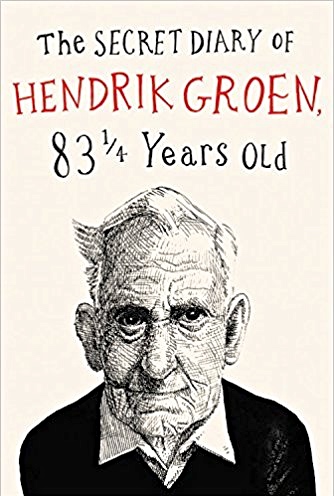 Hendrik Groen, age 83 ¼, a resident of an assisted living facility in the Netherlands, decides on New Year’s Day, 2013, that he still doesn’t like old people. “Their walker shuffle, their unreasonable impatience, their endless complaints, their tea and cookies, their bellyaching.” He regards himself, however, as “civil, ingratiating, courteous, polite and helpful. Not because I really am all those things, but because I don’t have the balls to act differently.” In order to keep himself from spiraling into depression in the home, he has decided to give the world “an uncensored expose: a year in the life of the inmates of a care home in North Amsterdam.” In case he dies, he assures the reader, he will ask his best friend Evert Duiker to read some passages from the diary, though he worries about what he will do if Evert dies first. And, of course, Evert’s dentures are in poor shape, the result of a careless jab of a pool cue from another inmate, this one with cataracts. What follows is a diary unlike any other, as Hendrik Groen describes in detail just what life in a senior home in the Netherlands is like – the friendships and petty jealousies, the resentments, the full-time complaining, the physical ailments, and often, the sheer boredom of life which stretches on for some and is suddenly ended for others.







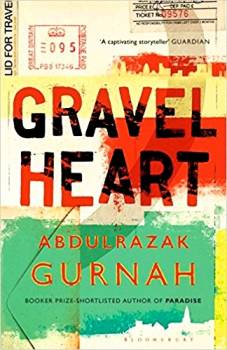 The author of eight previous novels, many of which have been nominated for international prizes, Abdulrazak Gurnah, from Zanzibar, specializes in novels which reflect a sense of alienation and loss as a person living, first, under the British colonial rule of his country, then later living under Zanzibar’s revolutionary rule after a coup following independence, and finally living in Britain itself. His characters often reflect similar dislocations, growing up and living without the pride one expects for the place where they grew up or much sense of belonging elsewhere within the world order. Sometimes at a loss and uncertain what will happen next politically, they may be unsure of how to go about traversing the multitude of competing influences on their lives and on the people they love. In this novel Gurnah examines these feelings through the life of Salim, a young man whose early childhood is upended when his father inexplicably leaves his mother and the home Salim thought was happy in Zanzibar and moves elsewhere, while his mother begins to spend time with another man. His alienation becomes more complicated as time passes.