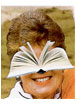
Naturalist/writer Gerald Durrell, with a writer’s eye for the odd detail, a great sense of humor and absurdity, and an unquenchable enthusiasm for finding unusual animals and telling stories about them, recounts his third animal-collecting trip to the Cameroons in this 1960 memoir. Recently reprinted by Penguin Books, the book is a classic of nature-writing, filled with amusing anecdotes about the animals, the discoveries made about them, and, especially, about the people whose interactions with them often led to hilarious escapades. Durrell is a lively writer with a commitment to conservation and a tremendous sense of fun. Giving the flavor of the whole trip, not just the academic details, he provides a sense of realism at the same time that he displays his own irrepressible humor, much of it directed at himself. Durrell’s zoo on Jersey has now celebrated its 50th anniversary.
Read Full Post »
Author Danticat introduces her story of Haitian immigrants and the lives they have escaped in Haiti with the story of Ka, a young sculptress whose parents think of her as a “good angel,” her name also associated symbolically with the Egyptian Book of the Dead. Ka is in Florida with her father to deliver a powerfully rendered sculpture to a Haitian TV actress. Ka’s father, who served as the model for the sculpture, however, destroys it, confessing tearfully that he is not the man his daughter has always believed him to be, that he was a “hunter,” he says, and “not the prey,” one of the “dew breakers,” or torturers, who as part of the Tonton Macoutes, committed political assassinations and inflicted unimaginable tortures on orders of dictators Francois Duvalier and his son “Baby Doc” between 1957-86. In a series of episodes which resemble short stories more than a novel in form, Danticat illuminates the lives of approximately a dozen Haitian immigrants as they remember this traumatic period “back home.”
Read Full Post »
Described as a “masterpiece of Korean fiction of the twentieth century” and as “one of the outstanding literary achievements during Korea’s colonial era,” Three Generations, written in 1931, has recently been translated into English for the first time. The novel traces three generations of one family–the Jo family–consisting of the grandfather and family patriarch, his middle-aged son (Sang-hun, and his wife), and Sang-hun’s 23-year-old son Deok-gi (and his wife and baby), the character around whom most of the action revolves. The family lives in Seoul in a large traditional house with inner and outer quarters, separate living areas for the several families, and spaces for the family’s servants. Within the household, traditional family values are being threatened. Arranged marriages are sought and performed (even for Deok-gi) to protect the family’s wealth, and real affection is not a requirement since the taking of concubines is accepted. No legal obligations exist between men and these concubines if the women have children, and their difficult lives come under scrutiny here.
Read Full Post »
Instinctive and natural as an actress, and impulsive and romantic as a person, Bergman conveyed sensuality at the same time that she conveyed innocence, and the public loved her. They saw her as Sister Mary Benedict in Bells of St. Mary’s and as Joan of Arc, never knowing much about her private life, and ignoring the fact that she left her young child and husband, Petter Lindstrom, at home in Sweden to come to the US to make movies. Her affairs with Gary Cooper and Victor Fleming were never reported. Alfred Hitchcock was unabashedly in love with her and was devastated, as was her public, when she became involved with Roberto Rossellini in 1950, while working on the film of Stromboli. Her flagrant affair, her pregnancy, and her out-of-wedlock child in 1950 became the subject of a speech on in the US Congress and were regarded as a complete betrayal of the public trust which had believed her image. “As it was, Ingrid Bergman was only really “Ingrid” from Casablanca [1942] to Under Capricorn [1949]—seven years,” in which she made ten hit films.
Read Full Post »
Maaza Mengiste’s remarkable debut novel, set in her home country of Ethiopia in 1974, brings to life the historical period from the assassination of Emperor Haile Selassie through the communist revolution and the subsequent resistance movement which followed shortly on its heels. A well-publicized 1974 television documentary, showing the educated Ethiopian public the horrors of famine, in which 200,000 people died in the remote areas of their country, juxtaposed against films of the wasteful excesses of palace functions, set the country up for revolution. As all the characters gradually become drawn into the larger political conflicts of the country, the reader is shocked by the extreme cruelty, both physical and emotional, of whoever is in power. The violence, which increases in intensity over the course of three hundred pages, involves false arrests, beatings, rapes, psychological warfare, brutal tortures in an effort to extract sometimes non-existent information, and the mutilation of women and children–very difficult to read for the length of the novel.
Read Full Post »