Feed on
Posts
Comments

Note: This novel is a continuation of My Brilliant Friend, and the summary here contains spoilers for those who have not already read that book.

“We had seen our fathers beat our mothers from childhood.  We had grown up thinking that a stranger must not even touch us, but that our father, our boyfriend, and our husband could hit us when they liked, out of love, to educate us, to reeducate us…Our mothers, after they were slapped by their husbands…despaired, they wept, they confronted their man sullenly…and yet, they continued to respect him.”

When Elena Ferrante created this epic about the women in Naples as they faced major cultural changes from the early 1950s to the present, it was too long and unwieldy for a single novel.  Instead, it has been issued in installments as three separate books.  My Brilliant Friend, the first installment, released in 2012, focuses on a broad spectrum of Neapolitan life in the 1950s, and this year’s volume, The Story of a New Name (which is called, simply, My Brilliant Friend, Volume II, in Italy), focuses on the same families and main characters as they continue their lives in the 1960s.  Readers of My Brilliant Friend, will remember from the Prologue to that novel, that Elena Greco, then sixty-six and living in Turin, received a long-distance telephone call in 2010 from the son of Lila Cerullo, who was once her best friend, asking for help in locating his mother, who disappeared from Naples two weeks before, taking all her possessions.  Out of touch with Lila for years, Elena is convinced, based on past experience, that the dramatic and spontaneous Lila does not wish to be found, and she decides to write down everything she can remember of Lila and her life from her birth in 1944 to 2010.  The trilogy which results from her efforts recounts the life of Lila, also known as Raffaella or Lina, and illustrates Elena’s own long relationship with her as a child and young woman, their two lives intertwining but moving in dramatically different directions in the course of the action.

Elena Ferrante is a pen name used by Italy’s most reclusive author. Some believe that she is a well known male author, but she has never been identified with certainty. More info in footnotes.

Nine families populate this complex trilogy, with over fifty characters listed individually by family in the (necessary and helpful) “Index of Characters and Notes on the Events of Volume I” included at the front of the book, and even readers of the first volume will need the reminders contained here.  Elena and Lila, who met as friends and rivals (and sometimes enemies) in the first volume, epitomize the changes occurring in Naples in the aftermath of World War II, with increased  schooling being the catalyst for many of these changes.  Both girls are very bright, but it is Lila who teaches herself to read at age three and learns several languages on her own.  Despite her academic skills, however, Lila, as a young teenager, decides not to continue her schooling, partly for financial reasons, partly because she has discovered a talent for designing shoes while working in her father’s shoe-making shop, and partly because she has met someone who is important and successful locally and who wants to marry her.  Elena remains in school, manages to keep passing her requirements, gains some financial and academic support, and eventually continues her education.  My Brilliant Friend ends with the elaborate wedding of Lila, at age sixteen, to Stefano Carracci, four years older, the son of a murdered loan shark and black marketeer.


A Naples street scene with its vibrant street life and five-story buildings, some which still house families which have been there for generations.

The Story of a New Name begins in the aftermath of Lila’s wedding, which from the outset is unhappy.  Lila, a passionate and temperamental person, does not suffer fools gladly, and she constantly alienates those around her, especially now that she has the financial resources to buy what she wants, whenever she wants, and the intelligence to use her position for personal payback on old grudges, when necessary.  The fact that her husband is now allied financially with the Solara family, Camorrist criminals who are far more organized and violent than Stefano’s father was, makes some of her own activities risky for her husband.  Her only real friend is Elena, and that relationship is complicated by Elena’s own obligations regarding school and her need to pay for her expenses – and, more importantly, by the fact that Lila has no idea what it takes to be a real friend.  She wants what she wants – right now.

The lovely Piazza dei Martiri is where Stefano locates his most elite shop.

Now in their late teens and early twenties, all of the characters here, with the possible exception of Elena, are dependent on making good marriages to sons from the shop-keeping families they already know from their Naples neighborhood, but with blackmarketeers and the Camorra using their financial resources to affect these local businesses and increase their own wealth, local shopkeepers are sometimes hard pressed to meet their financial obligations.  Most of their wives are willing to work in their family’s shops, but as the economy improves, the women also want more than what they have had.  Elena escapes most of this, even leaving the neighborhood for Pisa for additional schooling, returning home on vacations and/or to work during the summer.  Her own love interests must compete for time with her academic commitments, and when she is at home in Naples, she wearies of Lila’s imperious demands.  On one occasion, Lila persuades Elena to accompany her to Ischia on vacation, paying her way and providing a place to stay, a vacation filled with disasters as Elena discovers just how vengeful and jealous Lila can be.

The Scuola Normale Superiore in Pisa, to which Elena traveled for schooling.

At over eight hundred pages for the first two volumes, this trilogy is truly epic in length.  In its depiction of Naples in the aftermath of war, primarily in My Brilliant Friend, it adds epic themes and ideas.  In this second novel, however, the reader is already familiar with the characters and their families as they deal with the general economic picture, and the initial interest in these characters may begin to wane for some readers as the novel focuses on the minutiae of their daily lives, especially their turbulent and complex love lives.  With the reader’s attention focused on the small details and not the grand epic themes one would hope for, the many scenes of recriminations and tears expended on the novel’s men, for whom the “rules” of behavior do not apply, may become wearisome, and the novel may begin to feel  claustrophobic (as it did for me).  Only Elena, whose own life is not pretty, manages to get out of Naples and into a new environment, but she is so conditioned by her own insecurities and her academic challenges that she is unable to relax and come to know herself as a person independent of her culture.  She realizes very early that losing the Naples accent is one key to a different life in a bigger Italy, and though she is reluctant to admit it, she also  recognizes that “class” and her ability to find new opportunities are connected to obtaining a superior education.  She is not yet prepared to deal with that life-changing new awareness, however.  Perhaps that will become a focus and main theme in the next book in the series.

ALSO by Elena Ferrante:  TROUBLING LOVE, a stand-alone, and    MY BRILLIANT FRIEND (#1 in the “trilogy”).  The third book in the series, THOSE WHO LEAVE AND THOSE WHO STAY was released in September, 2014.   THE LYING LIFE OF ADULTS, a stand-alone.

About the author: Some have suggested (in many articles in Italy and some in the US, including both the Boston Globe and Wikipedia) that Elena Ferrante is a pen name for well known Italian author Domenico Starnone, though Europa Editions has published some letters that are attributed to Elena Ferrante herself.

Photos, in order: The color block is adapted from one posted on http://mariasmovers.com/

The Naples street scene appears on  http://www.kiddytravel.com/

The Piazza dei Martiri, where the most elegant of Stefano’s shops is located, is from http://www.sirenapartenope.it/

Caravan Palace, home of the Scuola Normale Superiore of Pisa, where Elena attended secondary school, may be found here:  http://www.customstore.it

ARC:  Europa

THE STORY OF A NEW NAME
REVIEW. Historical, Italy, Neapolitan series
Written by: Elena Ferrante
Published by: Europa Editions
Date Published: 09/03/2013
Edition: Neapolitan series, Book 2
ISBN: 978-1609451349
Available in: Ebook Paperback

“[My daughter] cannot conceive that we are really living in the end of times, that it’s goodbye to…all the goodies we had in the past. The easy days will not come again; they were a one-off, an abortive mutation in the evolution of civilization, as the peacock’s tail is over the top when it comes to attracting the dowdy peahen, merely an over-response.”

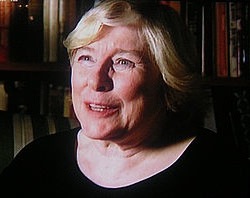
Fay Weldon, the immensely popular British author of twenty-nine previous novels, creates an unusual variation of metafiction in this largely satiric novel from 2010, about Britain’s twenty-first century issues as she sees them. Here, an elderly author is sitting on the stairs behind the closed front door of her house in Chalcot Crescent, evading the bailiffs who want to talk with her about her debts. The beleaguered author is Frances Prideaux, whose life parallels that of Fay Weldon in almost every key issue. Frances, however, says she is the sister of Fay, an author she claims is now reduced to writing cookbooks. Frances herself has written dozens of successful novels before losing her audience and spending more money than her novels are earning, and she has now decided to write “a fantasy about alternative universes…There are an infinite number of universes, too many to contemplate.”
The alternative universe of the novel Frances is writing in 2010 exists in the not-so-distant future of 2013, a time in which Frances sees Britain in even more dire straits financially and socially. Her novel-in progress, a broad satire of the issues she sees dominating British life in the immediate future, alternates her political commentary with observations on her own life and that of her family and how they are affected by the changes. The “Shock of 2008” has been succeeded by the “Crunch of 2009 – 2011,” including the “Squeeze and Inflation,” which leads to the phony “Recovery of 2012” and finally the “Bite of 2013.” It is a time of fuel allowances, ration books, wages given in Euros (often late), roads and other infrastructure in decay, power cuts, water shortages, mandatory sharing of cars, sixty percent unemployment, no arts or funding for them, and banks which charge the depositor for putting the money into the bank.

The National Unity Government (NUG) controls all, the National Institute for Food Excellence (NICE) feeds the people (mostly on National Meat Loaf, made from suspicious substances), and housing is provided by the National Institute of Homes for Everyone (NIHE). Neighborhood Watch, aided by CiviCams, keep an eye on all local activities and “protect the peace.” Greenpeace has become the much more radical Redpeace (“almost a cult”), all charities are merged into the nationalized CiviGaia, roving gangs control the streets, and people are awaiting the New Republic to come.

As Frances declares that she must “somehow find my inner bitch,” the reader learns about her child out of wedlock, her many marriages, the out-of-wedlock child of her oldest daughter, the marriages of her two daughters, all the children from their marriages and liaisons, and their relationships with her and with each other, a maze of characters as complex as the social issues she has been discussing. Several of the grandchildren and their friends have suddenly appeared at Frances’s house in Chalcot Crescent, intent upon using her house as the central headquarters from which they plan to capture an important person in the government and hold him in the empty house beside her while conducting their own coup.

Chalcot Crescent, photo by Simon Richardson

Weldon’s social and political commentary are to the point and have much potential, but that, and the satire associated with it, are heavy-handed, lacking the light humor and subtlety that allows the reader to participate in the fun. Frances herself recognizes this, noting that her writing has changed from her style of the past: “I write less implicitly [now], more explicitly, if you understand the distinction, but not so well,” certainly a facetious remark, though it does give the reader pause. Annoying aphorisms pop up everywhere to explain what is obviously going on, and revealing Frances’s closed mindset: “Money gives you confidence,” “You can laugh at authority,” “Fate determines all things. What happens was meant to be,” and “Possessions are for the middle-aged, not for the old.” And though Frances introduces numerous characters from her life and describes what happens to them, their importance to the thematic unity of the novel is unclear. Much information is repeated unnecessarily, and the novel, overall, feels rough and fragmented, “scattered” and less focused than what one expects from a novelist of Weldon’s stature.

ALSO by Fay Weldon:  KEHUA!      BEFORE THE WAR

Photos, in order: The author’s photo appear on http://whyjaneausten.com/writers.html

The photo of Chalcot Crescent, by Simon Richardson, is from http://commons.wikimedia.org

ARC: Europa

Note: This book was a FINALIST for the National Book Award, 2012, and was also a FINALIST for the Andrew Carnegie Medal for Excellence in Fiction.

“Here there are calamities without end – but sometimes I can clearly see us in the future, and it is good.  We will live in his house and I will cook for him and when he leaves food out on the counter I will call him a zangano.  I can see myself watching him shave every morning.  And at other times I see us in that house and see how one bright day…he will wake up and decide it’s all wrong…I’m sorry he’ll say.  I have to leave now.” – Yasmin, Ramon’s lover

I wish I had read The Brief Wondrous Life of Oscar Wao before reading this collection of stories.  Junot Diaz’s first, and so far only, novel has won accolades from virtually everyone, winning the Pulitzer Prize, the National Book Critics Circle Award, the Los Angeles Book Prize, the Salon Book Award, the Center for Fiction’s First Novel Prize, and has even been shortlisted for the biggest prize of all – the IMPAC Dublin Award.  I would have liked to see how Diaz melded all the disparate elements of a novel about the displacement of immigrants and the difficulties they have in creating new lives in a foreign country into such an intense and compelling novel, one which has astonished everyone I know who has read it.  I had hoped that this collection of stories might provide me with the same kind of appreciation of Diaz’s work, so that I could then read the novel with new understanding.


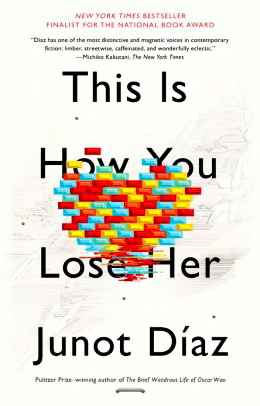
Consisting of nine short stories, all of which are about love, This is How You Lose Her describes whole worlds within the title itself.  Four of the stories are named for the speaker’s lovers, and all of them reflect the speaker’s inability to experience love on a plane higher than that of the physical, which drives every aspect of his life.  With a title that sounds a bit like an instructional manual by a now-frustrated macho man who is telling other similarly frustrated men how they can manipulate relationships in order to get and keep what they have – or at least not lose it – this collection of stories reveals the behaviors of several male speakers who have no clue about how to experience lasting love.  Nor, it seems, do most of them even seem to want one single lasting love when two or more loves can provide at least twice as many thrills, twice as often.

With Yunior, who appeared in both Diaz’s first story collection, Drown, and in The Brief Wondrous Life of Oscar Wao, as a main character in several of these stories, the narratives move back and forth in time, and for anyone who has read the biography of the author in Wikipedia or elsewhere, they become almost spooky in their closeness to the biography of the author himself.  Many settings parallel those in which Diaz himself lived, beginning with his initial arrival from the Dominican Republic in the middle of winter, with his mother and brother, and their stay in New Jersey near an enormous city landfill, with a father/husband they had not seen in five years.  Later references place him in Brooklyn, at Rutgers, and finally in Cambridge and Boston where he is working for his PhD and writing a book.  The intense feelings aroused by these vividly described settings suggest that other aspects of Yunior’s life also parallel that of the author and his difficult life out of extreme poverty, which also includes an absence of guidance from a strong father figure who might have served as an example.  As the speaker, be it Yunior (the author’s apparent alter-ego) or some other character, moves from one unsuccessful relationship to another in these stories, the reader cannot help but feel sorry for the degree to which hopes are dashed and women are used (willingly in most cases) and later hurt as a result of the male character’s insensitivity and, sadly, complete ignorance of the whole concept of respect.  A belief in the importance of secrecy and the use of lies to achieve one’s own goals reflect a kind of arrogance and self-importance which allows the speaker to attract a woman initially but not share a real relationship with her, and then, almost tragically, not have any understanding of what he has done wrong.

Casa de Campo, the elite resort in the Dominican Republic to which Magda yearned to go when "bored" on vacation with Yunior.

As the stories progress, so, too, does the life of the main speaker, primarily Yunior, and while this is not a novel and does not have a “happily-ever-after” ending, the speaker at the end of the collection has learned a great deal and seems to have moved significantly beyond the difficulties he created for himself early on in some of the stories.

Throughout the collection, Diaz, through various speakers, reflects his fondness for Santo Domingo and his Dominican heritage, noting with affection his “blackness” in comparison to the lighter complexions of some of the women he meets, and even to Rafa, Yunior’s brother, whom he jokingly calls “white boy.”  Even when these women are Spanish-speaking, some notation usually appears indicating what other country these woman may have come from, along with the differences in their cultures.  Diaz himself, having progressed from poverty to a PhD, has been exposed to many different cultural groups and many kinds of slang along the way, from Spanish street slang, obscenities in multiple languages, and the offensive anatomical colloquialisms of “male-speak” frequently heard in hip-hop, hard rock, and the subway, in addition to the very different language of academia.  All these “languages” combine here into an unusual “stew” which gives vibrancy and a sense of real life to the dialogue.  None of these terms are translated for those who do not share the speaker’s background, however, and though they add color and atmosphere, and perhaps, even humor for those who do understand the jargon, they can be frustrating for those who cannot figure out specific meanings from the contexts in which these foreign words and phrases are used.

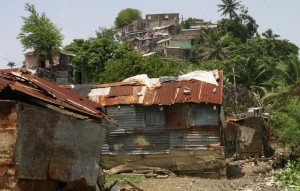
The Capotillo area of Santo Domingo, an area similar to where Elvis traveled with Yunior to meet Elvis's "baby-mama."

Ultimately, I came to appreciate the author’s style and the almost naïve intensity with which he recreates stories of love and loss and lessons learned (maybe) along with his hopes for the future.  The changes of point of view from speaker to speaker, with the author occasionally interjecting himself into the story, do prevent a reader from identifying very closely with particular characters, though the fate of Rafa, for example, is sadly memorable, however briefly it may discussed be in one of the stories.  Perhaps Diaz’s new novel, a science-fiction epic of the apocalypse, tentatively entitled Monstro (no release date yet), will turn me into the kind of rabid fan that most readers of The Brief Wondrous Life of Oscar Wao have become.  I look forward to that.

Photos, in order: The author’s photo, supplied by Nina Subin of Penguin Group, appears on  http://www.npr.org

The photo of the Casa de Campo resort is from  http://www.kiwicollection.com

Capotillo in Santo Domingo, posted by Ventucles, appears on http://www.capotillomibarrio.org/

Note: Indridason was WINNER of the Glass Key Award for Best Nordic Crime Novel in 2002 and 2003, and WINNER of the Gold Dagger Award from the Crime Writers’ Association in 2005.

“Outsiders like you can never really understand what it’s like to live here.  Even if I explained it to you, it would only be a fraction of the truth.  And that fraction of the truth would be seen as a lie by Haddi down at the filling station, for instance.  Even if you spoke to every single person – and spent twenty years doing it – you’d never get more than a tiny glimpse…”—Valdimar to Elinborg.


The cover description of this novel as “An Inspector Erlendur Novel” is misleading, especially for long-time followers of the dark and damaged inspector from Reykjavic and his grim and often grisly investigations.  Erlendur, in fact, does not appear at all.  At the end of Hypothermia, the previous novel in the Erlendur series, he has left to go hiking in the sparsely populated East Fjords, taking a break from his personal problems and the frequently horrific problems involving his children, his former wife, and their relationships with him.  No one has heard from him in almost two weeks, not even the sympathetic Valgerdur, a woman who empathizes with him and cares deeply.  With the competent Elinborg in charge of the office, Erlendur may be, once again, off seeking the remains of his younger brother, who disappeared at the age of eight when the two were caught and separated by a huge snowstorm, leaving Erlendur bereft, unable to form any close attachments since that traumatic event.

Author Arnaldur Indridason, photo by Cato Lein

Elinborg is quite different from Erlendur.  Living with the supportive Teddi and their two children, Elinborg is a cookbook author, specializing in desserts and working on her second cookbook, and she tries to keep the lines of communication open with her children, though her older son, in his late teens, is something of a mystery to her, at this point.  Despite her family responsibilities, she travels Reykjavik and its surrounding areas, investigating crimes, some of them bizarre, and tracking down criminals, many of whom are protected within the small, closed communities in which they have spent their lives.  Were it not for the nature of the crimes themselves – in this case, the rapes and disappearances of women, the use of rohypnol (the “date rape” drug) to paralyze victims, and a gruesome murder which opens the book – Outrage would come as close to a “cozy” as the darkly noir author Arnaldur Indridason is probably capable of writing.  The twisted and often macabre aspects of life seen in the book (and film) of Indridason’s Jar City, for example, have been softened here, reflecting the more feminine, intuitive approach of Elinborg and her efforts to communicate wherever possible with both victims and perpetrators, as she works to solve crimes.  As a result, this novel is more thoughtful, and, frankly, “tamer,” than the acknowledged noir prize-winners of Jar City and Silence of the Grave, though Outrage, with its different style, has its own charms and will appeal to many newer readers.

East Fjords, the remote area where Erlendur is hiking. Photo by Nigel Waring

Within the first dozen pages, Elinborg has already been called out to investigate a murder scene in Thingholt, a stabbing so bloody that the victim, a young, single man named Runolfur, is almost ex-sanguinated, his blood saturating his apartment in Thingholt, just outside the center of Reykjavic.  He is wearing a too-small woman’s tee-shirt, emblazoned with the words “San Francisco,” and other evidence in the apartment suggests that a woman shared his bed just before the murder. A shawl is found under the bed, and Elinborg, a chef, is intrigued by the fact that the shawl smells of tandoori, an Indian food rare in Iceland (not the kind of clue that Erlendur would ever notice). Though Runolfur kept an exceptionally neat and impersonal apartment, with no photographs and no books, he did have several large, framed posters of superheroes and a collection of the superhero figures.  Surprisingly, he had ingested a large amount of rohypnol, and his connection to drug dealers is quickly determined.

Olafia Hronn Jonsdottir, the actress who played the role of Elinborg in the film of JAR CITY, photo by Eggert John. Ironically, she, like Elinborg,  is a cooking expert.

The rohypnol connection reminds Elinborg of several previous cases in which women can remember nothing about their rapes, not even the smallest detail about where it has taken place or even who has committed it, and several women have disappeared over the past few years. When those cases took place outside the city in small towns, few reports were made at the time of the crimes, the victims feeling so humiliated by their rapes that they feared public exposure within the community.  Gradually, information about this strange murder comes forth from neighbors and acquaintances. Some former rape victims are interviewed for possibly new information and connections to the murder victim.  A girl’s disappearance in Akranes, a short flight from Reykjavik, provides Elinborg with still further information, and coincidences begin to connect people and events in unique ways.  The conclusion is typically “Elinborgian” – brought about not by physical action but by her ability to communicate with the murderer.

The tandoori pot provides Elinborg with a clue which Erlendur would never have found.

Though Indridason dots all the I’s and crosses all the T’s regarding this mystery, the novel ultimately feels more “domestic” than noir, more human and less grotesque than what one expects of an Erlendur mystery.  The bitter cold which permeates the atmosphere of so many Erlendur novels feels somehow less cold here, though it is still winter.  Elinborg, a warmer, more caring soul, feels the pain of the victims and their families, and is able to show it in ways that Erlendur cannot, allowing her an entrée into their feelings and even their secrets.  A couple of scenes feel hollow, however: The scene in which Elinborg is interviewing a rape victim gets a bit preachy and “over-explanatory” regarding the victim’s reactions to the crime, repeating the standard do’s and don’ts about rape which one finds everywhere.  In another scene she is talking with her daughter about her unappetizing school menus, and she elaborates on her own childhood and the uninspired menus her mother served – roast with pickled red cabbage and tinned peas, or mutton with horsemeat sausage and white sauce, a diversion which adds nothing to our understanding, other than  Elinborg’s already recognized culinary interests.  Outrage, with Elinborg, is a unique creation by Indridason, and while it is interesting to see such a novel with a female protagonist, Elinborg’s character has neither the charm nor the powerful personality which would have made her an intriguing “heroine” for me.

ALSO by Indridason:  THE DRAINING LAKE,     HYPOTHERMIA, JAR CITY,        VOICES,         OPERATION NAPOLEON,    REYKJAVIK NIGHTS,     INTO OBLIVION (2017)

The Thingholt section of Reykjavik

Photos, in order: The author’s photo by Cato Lein is found on http://www.norstedts.se

The East Fjords, where Erlendur has gone for personal reasons, appear on http://www.travelblog.org/ Photo by Nigel Waring.

The photo of actress Olafia Hronn Jonsdottir hightlights her interest in cooking, which is, ironically, one of the main freetime interests of Elinborg, whom she plays in the film of JAR CITY. Photo by Eggert John.    http://www.mbl.is/

The clue of the tandoori pot helps Elinborg track down a someone who can help with the investigation.  Photo by TM60, on
http://tonymead60.hubpages.com/

The photo of the Thingholt section of Reykjavik appears on http://www.icelandguest.com/

ARC:  Minotaur

“[Sophie Coburn’s] a lost soul. Came here because this is where her husband died …Vienna is finished, is what she says. Finito. For journalists [like her], she means. No more stories here. She even heard they are going to do a movie. In the fall. With Orson Welles. She was really quite upset.”—Karel Newmann to Anna Beer, 1948

Setting his latest novel in Vienna in 1948, nine years after the setting for his previous novel, The Quiet Twin, author Dan Vyleta continues the story of the city and some of its characters in the aftermath of the Holocaust’s atrocities, though this novel stands alone and is not really a sequel. Here Vyleta uses characters some readers already know in order to show how they have changed in the nine years that have elapsed since The Quiet Twin, while, at the same time, introducing these characters in new contexts and illustrating their changed lives, which makes them fresh and intriguing to new readers of Vyleta’s work. The Quiet Twin, set in 1939, uses an apartment house in Vienna as a microcosm for the competing forces in Vienna before the war, providing insights into how ordinary people were seduced by Nazi rhetoric and promises, and how and why some of them so willingly compromised their own values when they were threatened during a time of crisis. The Crooked Maid, set in 1948, by contrast, shows how they have been changed by war’s horrors, by imprisonment (in some cases), by living as refugees in other countries, and by the cumulative trauma of a city which has been in the grips of unimaginable evil and now finds itself uncertain of its values and its future.

As the dramatic action begins to unfold, the novel may appear, at first, to be a simple murder mystery within an historical setting, similar, perhaps to those written by many popular, best-selling authors, but Dan Vyleta transcends genre, his writing more similar to that of Dostoevsky than to pop fiction. The many mysteries and even murders that take place during this mesmerizing and fully-developed novel grow out of the moral vacuum in Vienna after the war, the macabre details of these crimes so deeply rooted in the city’s psyche that they feel almost “normal” in the context of the times. Vienna’s citizens, fearing retribution from a variety of sources, now freely ignore their crimes and even deny their co-operation during the Nazi occupation, or as one character notes, “We are a people who have already forgiven themselves.”

Filmed in Vienna in 1948, The Third Man, starring Orson Welles, is set in the midst of reconstruction.

The novel opens with a woman of about forty, Anna Beer, returning by train to Vienna from Basel, after being away from Vienna for nine years. She has just learned that her husband, Dr. Anton Beer, has been released from a Soviet prison camp, and though she had been separated from him because of his infidelity, she wants to meet him again to resolve personal issues. She is sharing a compartment with a teenage schoolboy, Robert Seidel, who is also returning to Vienna after being away at boarding school, unable to see his family for over five years. As the two passengers chat, Robert indicates that there are family secrets, perhaps involving the maid, that his father is hospitalized after falling out a window, and that his brother has “disappeared.” Despite the serious subject matter, however, Robert’s story is told in a casual, almost bantering tone, at this point, suggesting that the author has something more complex on his mind than a straightforward mystery story, no matter how dramatic. The foreshadowing and foreboding develop further after the two passengers arrive in Vienna, where a mysterious man with a red scarf watches the two arrive, the connections among the three of them unknown.

The rubble that was Vienna. Photo by Keystone/Hutton Archive/Getty Images

As the novel takes off in different directions, Anna discovers that though her husband was released five or six days before her arrival, no one in Vienna has seen him for three days. Robert Seidel returns to his house, which reeks, filled with garbage and flies, and meets Eva Frey, the only maid. Eva, who is his own age, has a crooked back, almost a hunchback, and she is tending to Robert’s mother, who is addicted to a closetful of drugs. Eva also tends to a roomful of crows who keep her company in the loft where she spends much of her time, the crows being an ominous symbol that repeats throughout the novel. Robert’s half-brother Gustav was a Gestapo officer during the Nazi occupation, but he eventually has “rehabilitated” his reputation as did so many other residents of Vienna, and moved back home. By the time of Robert’s arrival, however, Gustav has been jailed on suspicion of having pushed his father from the window, for reasons unknown.

The damage to Vienna's architectural heritage is seen in this photo by Picture-Alliance DPA

As the search for information about Anton Beer becomes more serious, and as Robert Seidel tries to figure out what is happening in his house, additional characters are introduced, though how much is true about each one involves many other mysteries. Most of the characters are not who they say they are, and their stories cannot be taken at face value. Robert, we learn early on, has been adopted by his stepfather. His birth father worked on behalf of the Gestapo (and was the villain of The Quiet Twin). We also learn early that Eva grew up in an orphanage and was hired to work for Robert’s family when she was fifteen. Soon overlaps begin to develop and characters find their fates intertwined. People disappear for periods of time, then reappear; conspiracy theories abound, even within families; new families are introduced to further the action, and bodies begin to appear; deliberate misdirections and ambiguities keep the tension high and the uncertainties fresh as those with something to gain manipulate outcomes. Throughout it all, a stranger with a red scarf keeps appearing and reappearing, though no one knows for sure who he is.

Graham Greene's famous novel, published by Penguin Classics, is set in Vienna in 1948.

The novel’s unlikely coincidences, so obviously deliberate, and the author’s occasional flashes of humor remind the reader that the plot is one of the least important aspects of this novel for the author, though the plot is very good, very exciting, and very complex. His focus on the social aspects of the 1948 atmosphere, lead him to begin each major section of the novel with historical data from Stalingrad which shows the horrors of this war in terms of sheer numbers—one shocking statistic of which is that of 91,000 German, Austrian, Rumanian, and allied soldiers taken prisoner at Stalingrad, fewer than 6,000 returned home. Those who survived imprisonment were released slowly, between 1945 and 1955, and that number includes some of the characters here. Eventually, every detail is either explained or resolved, if it can be resolved, and the novel is brought full circle. Intense, beautifully structured, and challenging, this novel will thrill those interested in a “mystery novel” filled with dark ironies, a novel which goes far beyond the limitations of that genre.

ALSO by Dan Vyleta:  THE QUIET TWIN

Photos, in order: The author’s photo appears on http://www.weeklystandard.com/

The poster of the Third Man, starring Orson Welles, is from http://providencedailydose.com/

The rubble of Vienna, by Keystone/Hutton Archive/Getty Images may be found on
http://www.dw.de/

The damage to architectural treasures, by Picture-Alliance DPA, appears on http://www.dw.de

Graham Greene’s The Third Man, which was the basis of the film, is available as a Penguin Classic. http://www.amazon.com/Third-Fallen-Classic-20th-Century-Penguin/dp/014018533X

« Newer Posts - Older Posts »