Feed on
Posts
Comments

“As for the [missing woman’s] fate, the [police] argued, a body would turn up. The sea would spit it out, a hiker would stumble across it in the hills, a farmer would unearth it while plowing his field. That was the way it was on the island. Corsica always gave up its dead.”

An escape novel by best-selling author Daniel Silva always seems to be part of my summer reading list, and after looking at the dates for Silva’s novels, it is easy to see why. Of the twenty novels listed on Amazon (some of them duplicates in different editions), fifteen have been published during the summer months. Only five have been published in the winter, all in January or February, and all between 2003 and 2006, in the years before Silva became the huge, popular success that he is now. This latest book, The English Girl is another good book for summer reading – though not as interesting or challenging as his previous novel, The Fallen Angel, which dealt with on-going Arab-Israeli conflicts, a planned terrorist attack on an Israeli site in Europe, and the possibility that there is a very early Jewish temple built underneath the al-Aqsa Mosque on the Temple Mount. Silva’s own conclusions regarding the status of Israel and the Middle East in general, including the effects of the Egyptian uprising, also give immediacy and dramatic tension to that novel and its subject matter.

The English Girl, by contrast, feels much more “domestic,” concerning itself for much of the book with the kidnapping of a young woman who has been the lover of the Prime Minister of England, a circumstance which the prime minister’s political friends want resolved privately and as quietly as possible. Gabriel Allon, an Israeli art restorer who also works for the Israeli secret intelligence agency, has connections to intelligence services throughout the world as a result of his extensive international work, and when he is contacted by the deputy director of MI5 in England, he agrees to try to find and free Madeline Hart, the woman being held hostage in some unknown place. Traveling from Israel to Paris, then to Corsica, where he connects with Don Anton Orsati, a professional assassin who manages a whole “family” of assassins for hire, Allon eventually follows a trail to Marseilles and to a villa occupied by “the Englishman,” Christopher Keller.  A renegade SAS veteran and the only person in his unit to survive a friendly fire accident during Saddam Hussein’s invasion of Kuwait, Keller can travel without fear of recognition – no one knows he survived. Together, Allon and Keller begin the investigation, traveling through France to Nice, Aix-en-Provence, Rognes, Vaucluse and the Luberon, usually staying in “safe houses.”
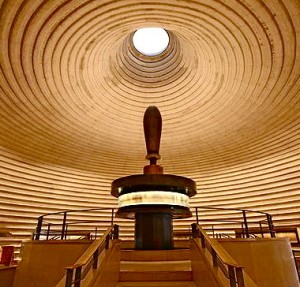
The Shrine of the Book, which houses the Dead Sea Scrolls. This building project was purportedly  brought to fruition by Chiara Zolli, Gabriel Allon’s wife. Photo by Ron Peled

Throughout the first part of this book, the history of Gabriel Allon, his personal life, and his history as an assassin for the Israelis are revisited.  (He personally murdered six of the Black September terrorists who had assassinated the Israeli athletes during the Munich Games.) Many of his past cases, developed in previous novels, are summarized briefly within the context of the developing action, in order to help readers remember the repeating characters, many of whom appear once again in this novel.   Ari Shamron, former head of Israeli security, his successor Uzi Navot (Shamron’s second choice, since Gabriel Allon had refused the job), Gabriel’s wife Chiara, also an agent, and Eli Lavon, among others, all play a role here.  The complexities of British politics are also examined, since Prime Minister Jonathan Lancaster is considered to be primarily the mouthpiece for the real ideas coming from his Chief of Staff, Jeremy Fallon.  The dramatic conclusion to the first part, regarding the missing Madeline Hart, is followed by Allon’s deeper investigation into her background and the real reasons she was kidnapped.
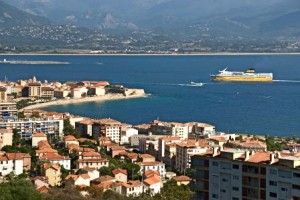
The ferry from Marseilles arrives in Ajaccio, Corsica

In the second part, the novel becomes more complex and more relevant to present day international relations. When, during his investigations following the climax of the Madeline Hart search, Allon finds evidence that the Russians are interested in drilling for oil in the North Sea, he calls on Viktor Orlov for information on the Kremlin, the Russian oil business, and the involvement of Russian President Vladimir Putin.  Orlov, once one of the richest oligarchs of the Russian oil industry, is now out of Russia and living in London. He and Gabriel Allon have a past history, and Orlov readily explains the maneuvering in Russia for control of the oil industry, the implications of which are obvious to the reader.
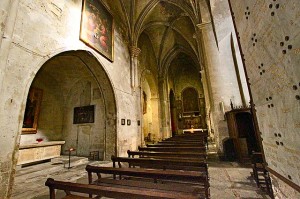
The Basilica of Sainte Anne in the Luberon, where Gabriel and Christopher Keller meet to converse.

Though much of the excitement for which Silva is well known evolves as this novel further develops, the general subject matter itself is not as exciting as in some past novels. There is nothing here that compares in importance to the archaeological investigation of the Temple Mount on the site of the al-Aqsa Temple in Fallen Angel. Nor is there anything as historically significant as the study of the Vatican’s involvement in the Holocaust as in The Confessor. Nor the powerful interests involved in international art theft and smuggling, as in The Rembrandt Affair; nor the uncontrolled arms sales and the horrific implications for the future, as in Moscow Rules.
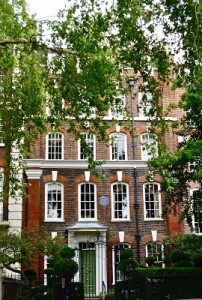
Viktor Orlov lives in a tall, narrow house on Cheyne Walk. London. This similar house on Cheyne Walk is where author George Eliot died in 1880.

This is not to say the book is not fun to read. It is, but it lacks the customary intensity and power of some of the earlier novels. The clear separation into two-parts prevents this nearly five hundred-page novel from developing tension in a cohesive, increasingly exciting narrative, and it leads to a narrative device that I do not remember seeing in previous Silva books: On several occasions during the conclusion, Silva ends up “telling about” what’s happening, instead of recreating the action and involving the reader in it.  Some of the novel’s foreshadowing is provided by a Corsican fortune-teller, whom Gabriel not only visits but takes seriously, not a characteristic I would have expected from this assassin of a dozen or more men on behalf of Israeli security. Though there is a twist at the conclusion, which will please long-time readers, the novel ultimately left me feeling that the book lacked the drive and commitment of past novels.   I read every word, but I was not engaged by it in a way which might have allowed me to “participate” in it as I have done with numerous other Silva novels from the past.

ALSO by Daniel Silva:  THE FALLEN ANGEL,     THE CONFESSOR,      and      THE HEIST

Photos, in order: The author’s photo appears as part of an interview on http://www.today.com/

The Shrine of the Book, at the Israel Museum, purportedly brought to fruition by Chiara Zolli, wife of Gabiel Allon, contains the Dead Sea Scrolls. Photo by Ron Peled http://allaboutjerusalem.com/

The Ajaccio-Marseilles ferry is seen on http://thieery.photos.blog.free.fr

The Basilica of Sainte Anne in the Luberon is shown on http://www.bonjourquilts.com

The Cheyne Walk house of George Eliot, supposedly similar to the house belonging to Viktor Orlov, is from http://tonyshaw3.blogspot.com

ARC: Europa

“Everybody’s played the system, Simo, you know that – some more than others, but they’ve still done it.  And if they haven’t done it, they’re going to one day, and if they don’t end up doing it, they’re going to regret it; nobody wants to be the chump.”

In this deliciously wicked new novel, her best one yet, Argentinian author Claudia Pineiro, focuses once again on the evil that lurks within the hearts of men, even those who seem innocent or numbed by their own circumstances.  Honesty does not seem to enter the equation here, as Pineiro also mines this theme in her two previous novels, recently translated for an American audience – All Yours and Thursday Night Widows, which was made into a hit film in Latin America.  As dark as the theme seems to be, the author works it with a light hand, employing surprisingly little violence (which usually takes place “offstage”) and creating characters who often bumble their way through the complex mazes of their lives and into situations over which they believe they have little or no control.  Life in Buenos Aires may seem dark here, but Pineiro’s characters take their circumstances for granted and do what they believe they must do to succeed. In the process, they become understandable – and all too human in their weaknesses – no one wants to be the chump described in the opening quotation.

Pablo Simo, the forty-five-year-old architect who is the main character here, has been married to Laura for eleven thousand seventy days.  It is a marriage about which he has thought little, and though he does not believe he is in love with her any longer, neither has he strayed much farther than the realms of imagination, primarily with a sexy female partner at the architectural firm at which he has worked for his whole career.  The construction business in Buenos Aires has been booming, and beautiful old buildings are constantly being demolished so that apartment buildings can be constructed with a better “plot ratio” (more floor space – and potential profit – relative to the size of the building lot).  Though the architectural firm of Borla and Associates has been extremely successful and Pablo Simo has been there for almost twenty years, he is not a partner and has had no piece of the action, for reasons that he never even questions.  He spends his spare time at his desk making hundreds of designs for an eleven-story apartment tower with a north face which he believes will be perfectly beautiful, regardless of plot ratio, and he hopes that one day he will be able to build it, not in Buenos Aires, where one building must be destroyed to build another, but in a new city where he can choose the perfect site.

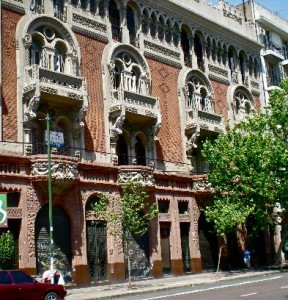
Palacio Barolo, an Art Nouveau building by Mario Palanti, is one of the five buildings Pablo chooses for Leonor’s project. Pablo’s sense of order is offended by the random air-conditioners on the facade, and, presumably, the awnings and sun shades.

Pablo’s life becomes suddenly more complex when a young woman comes to the office looking for Nelson Jara, someone with whom she says she has business to sort out.  Mario Borla and Marta Horvat, the firm’s partners, emphasize that they have no idea who Jara is, and Pablo just keeps his mouth shut, unable to utter a single word.  By page twelve, the reader learns that “Nelson Jara is dead, buried a few feet beneath the heavy-wear tiles over which the three of them walk every day on the way into or out of the office under the concrete floor of the parking lot, exactly where they [all] left him that night, three years ago.” Jara had lived in the apartment building beside a new apartment tower being built by Borla Associates, and a huge crack had developed in the wall of his apartment.  He was convinced that the construction had not been done according to code and, though he threatened to report the architects to authorities, he was willing to come to some “accommodation” with the architects.  Pablo was put in charge of putting Jara off for a week, at least until the concrete footings could be poured, and it is during this time that he came to know Jara for the man he was.  When the week ended, so did Jara.

El Edificio de los Pavos Reales, by Colombo, reminds Pablo of what he heard in a class in which this elaborate facade was described as: “Stucco, not fondant. Stucco, not fondant.”

What follows is a story reminiscent of those by Guy de Maupassant, as irony piles on top of irony and Pablo’s predictable life becomes more and more unsettled.  His marriage is uninteresting, his teenage daughter is out of control, he wonders if his wife has a lover, and he has serious philosophical questions about what love really is.  He wants to experience what he is missing, and he maintains a strong residual guilt over his role in the burial of Jara three years ago.  When he stops at an unfamiliar coffee shop on his way home from work soon after the young woman appeared at the firm’s offices looking for Jara, he runs into her, but she no longer needs Jara, she says, as she has solved the business matter that was so pressing.  Attractive and apparently interested in him, the twenty-eight-year-old woman, Leonor, soon engages the hapless Pablo to help her with a paper she is writing on five of the most beautiful buildings in the city.

La Casa de los Lirios, the House of Lilies, by Ortega, an example of Catalan modernism. Pablo says that if he didn’t “know that it was called The House of the Lilies, he would say that this building had fallen into the clutches of man-eating plants.”

Gradually, through flashbacks, the full, highly ironic story of Jara, his death, and its aftermath unfolds, at the same time that Pablo’s own life begins to go off the rails, with wife Laura, daughter Francisca, and new acquaintance Leonor all adding complications to the orderly existence that he has taken for granted.  Throughout, author Pineiro conveys Pablo’s state of mind through the many small details of his life, including his need to have his life follow predictable pathways, and as his understanding of people and his recognition of his own life’s possibilities grow, Pablo becomes more interesting.

From the beginning of the novel on, author Pineiro has one surprise after another for the reader, many of them the result of coincidences which, while unlikely, make the story much more fun to read and imagine.  The bare outline of the novel’s beginning, given here, is filled with ironic details which will keep a smile on readers’ faces as one surprise after another unfolds.  The action is fast and furious, Pablo is suitably dense as a protagonist, and few readers will predict the grand outcomes of this clever and often amusing novel.  The biggest crack in the novel ultimately comes in the “wall” of Pablo’s own stultifying life.

ALSO by Claudia Pineiro:  ALL YOURS,     THURSDAY NIGHT WIDOWS,    BETTY BOO,     ELENA KNOWS

Photos, in order: The author’s photo appears on http://revistacalibre38.wordpress.com

Palacio Barolo, an Art Nouveau building by Mario Palanti, offends Pablo’s sense of order with its random air-conditioners on the facade, and, presumably, the awnings and sun shades. http://buenosaires.for91days.com/

El Edificio de los Pavos Reales, by Colombo, with its unusual surface on the face, reminded Pablo of a class in which the unusal survace on the facade was described as “Stucco, not fondant!  Stucco, not fondant!” http://www.tripadvisor.com

La Casa de los Lirios, the House of the Lilies, by Ortega, reminded Pablo if he hadn’t studied it in class that he might say that this building had fallen into the clutches of man-eating plants.” http://www.clarin.com

A Caran d’Ache pen for architects, which Pablo was always careful to line up properly on top of the file folder on his desk, appears on http://revistacalibre38.wordpress.com

A CRACK IN THE WALL
REVIEW. Argentina, Humor, Satire, Absurdity, Mystery, Thriller, Noir, Social and Political Issues
Written by: Claudia Pineiro
Published by: Bitter Lemon Press
ISBN: 978-1908524089
Available in: Ebook Paperback

Ciaran Collins–THE GAMAL

“Don’t be expecting any big flowery longwinded poetic picturesque horseshit passages in this book explaining the look of something.  If I have to go into that much detail I’ll take a photograph or draw a picture.  This is for people like myself who hate reading.”

Charlie McCarthy, who is twenty-five as the book begins, is writing about events which occurred five years ago in Ballyronan, outside of Cork, events so traumatic for him that he is still suffering from Post Traumatic Stress Disorder.  And that’s on top of his problems as a “Gamal,” short for Gamallogue, an Irish word for someone who is “different” – not someone who is developmentally limited in the usual sense but someone, like Charlie, who seems to do everything wrong – unintentionally wearing his shirt back to front, forgetting to wear his socks, spilling his Lucozade on his shirt in the pub, and saying the wrong things at funerals.  For two years “after the things that happened,” he says, he was unable to do anything at all.  “I just was.”  The reader knows from the opening paragraph that Charlie’s trauma involved two lovers, his friends Sinead and James, and his early descriptions of Sinead in the past tense lets us know from the outset that she has died.  We know nothing else, however, nor do we know much about James, at that point, except that he and Sinead were Charlie’s only friends in a school atmosphere in which bullying was common.


Charlie’s “main shrink” has persuaded him to write a thousand words a day about his life, and he has agreed, reluctantly, telling his reader that “You won’t like me.  Mainly because you know I don’t care whether you like me or not, and people don’t like that, do they? They might say they do but they don’t.  Saying means nothing cos it could just as well be lies.”   Inserting drawings instead of bothering to describe people and places, Charlie begins his book – this book – also including passages from psychology textbooks, dictionaries, and eventually court transcripts.  Since he loves music, and Sinead and James were teenage folk musicians, he had hoped to include the words to particular songs, but he does not want to pay royalties, so he names the songs and the singers and leaves spaces for the reader to insert the lyrics.  When he updates the reader on how many words he has written, Dr. Quinn demands he pay attention to his task and stop delaying, and he finally writes that five years ago he was a witness in a court case in criminal court and that it went on for four weeks.  He can remember virtually every word that took place, with a kind of audio memory that he says is akin to the photographic memory associated with sight.  The case involved Sinead and her death.

Carrigadrohid, a castle near Cork, similar to the one that the Kent family restored. Photo by Mike Searle

Slowly, through flashbacks, Charlie reveals information about his life, Sinead’s, and James’s, though Dr. Quinn also requires him to include other characters who are “secondary” characters, especially Dinky, Teesh, Snoozie, and Racey, all of whom he refuses to discuss for much of the book.  The reader learns that Sinead, in addition to having a beautiful voice, is also an artist, and Charlie reveals that she is planning to go to an art college in Dublin after graduation from secondary school.  Her family has very little money, lives in a council house, and her father is “the meanest alcoholic in Europe.”  James is planning to attend Trinity in Dublin.  The son of a wealthy Protestant who has moved with his family to Ballyronan after purchasing and restoring an old castle, James is not only intelligent but is also an outstanding athlete, able to play any sport, something that does not endear him to the locals when he becomes the best player on their Gaelic football team.  Charlie lives with his hard-working parents who are often harsh with him, and he is often bullied at school, even by his primary school teachers.  He first became friends with Sinead, in fact, when she stood up for him against a teacher who was insulting him.  As soon as Sinead meets James, however, the two become inseparable, though they continue to include Charlie in their lives and activities.

Library at Trinity College, where the Book of Kells is one of more than five million volumes. This is where James started college.

Gradually, all the characterizations develop with substantial detail, and Charlie’s attitudes toward various people add color to the action.  His special vernacular makes the prose fun to read, and when Dr. Quinn suggests that Charlie’s story might be better if he included similes, his response – five pages of similes – is hilarious, including the unique observation that “similes are like empty retches between vomits.”

For the first hundred pages, however, the reader knows almost nothing about the mysterious tragedy of Sinead and James,  even as Charlie makes remarks like “Sometimes I think I’m like the cameraman who let it happen.  Other times I know I’m not.  I didn’t let nothing happen.  And I did nothing.  I know it.”  The reader still has little idea what the “it” is, other than the one or more deaths which have been known since the opening page, nor does s/he know how “it” happened, a long time for a reader to wait for crucial details, especially with all the foreshadowing beginning on page one.  Through transcripts of testimony given by secondary characters, the reader very gradually learns more about Sinead’s death and its all-encompassing aftermath, but it is impossible to know whether the testimony is the truth and what these characters might gain if they lied.  Snippets of the story are revealed, initially, with little context, creating still more foreshadowing but little sense of the overriding tragedy until well past the halfway mark of this nearly five-hundred-page book.  At that point, however, the novel makes up for lost time.  The characterizations, especially those of the secondary characters, make the nastiness which occurs among these school “friends,” and which leads to a terrible death, that much more dramatic and affecting.

Copper beech, a tree which is featured in the novel.

Debut novelist Ciaran Collins, a teacher living in Kinsale, has a fine sense of the dynamics of a small town and of the long-term effects of trauma on a character like Charlie.  His characters, some of them loathsome, never veer far from the meanness everyone has seen among young, small-town bullies, and his sense of a grand, horrific climax is daunting.  What takes this novel beyond narrative gamesmanship is the pervading sense that no one can be trusted, and at the conclusion, still more revelations gradually dawn on the reader.  Though the novel does have some problems with pacing at the beginning, Collins’s control of  his story is absolute, and readers are in for a treat with his characterizations.

Photos, in order: The author’s photo appears on http://www.smh.com.au

Carrigadrohid, the small castle pictured here, similar, perhaps, to the one that the Kent family restored, is by Mike Searle and is seen on http://www.geograph.org.uk/ , reproduced here under the terms of the Creative Commons Licence.

The Library at Trinity College, Dublin, which James attended, contains over five million volumes, including the Book of Kells.

The Copper Beech tree, is one of the world’s most beautiful and symmetrical trees.  It plays a role in the concluding section of the novel:   photoadayfor2010.wordpress.com

ARC:  Bloomsbury

Alfred Hayes–IN LOVE

Note: This novel and a later novel, My Face for the World to See, were re-published by NYReviewBooks in 2013 and are now readily available in shops and on-line.

“Nothing we want ever turns out quite the way we want it, love or ambition or children, and we go from disappointment to disappointment, from hope to denial, from expectation to surrender, as we grow older, thinking or coming to think that what was wrong was the wanting, so intense it hurt us, and believing or coming to believe that hope was our mistake and expectation our error.”—The Speaker of this Novel.

As the novel opens, an unnamed forty-year-old man meets a pretty girl at a hotel bar at four o’clock one  afternoon in the 1950s, and lonely and cynical, and looking to connect with her, he promises to tell her a story.  He confesses, however, that “I don’t know anymore, what things signify; I have difficulty now identifying them; a sort of woodenness has come over me,” a “woodenness” which leads him to use her as a passive sounding board while he relives his previous relationship with another woman whom he believes he loved. What follows are the maunderings of an insensitive man who has no idea who he is or what he is doing, other than telling a story to a woman at a bar.  Since he is the only speaker in the novel, the primary listener to his story becomes, in effect, the reader, rather than the pretty listener at the bar.  Neither is able to escape from all the excuses and self-justifications of this terminally dense and self-important man.

Alfred Hayes (1911 – 1985)

Here Alfred Hayes (1911 – 1985), a brilliant but woefully neglected author, recreates the failed efforts of this man in his relationships with women in New York in the 1950s.  His most recent failure has been with another, much younger woman of about twenty, whom he also met at a hotel bar, a divorced mother of a child being raised, at that moment, by the woman’s parents.  Both beautiful and in many ways vulnerable, the woman, we learn, had come to New York City hoping to find a suitable (and financially secure) lover and, eventually, a husband.  With little education and not quite enough talent to become successful as a singer, she finds that her best chance to meet successful men is at hotel bars.  When the speaker meets her and suggests that they go to his hotel room together, he does so without any sense of commitment beyond a single night.  Her beauty captivates him from the start, however, and they begin an affair. After a time, she finally becomes impatient with his lack of commitment and begins to wonder aloud what would happen if she left him.  “I didn’t think her going would have really occasioned in me more than a particularly sharp regret,” he concludes, “[but only] an extreme of suffering, or even possibly a gentle attempt to hang myself from some convenient chandelier would have satisfied her [of my love].”

One evening when the two are out together with another couple, she meets stodgy but wealthy Howard, whose success has given him a different view of the world – “One should be born either beautiful or rich, everything else was a handicap, [and] she was left with the feeling that ugliness, poverty, lack of talent, were misfortunes almost all the world, except herself and he, had suffered, and that they were, by these gifts of his money and her beauty, divided from all the unlucky millions.”  Eventually, a  turning point is reached for them all, as Howard offers her a thousand dollars for just one night with him, an offer this woman discusses with the speaker.  “It would be all over in a night,” she asserts, and the money would be a wonderful gift for her little daughter Barbara. The man then observes to his listener, that what bothered him most about this proposal was that she might sleep with “somebody I could not feel superior to.”  With his ego wounded, he now has to decide if he really loves her, and it is here that the novel begins to develop more fully.

The iconic Jersey Shore House, by Adam Elmquist. The speaker takes the young woman to a place on the Jersey Shore, but it is late October, and everything is closed.

As he discusses all this with his companion in the bar, the novel’s reader becomes exhausted with the mundane details, the banal “insights,” and the ignorance with which the speaker tries to justify his present situation.  The beautiful woman in the bar, however, never interrupts, never comments, and just lets him talk (which reveals a lot about her own desperation).  Eventually, the author realizes that both the listener at the bar and the reader have had enough:  “You’d like to go now, wouldn’t you?…It’s nice to have someplace to go, like home, and something to do, like eat dinner, and someone to see…and something assured, like a bed to lie down on.  It’s what we use as hope.”  Since all these “nice,” homey aspects of life involve someone else serving him, one can only hope that the next woman he tries to seduce will see him for the person he is but fails to recognize.

With no place to stay, they head for Atlantic City, not a relaxing place for them in their tense situation.

Alfred Hayes’s insights into human nature and his enormous skill as a writer are challenged to their limits here since this novel has only one speaker, but  Hayes succeeds in making the speaker’s situation intriguing enough that the reader wants to know whether he gets his well-deserved comeuppance, whether he learns anything, or whether he simply moves on. As a screenwriter with a flawless ear for dialogue, Hayes creates a speaker whose monologue includes conversations with his lover and the additional commentary he imagines from his listener at the bar.  The speaker sounds like a real person, albeit one so ordinary that he never betrays a sign of unique self-knowledge.  The women in the novel were all children during the recent horrors of World War II, so there are no Rosie-the-Riveters among the un-liberated young beauties who appear here at hotel bars looking for escorts. They are all willing prey for characters like this man, but their lack of prospects and their personal plights create some sympathy.  Far more experimental than either The Girl on the Via Flaminia or My Face for the World to See, this novel features the same kinds of male characters, either naïve (as in The Girl on the Via Flaminia) or self-centered (as in My Face for the World to See).    Ultimately, the speaker asks, “Do I appear to be a man…who doesn’t know what’s wrong with him, or a man who privately thinks his life has come to some sort of end?  Assume I don’t.”  A small insight, perhaps.

Also, by Alfred Hayes:  THE GIRL ON THE VIA FLAMINIA,     MY FACE FOR THE WORLD TO SEE,     THE END OF ME

Photos, in order: The author’s photo is from http://unionsong.com/

The famous bar at the St. Regis Hotel appears on  http://womenworld.org/

The iconic Jersey Shore House is shown on  http://www.panoramio.com The photo was taken by Adam Elmquist: http://www.panoramio.com/user/

The Steel Pier at Atlantic City, in the 1950s, may be found here: http://vimeo.com/ Click on the link and then the video that appears for a real 1950s rock-and-roll party!

ARC:  NYReviewBooks

Note: This novel was SHORTLISTED for the Man Asian Prize in 2012.  It was WINNER of the Tanizaki Prize (Japan’s highest) when it was first published in Japan in 2001.

“What the hell was I doing here, on a hillside in some strange fishing town, surrounded by the sea?  [The] figure up ahead of me grew more distant.  His back seemed somehow cold and remote.  Despite the fact that we had come on this trip together…the person moving steadily away from me…was a stranger.”—Tsukiko Omachi, on a trip with Sensei

From the opening page of this simply narrated story, author Hiromi Kawakami establishes characters who, in their disarming complexity and iconoclastic actions, behave differently from the expectations that many American readers of Japanese novels may have come to expect.   Tsukiko Omachi, a single businesswoman of thirty-eight, introduces herself as the narrator of the novel by describing her meeting with Mr. Harutsuna Matsumoto at a crowded bar after she finishes work.  Tsukiko is not a traditional Japanese woman, and the man she meets is not her contemporary trying to pick her up.  She is aggressive, accustomed to living by her own rules without interference from anyone else, and, though she eventually joins Matsumoto for dinner, she is not looking for a relationship. Matsumoto, a man about thirty years older than she, has recognized her from the past – she was a student in one of his Japanese classes in high school, years ago.  Though he remembers both her first and last names, she remembers him only as “Sensei.”  She recognizes his face and remembers some of the quirks of his teaching style, but she did not enjoy his class, was not a good student, and has no residual affection for him.


Hiromi-Kawakami22 (1)

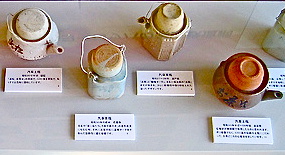
Five bottles of sake later, however, she is seeing him somewhat differently.  “Our food preferences weren’t the only things we shared; we had a similar rhythm, or temperament.  Despite the more than thirty-year difference in our ages, I felt much more familiar with him than with friends my own age.”  They continue to meet at the bar occasionally after that, always without planning in advance, and they sometimes go on from that bar to another one.  “The few times we got as far as a third or fourth bar, we inevitably ended up having the final drink at Sensei’s house,” Tsukiko says, though the relationship remains formal.  Divorced for fifteen years, with an adult son, Sensei lives in clutter, with mementoes of his past piled up in every corner – including a collection of “railway teapots,” used in the 1950s and 1960s.  Sensei denies consciously collecting these –  “I would never engage in such a crazy whim” – yet he remembers the train trips on which he acquired some of these teapots, such as on his first trip to university and on his honeymoon.

Railway teapots like those in Sensei’s collection. Photo by Joel Abroad

He also has a large collection of dead batteries: “I feel pity for these batteries that worked so hard for my benefit, and I can’t throw them away [at] the moment they die,” he remarks.  “These batteries have illuminated my lights, signaled my sounds, and run my motors,” an obviously symbolic remark, pathetic in its insights into the man himself.  Tsukiko, for her part, “had been alone.  I rode the bus alone, I walked around the city alone, I did my shopping alone, and I drank alone.  And even when I was with Sensei now, I didn’t feel any different than when I did these things on my own…[though] doing these things with him made me feel proper.”

The Yomiuri Giants, Sensei’s favorite team, win the Asia Series 2012

Sometimes months pass without Tsukiko and Sensei seeing each other.  She sees other people but finds men her own age shallow and uninteresting.  Sensei just continues his lonely life as he has lived it for years.  Whatever relationship they have is turbulent –  always unpredictable. On one occasion they go to a household market, where Sensei, in a moment of delight, makes an unexpected purchase.  On another they have their first fight – about Sensei’s passionate interest in the Yomiuri Giants baseball team, whom she cannot stand.  Their mushroom-hunting trip with the owner of the bar and his friend is also fraught.  As the seasons change, the relationship changes, not just for Tsukiko but for the reader, too, sometimes in a good way and sometimes not. Her first trip to a pachinko parlor has subtle and symbolic overtones, as both of the characters try to keep the other guessing so that neither takes the other for granted.

Amanita muscaria, a dangerous, psychedelic mushroom found by the mushroom hunters.

Gradually, the two begin to trust each other, though they remain independent, with neither willing to give up personal autonomy.  After two years of casual meetings, Tsukiko begins to be able to predict what Sensei will say under various circumstances, and when she takes walks alone she begins to wonder what Sensei is doing.  On one occasion, she senses that she has an invisible version of herself hovering somewhere, an obviously symbolic realization.  On another, we see Sensei responding uncharacteristically when Tsukiko is insulted by a drunk at a bar.   Eventually, Tsukiko and Sensei find themselves at a kind of “middle place, perhaps a borderline.”

Pachinko parlor

Though some readers may become frustrated by the excruciatingly slow pace at which the relationship between Tsukiko and Sensei develops, with long months often elapsing between some of the key events, the author’s ability to show the subtle changes which occur between these two strong and independent people will delight lovers of precise writing and careful development.  Sometimes Kawakami accomplishes these magical changes through her use of obvious symbols, sometimes through quiet observations made by her characters themselves, and sometimes through such precise descriptions of a character’s behavior that the reader fills in the blanks and draws his/her own conclusions.  The writing is clean – pristine, even – with every word, every event, and every psychological nuance presented clearly. Rarely have I seen a novel of such psychological acuity, and the emotions it evokes, especially toward the character of Sensei, are strong and empathetic.  Inspiring in its honesty and integrity, The Briefcase is well on its way to becoming a literary classic.

Also by Kawakami, reviewed here:  THE NAKANO THRIFT SHOP     and     THE TEN LOVES OF NISHINO

Photos, in order: The author’s photo is from http://www.counterpointpress.com/

The railway teapots are from  http://www.flickriver.com The photo is by Joel Abroad

The Yomiuri Giants, which won the Asian Series in both 2011 and 2012, are pictured on http://web.theabl.com.au/

The Amanita Muscaria mushrooms (dangerous) are from http://jordynredwood.blogspot.com

The pachinko parlor is shown on http://www.investorvillage.com

« Newer Posts - Older Posts »