Feed on
Posts
Comments

When the novel’s speaker brings a framed picture to a meeting with a mysterious messenger, as requested, his life changes forever.  “This,” the messenger announces, “is an engraving of the last Byzantine emperor, Constantine Dragas Palaeologus XI [who died in exile in 1475]…and you, sir, are his last descendant, which is to say, you are the current Byzantine emperor-in-exile, Constantine Palaeologus XV.”

When the son of Paul Hackett, an American, hears these words, he is stunned, unable to imagine how these circumstances have evolved.  He has lived with his mother’s family in Turkey ever since his parents divorced when he was two, and he has shared the name of his Turkish grandfather, ever since.  Telling his own story, the speaker is now a successful businessman in his early thirties, and an associate professor who teaches two days a week at Bosphorus University.  An economist schooled at Columbia in New York and at the London School of Economics, he loves research and writing, and he is intrigued by the prospect of investigating the baffling announcement that he is truly the latest emperor-in-exile.  Long fascinated by the history of the Byzantine Empire, which lasted for over eleven hundred years before being finally defeated by the Ottoman Turks in 1453, the speaker is anxious to investigate further.

A secret organization known as Nomophylax (Guardians of the Law) has been guarding Constantine XI’s fortune for the more than five hundred years since his death in exile in 1475, and they have secretly kept the throne-in-exile alive and occupied.

“They never failed to increase the fortune they had inherited, never cut corners and never took risks.  Nobody knows how many billion dollars the Nomo balance sheet is worth these days.”  The will belonging to the speaker’s grandfather was also left with Nomo, attesting to the connection between the speaker and the organization.  Nomo representatives then reveal the whole story to the speaker, announcing:  “The moment you take your oath accepting the honor and obligations of the imperial crown, you will be assigned a special mission,” he is told.  “When this mission is accomplished, it will mean that a very significant trial has been passed.  It is then that you, together with the members of Nomo, will decide the future of the organization.”

The speaker looks out his window at the Galata Tower and comments on the maze of streets surrounding it.

As soon as the representatives from Nomo explain his mission, the speaker immediately leaves his job and begins serious study at the Center for Research in Byzantine History at Chatham House in London, before going to Dumbarton Oaks in Washington, DC, to study at their library in Byzantine Studies.  He also goes to the University of Virginia, where he tries to find out more information about his father, a graduate of the law school there, eventually meeting some Hackett family members on the West Coast.  (In a humorous aside, he is aided by a private detective, Kinsey Milhone, a name well known to readers of mystery stories.) His nearly full-time travels then begin in earnest.  On his return to Istanbul, he visits the Tekfur Palace, the crumbling remains of the palace once occupied by his emperor ancestor, and it is at a meeting nearby that he is finally given a box for which he must find the six tiles that fit into special slots and are the key to his quest.  Subsequently, he visits, among other places, the Antioch Museum;  then Athens, where he sees a statue of Constantine XI; and the Greek city of Mistra, near Sparta.  Continuing  on, he goes to Venice and Cappadocia in Italy, then to Nice, Seville, Lausanne, Hamburg, Nantes, and Liege.  The travels seem never-ending, though he manages occasionally to visit a woman to whom he is seriously attracted in Stockholm, before leaving again for other places, like Sao Paolo, or Lindos on Rhodes.

Remains of the Tekfur Palace, once occupied by Constantine XI

This unusual novel defies genre.  The story as described above, resembles a fantasy, providing a framework for this novel, but it represents only a small part of the actual text.  The novel is also a “quest story.”  The speaker is given tasks, in this case finding six tiles to fit into a special box, and as is typical of quests, he travels throughout the world searching for these tiles.  The fact that he finds them more by chance than through his own efforts suggests that Turkish author Selcuk Altun has created this search primarily to allow the speaker to travel to a variety of well-described places important to Byzantine history, rather than to emphasize the plot itself.

The speaker’s travels, typical of a quest, do not involve hardship, financial or otherwise, and this is not a travel narrative in which a main character faces dangerous obstacles as he travels to exotic places around the globe.  Here the travels are to places well known to historians and tourists who have traveled through Turkey, Greece, the eastern Mediterranean, and Europe.   The author provides insights into the Byzantine history associated with these places as the speaker travels, a pattern which slows down the narrative for those who are primarily interested in the quest and fantasy aspects of the novel, but which will intrigue many readers unfamiliar with this background.

Mistra, in Greece

Author Selcuk Altun is a “friend” of the novel’s speaker, as we discover through references to him throughout the novel, and it is clear that Altun is obsessed with Byzantine history and thrilled to use the novel to provide little known information to readers.  Detailed information about the order of the emperors and how they ascended to their thrones, the people they killed and maimed, and how they themselves died sometimes make the novel feel more like a history book than a novel.  The term “Byzantine intrigue” takes on new meaning as the stories of the emperors unfold.

The speaker would like to return these four horses to Constantinople from Venice. They were plundered during the sack of Constantinople in 1204.

By the time the speaker’s quest ends, the reader will have been treated to a panoramic view of Byzantine history and some of the empire’s contributions throughout the world over the eleven hundred years of its existence.  The story of the quest keeps the reader occupied during the slower, historical parts of the narrative, while the travels will intrigue many readers who may have traveled to these sites.  At the same time they may inspire the reader who has not traveled to these places to visit them, either in person or on-line.  For those curious about Byzantium, the “heir to the civilizations of Greece and Rome,”  this novel is an unusual, non-traditional novel about its history and on-going influence.  The author himself concludes, “If humans ever offer prayers of gratitude for the gifts they have received, the name of Byzantium ought to come after God and before Jesus.”

The Palace of the Grand Master of the Knights of Rhodes

ARC: M. Zegarek PR

Photos, in order: The author’s photo is from http://oklapkutuphanesi.blogspot.com

Galata Tower, with its maze of streets, appears on http://members.virtualtourist.com and was posted by Santini738:

The Tekfur Palace appears on http://www.atamanhotel.com/tekfur.html

Mistra is from http://commons.wikimedia.org and was posted by Ed88

The Four Horses on San Marco are shown here: http://en.wikipedia.org These are the originals, now in a museum, and copies appear on the facade of San Marco.

The Palace of the Grand Master is from http://travelsort.com

ARC:  M. Zegarek PR
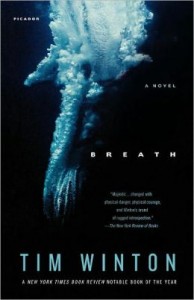
Tim Winton–BREATH

“Could I do something gnarly, or was I just ordinary?  I’ll bet my life that despite his scorn, Loonie was also [posing these questions to himself].  We didn’t know it yet, but we’d already imagined ourselves into a different life, another society, a state for which no raw boy has either words or experience to describe.  Our minds had already gone out to meet it and we’d left the ordinary in our wake.”

When a middle-aged EMT arrives at the scene of a “suicide” by a seventeen-year-old who has hanged himself, he knows instinctively that this is an accident and not a real suicide.  Two girls are hunched on the couch downstairs, the boy’s father sports a broken collarbone, and the suicide site has been “sanitized,” well before the call to the EMTs, a clear indication to the arriving EMT that the boy was experimenting with auto-asphyxiation and that he went too far.  Through flashbacks, the EMT on the scene, Brucie Pike (“Pikelet”), relives his own coming-of-age on the west coast of Australia in the 1960s and 1970s.  A lonely boy leading a solitary life, he finds a companion, if not friend, in Ivan Loon (“Loonie”), with whom he shares his love of extreme surfing.   “How strange it was,” Pikelet remarks, “to see men do something beautiful.  Something pointless and elegant, as though nobody saw and cared.”

Tim Winton on Facebook

But the beauty of surfing quickly yields in importance to its excitement and its increasingly dangerous thrills.  “There was never any doubt about the primary thrill of surfing, the huge body-rush we got flying down the line with the wind in our ears.  We didn’t know what endorphins were, but we quickly understood how narcotic the feeling was, and how addictive it became; from day one I was stoned from just watching,” Pikelet declares.

Tim Winton, one of Australia’s best known and most prolific contemporary authors, takes the reader along on a series of  athletic “tests” which Pikelet and Loonie face as young teens.  They prepare for their dangerous challenges by practicing holding their breaths for extraordinarily long periods of time so that they can dive deep and survive the boiling surf if they are upended during their most dangerous rides, and they force themselves to go the limit on every ride, no matter how frightening it may be.

Soon the boys become disciples of middle-aged Billy Sanderson (“Sando”), a surfing guru who fears nothing and who takes them to remote and ever more dangerous sites where they can test their mettle.   Regarding themselves as a “secret society of three,” they seek surfing “appointments with the undisclosed.”  As they learn to “inoculate” themselves against the worst of their fears, Sando tells Pikelet and Loonie that “It’s not about us. It’s about you.  You and the sea, you and the planet,” and they respond by practicing hard, obeying the training regimen set up by Sando, and believing that “what we did and what we were after…was the extraordinary.”

In their excitement about pushing themselves to the limits, none of the “cult” of three pays any heed to the idea that they could actually die by testing themselves in this way, believing instead that one becomes extraordinary only by facing fears and taking risks, and the bigger the risk, the better.   “There was an intoxicating power to be had from doing things that no one else dared try,” Pikelet observes.  Over time, he begins to become prideful, isolating himself almost completely from his school peers:  “Wherever I went, I felt like the last person awake in a room of sleepers.”

Scuba diver (bottom center) and surfer (far right in surf) enjoy a day with dolphins. At least I think they are dolphins.

Eventually, however, Pikelet begins to question the relationship between excitement, thrills, risk, and death and what maturity really means.  Does being a mature man mean giving up thrills and choosing to be “ordinary?”  Is “extraordinary” a relative term bestowed on one person by other people who share the same goals?  And how does one really become “extraordinary?”   Ultimately confused, after thinking he has discovered all the answers, Pikelet must finally work out what is really important and what risks are really worth taking.

In spare prose which uses some of the most vivid action verbs ever included in a novel, Winton tells an exciting story which makes the seductive thrills of surfing comprehensible to the non-surfer.  Pikelet, Loonie, and Sando clearly reveal who they are as humans—within the surfing milieu and within their private lives.  Some of them grow in the course of the novel, and some do not.  Clearly articulated, the life lessons which Winton illustrates evolve from the action of this unusual plot, and his style and structure emphasize their importance.  In the conclusion Brucie Pike reviews his life at age fifty-two, finally putting his life as Pikelet-the-surfer into perspective.  Here Tim Winton has created a western Australian coming-of-age novel in which his characters discover what makes men humans and ultimately what makes life worth living.

Photos, in order: The author’s photo is on his Facebook page.

This beautiful photo of a surfer inside the curl of a wave is from http://andrewmichaelroberts.blogspot.com

Dolphins, a scuba diver, and a surfer (on board to far right) share a wave: http://www.australia.edu

“Most people are blown away by their first sight of the Grand Canyon; their first experience of the Balinese Monkdu Dance, the Ketjak; their first glimpse of a breaching humpback whale.  That was how I felt.  Being among these [Ju/’hoansi, the Real People of Namibia] exceeded my dream.  And maybe happiness was the wrong word; perhaps what I felt was bliss bordering on rapture.”

If a reader were to base his/her whole opinion of Paul Theroux’s latest travel book on this one quotation from the opening chapter, one might conclude that this book is a genuflection to simpler cultures living the hunter-gatherer lives of their forbears, a rare reaction by Theroux who is notoriously hard to please.  That conclusion would be completely wrong, however, even in relation to his experience among the lovely Ju/’hoansi bush people who so impress him in Namibia. Traveling to places rarely, if ever, visited by tourists  – this time to places along the south and west coasts of Africa – Theroux flashes back to the beginning of his trip in  South Africa, where he spends significant time in the townships of Capetown.  There he discovers that while these special townships created for the poor have improved in the last ten years, more desperate poor are arriving from rural areas and creating new, and even more primitive settlements in slums on the outskirts.  He is ready, perhaps even over-anxious, for the surprise of the Ju/’koansi group when he explores Namibia.

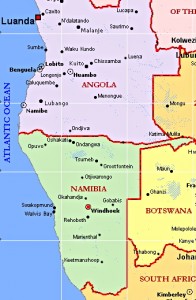

On his loosely planned itinerary, he expects to travel up the west coast, primarily by train and bus, from Capetown to Timbuktu in Mali. He has set no time limits and made no advance reservations, and he will do what he has always done – seize opportunities as he travels, make notes as he goes, and post his observations of this part of Africa in ways similar to his observations of Africa’s eastern coast ten years ago.  His visit with the Ju/’koansi in Namibia has been the first sign of hope that he has had on this trip since he started in Capetown.

(If you double-click on this map, you will see a larger version.)

In Theroux’s previous book, Dark Star Safari (2004), he details his travels from Egypt to Capetown, and though he makes insightful comments on the countries he visits, he is dispirited by what he sees on that trip, both in terms of governments and in terms of the daily lives of ordinary citizens.  Even hungrier and more impoverished in 2004 than they were in 1963, when he was a Peace Corp volunteer in Malawi, and with even fewer resources, the rural poor and the urban slum-dwellers whom Theroux meets leave him both sad and angry, and he is a curmudgeonly (and seemingly arrogant) narrator to spend time with for the nearly five hundred pages of that book.

This new book shows even more poverty and economic horror, but Theroux himself is a much more thoughtful and sensitive narrator here, and as he makes sometimes risky trips into rarely visited areas, teaches a few English classes, and meets and admires a number of people dedicated to improving lives, he inspires the same admiration for them in the readers of this book as he obviously experiences himself.  Theroux also reveals his own fears and insecurities, something I have never seen him do in any of his previous books.  Now seventy-two, he knows that this may be the last such trip for him.  Though he has seen and done a lot in his life, he no longer feels as if he has to test himself, and his conclusions are bittersweet for those of us who have followed his work since the 1960s.  He becomes more “human,” more one of “us” than I have seen before.

Table Mountain, Capetown

In Capetown, he notes that on Table Mountain, the rich look down on the poor, physically, from the mountain, and the poor must look up at the rich.  No one can hide. Life for the poor has improved, though Theroux decries the “township tours,” run by tour companies, which now take tourists through poor townships in a program to show all aspects of South African life – “the voyeurism of poverty,” in Theroux’s opinion.  He also points out the crime statistics.  Since the end of apartheid in 1994, three thousand white settlers have been murdered, and he criticizes entertainers like Bono for their lack of statistics as they make proclamations to the world.

The Ju/’hoansi, near Tsumkwe, Namibia

Windhoek in Namibia provides a huge change from the grinding poverty and filth of South Africa’s townships and slums.  A city founded by German colonizers, it is clean, with people sweeping the streets, which are almost absent of trash.  Here he expounds on his ideas regarding aid, which he sees as well-intentioned, though promoting dependency and corruption, and impeding growth.  With its high literacy rate, he says, Namibia has more high school graduates than Newark, NJ, despite Namibia’s long war with S. Africa, and there are fewer murders.  The culture as he sees it in Windhoek, is characterized by “efficiency, order, mildness, and cleanliness.”  Tsumkwe, a rural crossroads in Namibia, is, however, “a famine-haunted, thinly populated bush area, near the Angola border.  There he meets the Ju/’hoansi and officials from UNESCO, from whom he learns more about the Ju/’hoansi.  Ultimately, he realizes that his initial impression was wrong:  These are the “most victimized and brutalized people in the bloody history of southern Africa…They are reminders of who we once were, our ancient better selves.”

Abu Camp, Okavango Delta, Botswana

Abu Camp in Botswana, in which orphaned and injured elephants are trained to carry tourists through the Ojavango Delta (since they cannot yet be returned to the wild) introduces Theroux to young people who are devoted to their jobs of training these elephants to carry people on rides through the Delta.  Wealthy tourists spend thousands of dollars to come to this camp and do their tour on the backs of elephants, an activity that is not natural for this variety of elephant.  The contrasts between these tourists and the poor local people who live in rural areas are highlighted when some young people wait till tourists finish their meals and then ask politely if they can eat what is left on their plates.

The newly built train and rail station in Lobito, Angola, opened by the Chinese government in August, 2012

Angola, Theroux’s next stop, proves to be the turning point.  One of the richest countries in the world in terms of its oil production and revenues, all of which end up in the pockets of politicians and businessmen, and none of which trickles down at all, Angola becomes the centerpiece of the book in terms of the corruption at the heart of African life.  No animals or birds at all exist in the wild here, thanks to years of bloody wars and the millions of land mines that prevent humans and animals from moving freely. Angola generates “a billion dollars of gross revenue every five days, an almost unimaginable cash flow, with none going to the people.” As one man comments, “This is what the world will look like when it ends.”

Giant sable antelope, the only such animal left in Angola, with horns measuring five feet in length.

Ultimately, Theroux must decide whether to continue on to a tiny area of Angola, an “island” completely surrounded by the Congo, in order to see the rare sable antelope, with the longest horns of any antelope in the world.  It is now the only such animal left in what is officially Angola, and it survives because it lives in a protected habitat.  Ultimately Theroux asks, “What had I learned?”   And then answers: “Proctology pretty much describes the experience of traveling from one African city to another, especially the [horrific] cities of urbanized West Africa…[One needs] a strong stomach and a fascination with decay, and disorder, and hopelessness, and township anarchy.”  As Theroux completes his journey,  he reveals his own melancholy and even despair, feelings which the reader shares with him.

ALSO by Theroux:  SIR VIDIA’S SHADOW, about his relationship with Nobel Prize-winner V. S. Naipaul in Uganda, and  DARK STAR SAFARI

Photos, in order: The author’s photo by Yingyong Un-Anongrak, appears on  http://travel.nationalgeographic.com

The map of the area is from http://www.sitesatlas.com/.  Just double-click on the image to go to a larger copy of this map.

Table Mountain, one of the Seven New Wonders of Nature, is here: http://www.tandatula.com/

An article about the Ju/’hoansi (and additional photographs) may be found on http://www.wilkinsonsworld.com/, the site of this photo.

Abu Camp on the Okavango Delta may be found here:

http://www.smithsonianmag.com. Photo by Sergio Pitamitz / Biosphoto / Minden Pictures

The Lobito Railway Station appears here:  http://www.angolahub.com

The giant sable antelope with its five-foot horns is an exhibit in the American Museum of Natural History: http://en.wikipedia.org/wiki/ Photo by Stavenn.

Jane Gardam–LAST FRIENDS

Note: Jane Gardam is the only woman in history to have been WINNER of two Whitbread Awards for Best Novel of the Year.  She has also been appointed Officer of the British Empire (OBE) by the Queen in 2009.

“On the way home [Old Dulcie] decided to get eggs from the farm.  There was a wooden box hung on a field-gate.  It had been there fifty years.  You took out the eggs and left the money.  Beautiful brown eggs covered in hen-shit to show how fresh they were.  Today she opened the flap of the box and there were no eggs and no money but a dirty-looking note saying, ‘Ever Been Had?’ ”

In many ways this anecdote from Jane Gardam’s Last Friends epitomizes the bittersweet, often ironic, style of this third book of an unforgettable trilogy.   The first novel, Old Filth, tells the story of Sir Edward Feathers, a “Raj-orphan” born in Malaya, unloved by his parents.  As was the tradition, he was sent alone at age six to be schooled in England, halfway around the world.  His adult career lives up to the adage, “Failed inLondon, Tried HongKong,” resulting in his nickname, “FILTH.”  In Hong Kong, he marries Betty MacDonald, also a Raj orphan, and leads an unexciting, though professionally distinguished, life as a judge representing the Crown and the Empire.  The second novel, The Man in the Wooden Hat, is Betty’s story, a story of her marriage to Filth, a man she respects but has never really loved, though she enjoys a great deal of freedom to pursue her own interests.  Each of these novels is written in a different style befitting the two different characters.   Filth’s story, subtle and sophisticated, is filled with ironies, while Betty’s is much more down-to-earth, revealing simultaneously her romantic nature and the enduring commitment she and Filth have to each other.  Both novels are filled with wryly humorous moments, lively dialogue which clearly establishes the characters and their attitudes towards others, and memorable scenes in which they separately display their feelings about their lives together.

Last Friends, the third novel, is ostensibly the story of Sir Terence Veneering, a man of mysterious origins, the lifelong rival of Filth, rumored to have been Betty’s lover.  This is, however, the culmination of the trilogy, and as such, it reveals almost as much about Filth and Betty and their relationship with each other as it does about Veneering and their separate relationships with him.  As the novel opens, many decades have passed since they were young foreign service officers, and Betty has been dead for several years.  Now friends and relatives are traveling from the tiny Dorset village of St. Ague, where Filth and Veneering both lived in retirement, to London for the funeral of Filth at Temple Church, the second such trip they have made in just a few months – Veneering’s funeral was held there just a few months before.

Temple Church, London, where the funerals of Veneering and Filth were held.

Leading the group from St. Ague is the irrepressible Old Dulcie Williams, the village elder and widow of “Pastry Willy” Williams, a judge also in the foreign service, who performed the wedding of Filth and Betty.  Clearly dotty, though never shy in expressing her opinions, Dulcie provides an unusual point of view from which to learn the backstories of other characters, since she “sees” events which may or may not be real, has conversations with people who are long dead, and ignores anything (like the increasingly urgent communications from the bank) that might have the potential to complicate her life.  She no longer even remembers her husband Willy or what he looked like:  “Tags and watchwords, she thought.  That’s what all the love and passion comes down to.  We never really talked.  And imagine, sex!  Extraordinary!  I suppose we did it?  Susan was such a lovely baby.”

With its Norman Tower from 1200 A.D., this rural church in Herringfleet, where Veneering grew up, is a great contrast to the Temple Church where his funeral was held.

As Dulcie makes ready for the trip to London, she sees Fred Fiscal-Smith, a mutual friend of her and her husband, tramping up the hill towards her house.  Fiscal-Smith, a retired solicitor who served as Filth and Betty’s best man and also knew Veneering, has come down from Darlington, near the Scottish border, and is the “meanest,” most impecunious, person Dulcie has ever known.  He hopes to spend the night and perhaps longer at her house after the funeral.  It is in this section that Gardam writes some of her funniest scenes ever, filling them with hilarious patter worthy of the best dramatic comedy. A classic scene in which Dulcie and Fiscal-Smith get locked in the church in St. Ague is laugh-out-loud funny, not a description one normally associates with Gardam, who is usually so subtle and sly with her wit and irony. Her sensuous descriptions add further life to the scene:  “Inside, the church scowled at them and blew a blast of damp breath.  Hassocks looked ready to sprout moss and there was the hymn-book smell…Rows of regimental flags hung drooping down the side-aisle like shredding dish cloths, still as sleeping bats.”

Herringfleet is part of The Broads National Park in Suffolk, an area northeast of London with numerous estuaries and wetlands

Gradually, both Dulcie and Fiscal-Smith reveal the background of Veneering, Filth’s lifelong rival, and the extensive, even intimate, connections among these characters.  The reader learns about Veneering’s Russian acrobat father and sixteen-year-old British mother, his early childhood in rural Herringfleet, his escape from the Blitz, his eventual education, his connections with Fiscal-Smith and with Edward Feathers (Filth) and his long, often parallel career with that of Filth.  Dulcie’s information sometimes feels as if it has been retrieved from the “wooden box hung on a field-gate” in the opening quotation.  Whether the reader gets “fresh eggs” from her memory box or the ironic, unstated message “Ever Been Had?” depends on the time and circumstances under which Dulcie yields up her recollections.

This Malta clifftop may resemble the place where both Betty and Veneering lie down to peer through a crack at the freshwater spring bubbling at sea level.

At her (surprisingly) boisterous best here, Gardam still manages to create scenes of sensitivity and understanding, especially toward Fiscal-Smith, a sad and lonely old man.  Throughout, Gardam recreates a vibrant and rich background, filled with details presented through unique images and observations.  Her control of her material, her insights into people and places, and her wonderful humor infuse all of her novels, and with this trilogy, she hits her peak.  While some might argue that this novel is a stand-alone (and it is, in terms of its focus and sense of direction), it will be far more memorable to those who have read the novels which have come before it and fully understand the novel’s contexts.  A lively and memorable trilogy which lovers of literary fiction will celebrate for its ironies and insights, this trilogy  begs to be made into a film or TV series.

ALSO by Jane Gardam:  In the Old Filth Trilogy:  OLD FILTH,     THE MAN IN THE WOODEN HAT,   and   LAST FRIENDS

Separate novels, not part of the trilogy:  THE PEOPLE OF PRIVILEGE HILL, THE QUEEN OF THE TAMBOURINE,     GOD ON THE ROCKS,      CRUSOE’S DAUGHTER,     A LONG WAY FROM VERONA     THE FLIGHTS OF THE MAIDENS

Photos, in order: The author’s photo appears on http://wisewordsfestival.co.uk

The Temple Inn Church, by David Monniaux, 2005, is from http://commons.wikimedia.org

St. Margaret’s Church in Herringfleet, with its Norman tower, dates from about 1200 A.D. and may be found here:
http://www.suffolkchurches.co.uk/herringfleet.htm

The Broads, a National Park, includes areas of both Norfolk and Suffolk, and may be found on
http://en.wikipedia.org/wiki/The_Broads_National_Park

The Malta cliff top is part of a hiking adventure on http://www.wanderlust.co.uk/

ARC:  Europa

Note: This novel was WINNER of the French Prix Medicis Etranger for Best Novel Published in Translation.

“[At the Jerusalem Theatre], someone recognizes [director Yair Moses]. They are actors and singers and dancers here for the dress rehearsal of a musical play for children…
“A play? By whom, about what?” Moses asks.
“Based on Don Quixote, adapted to an Israeli setting.”
“More Don Quixote?” sniffs Moses. “Enough is enough, no? The eternal hero.”

In this age of sound bites and tweets, few novelists devote hundreds of pages to the creation of thoughtful and insightful novels of ideas concerned with major philosophical and moral issues. Israeli author A. B. Yehoshua is just such an author, however, creating a surprising novel which ranges widely, as it examines such issues as reality vs. the recreation of reality through art and film and myth; life, as opposed to the afterlife, and whether the afterlife is real or imagined; the actualities of the past vs. memories of the past; the concept of guilt and whether one can atone; and the many aspects of love – love and death, love and hatred, love and jealousy – as it controls our actions (and even our politics).

The development of these ideas, revealed through the novel’s actions and symbols, also applies to contemporary Israel – the violence between residents of Gaza and Israel; the various branches of Judaism with their different interpretations of their obligations; the parallels between Spain and its Sephardic Jews, attacked and killed during the Inquisition, and Jews who were attacked during the Holocaust; and the contrasts of the devout Catholic priests with whom Moses associates in Spain and the crass behavior of Moses himself when they grant him a prize. Obviously, this novel is challenging (and occasionally slow moving), providing much to ponder as important concepts unfold.   Virtually every detail adds to the author’s depiction of one or more of the novel’s big ideas.

Cathedral at Santiago de Compostela

The story line itself is not complicated. Famous Israeli director Yair Moses has received an unexpected invitation to attend a retrospective of his films to be held in Santiago de Compostela in northwest Spain. He arrives from Israel with Ruth, an aging actress whom he regards more as a character in his films than as a real person. He soon discovers that the three films to be shown the first day, and all the succeeding films, are his earliest films, each made with the help of a brilliant screenwriter, Shaul Trigano, one of his former students.

As the seven films shown at the retrospective are described successively by the author, the reader becomes familiar with some of their themes and how they are developed. The dramatic changes between these early films and Yair Moses’s films of the past twenty years become obvious, however, when Juan de Viola, the priest who is also the institute’s host and guide, comments: “It seems to us, Mr. Moses, that in the past two decades you have turned your back on the surrealistic and symbolic style of your early films and have become addicted to extreme realism that is almost naturalistic…Why? Do you no longer believe in a world of transcendence, in what is hidden, invisible, and fantastic, so much so that you are mired in the mundane and obvious?” A young teacher follows up this question: “There is a feeling, sir, that in your latest films, the material aspect has assumed supreme importance, and not necessarily out of a new aesthetic. As if you are sanctifying the materialism of the world or succumbing to it…Does not such naturalistic realism smother the possibility of mystery, of rising to a higher vision?”

Matthias Meyvogel’s 17th century depiction of the “Caritas Romana”

All of this change has occurred in the films made after Moses and screenwriter Trigano disagreed regarding a key scene which Ruth refused to play. Moses sided with Ruth, leading to a permanent break with Trigano and Trigano’s departure from film-making. The strange scene in question, which is also the subject of a painting on the wall behind Moses’s bed at the hotel, was to be a re-enactment of an ancient story dating from 30 A.D., one so well known in those days that it has even been found painted on a wall in Pompeii. It is the story of “Caritas Romana,” or “Roman Charity,” reflecting the horrifying plight of Cimon, an old man who has been sentenced to death by starvation. His daughter Pero, who has just given birth, visits her father in prison, and seeing his condition, and wanting to save his life, she offers him her breast and then suckles him. When her actions become known and publicized by the jailer, she is seen as a heroine, the epitome of the devoted daughter. For her love and care, her father is pardoned. For screenwriter Trigano, this scene was intended to be the high point of the film, with every other action dependent upon it, a scene of such importance and significance, such “depth and timelessness in its theme…[that it would] enrich the arts for generations.”

Tomb of St. James, which Moses passes when he accompanies a priest to confess his sins.

As Yehoshua further expands on “Caritas Romana,” its symbolism for Trigano becomes obvious, and Trigano’s eventual, and seemingly bizarre, demand of Moses as a proper atonement for Moses’s failure to film the scene becomes understandable, at least on the level of its symbolism. Trigano believes that “There is no disgrace in art…Art makes the disgraceful beautiful and the repulsive meaningful. ” For the reader, however, there is no getting around the father/daughter action in the dominant scene of “Caritas Romana,” a subject so far from “normal” in our own society that identifying with it as “beautiful” is difficult, if not impossible. Though I could appreciate what Trigano was saying and understand how someone  totally invested in aesthetics might find this beautiful, it did not really work for me as a scene of life-changing magnificence.

Jerusalem Theatre

The novel is rich in detail, ideas, and symbolism, and the author’s narrative is both energizing and exciting in its possibilities. Its fine organization allows information about the characters to be revealed gradually. Like so many other novels of ideas, however, it subordinates characters and their lives to the overall structure in order to clarify and illustrate philosophical and thematic ideas. As a result, the characters become vehicles, rather than living, breathing “humans” as they move in and out of their films and their “reality,” which is, of course, reality as depicted in an imaginative and unusual piece of fiction. The final two or three pages, which tie up some loose ends, do fit the novel thematically and do draw on a long literary tradition, but in this context with Moses, unfortunately, they felt facile and even a bit clichéd to me.

ALSO by Yehoshua:  A WOMAN OF JERUSALEM and    FRIENDLY FIRE

THE RETROSPECTIVE
REVIEW. Israel, Spain, Literary, Social and Political Issues
Written by: A. B. Yehoshua
Published by: Mariner Books
ISBN: 978-0544157989


Netivot, which Moses visited with Trigano, is located near Gaza.


Photos, in order: The author’s photo appears on  http://www.thebestwriters.com

The Cathedral of Santiago de Compostela is from http://www.bestourism.com

The picture of “Caritas Romana,” by Matthias Meyvogel, an artist from 17th century Dutch Zeeland, a copy of which is on the wall behind the bed in Moses’s hotel room, appears on http://www.internetlooks.com.  Both Rubens and Caravaggio also painted this scene in the early seventeenth century.  The Pompeii version from 45 –  79 A.D. (not pictured here) may be seen on: http://en.wikipedia.org

The Tomb of St. James, which Moses passes on his way to confession with Manuel de Vega, may be found here:
http://www.turnbacktogod.com

The Jerusalem Theatre, by Avishai Teicher, appears on http://commons.wikimedia.org/

The map of Israel, with Netivot highlighted, is from
http://www.theisraelproject.org

« Newer Posts - Older Posts »