“So this is what the process of globalization looks like? The whole world will become a village?…If this is really the case, then why does Dr. Watson want to get out of here as fast as possible? Why does Sapam Tomba stand mute?…Why are non-Bengalis afraid in Calcutta and non-Marathis afraid in Mumbai? Why was the Christian minister Staines burned alive in his car…? Why have the few Hindus of Kashmir…become refugees, lost, wandering from door to door?”
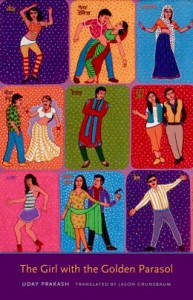 If you came to this review because the title suggests that this is a romantic, even pretty, little novel of love in exotic India, then you will be shocked by what you discover here. This is a tough novel depicting what author Uday Prakash, controversial in his own country, sees as a major hurdle for India – not necessarily in the major cities so much as in the rural countryside. The economic changes in India in the 1990s have brought about a thriving middle class and a vibrant life in the cities, much of it “American style,” but those changes do not translate into similar changes in rural states, where traditional ways of life continue, including dramatic contrasts between the wealthy Brahmin class, which still controls the economic, political, and intellectual life of many areas, and the non-Brahmins who seem unable to rise, no matter how hard they try, because those very Brahmins also control most of the opportunities.
 A sweet love story between Rahul, a non-Brahmin student at a university in the state of Madhya Pradesh, and Anjali, the Brahmin daughter of the state minister of Public Works, provides the framework through which the author illustrates what he sees as a cultural crisis for the next generation. Madhya Pradesh, in the center of India, is “one of the least developed states in India,”* and its isolation from the major economic trends allows its ingrained, traditional ways of life, going back centuries, to continue. Within this seemingly simple love story, author Prakash asks whether the economic good news of the past twenty years, as we see it in Mumbai and New Delhi, will eventually dominate the country as a whole, or whether the struggles of those left out of the “success story” and its “progress,” by virtue of their lack of “status,” will eventually be heard. Which group will succeed, “the one with a Pepsi in hand, half-naked model on his arm, Visa card in the pocket, or…the one with red eyes, whose parents have been plundered for fifty years by successive regimes, who has a weapon in hand and is killed every day in ‘encounters’ [with police and security forces]”?
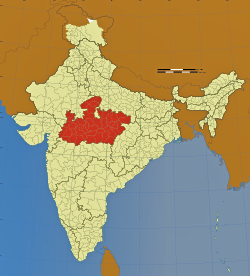
Madhya Pradesh, in the center of India, has been described as "one of the least developed states in India."
Rahul, who begins his university studies as an organic chemistry major, quickly changes to anthropology, and when he first catches sight of the beautiful Anjali Joshi, changes again to Hindi, her major, which, for most other students, would be regarded as the “kiss of death.” “No one really knew for sure why [this] department existed at all…Those boys were ragged, misfits, backward, isolated from the real world, and their teachers made for the same caricature. One student would shamelessly scratch his crotch in public, while another shaved-head dhoti-clad type would ogle some girl like a chimpanzee.” All but Rahul and two others are Brahmins, and all the faculty are Brahmin. Even knowing this, Rahul still has no clues as to his future difficulties. He quickly learns, however, that goondas, some of them supported by government officials and their minions in the post office, know when students will be receiving money from home and then show up for their “cut.” These goondas “could break in at any moment and put a gun to your head. We are merely prey, living in a cruel, criminal, and degrading time. It’s an age of thugs, counterfeiters, smugglers, and real-estate developers. Nowadays, righteous and upstanding Indians suffer under this regime as if they were Kashmiris, Manipuris, or Naxalites.”
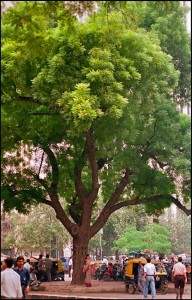
Students, including Rahul and Anjali, often meet under the neem tree.
Banding together against the “goondas,” the students form the SMTF, the Special Militant Task Force, and prepare to strike back. Their computer skills allow them access to information which shows how widespread the corruption is and how many in the university administration are part of the conspiracy. As one of Rahul’s friends points out, “There’s a part of our society afflicted by a superiority complex. The Great Indian Puritanical Sectarian Casteist Hedonist Homogeneous Middle Class. In that same family you’ll find a white, a black, a light brown, a dark brown, a flat nose, a big lips, a long and thin nose, a round eyes, a fine brow, a yellow face. Ha! Everything’s mixed in there.” Bottom line, trust no one.
The suicide of one student causes Rahul to wonder “if it’s true that all former frames of reference are now immaterial, and if it’s true we’ve reached the end of history….[Is this] a new world, a new world order where the entire terrain of the past is irrelevant?” As Rahul contemplates the future, he also ruminates on the past: “The Parliament of India has been filled with killers, smugglers, lackeys of foreign companies, profiteers, black marketers – all dishonest…The prime minister was going to jail. Embezzlement, corruption, and thuggery cases were pending against multiple state chief ministers. The judge was on the take. Police were in cahoots with criminals, and each day of the turn of the century was smeared with the blood of innocent, honest, justice-seeking Indians.”
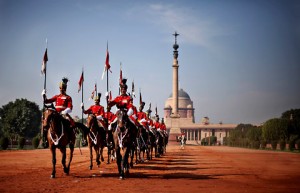
The President's House in New Delhi, built by British architect Edward Lutyens, is regarded by many as a symbol of the British occupation, and, as indicated in this novel, many want this building replaced.
Eventually, Rahul and Anjali themselves reach the crisis point and must make their own decisions regarding the future, keeping in mind all the traditional family objections, the problems associated with their limited opportunities and their lack of achievements, and how all those issues affect any chance they may have for future success.
An unusual novel in which plot is subordinated to message without overwhelming the reader with moralizing, The Girl with the Golden Parasol recreates life in rural India during the beginning of the twenty-first century. Long-time traditional values are distorted by dishonesty and petty actions by police and officials who feel threatened on the local level, creating a new immorality which makes life impossible for those non-Brahmin citizens living on the “outside.” Translator Jason Grunebaum, who has geared his translation for an American audience, also recognizes its importance for other English speakers, including some in India, and his translation is lively and informative without becoming ponderous, with a message that rings clear.
*The quotation about Madhya Pradesh as “one of the least developed states in India” appears on Wikipedia.
Photos, in order: The author’s photo appears on http://commons.wikimedia.org
The map of Madhya Pradesh is from http://en.wikipedia.org
The iconic neem tree may be found here: http://getmuchinfo.blogspot.com
The President’s House and the arguments surrounding it may be found on http://india.blogs.nytimes.com
ARC: Yale U. Press
 Although Irish author Colum McCann has written six previous books and a collection of stories, winning many literary prizes including both the National Book Award and the IMPAC Dublin Prize for his most recent novel,



 Baron Luigi Alfredo Ricciardi di Malomonte, Commissario of Public Safety at the Royal Police Headquarters in Naples, is a lonely man. Growing up as the orphaned child of a wealthy family, he has been living with his Tata Rosa ever since. Now in her seventies, she is “a bossy, indelicate, nitpicking ballbuster, a lousy cook with a rotten personality. But she’s all the family I have,” he comments. With a natural shyness that is close to terror when it comes to women, the thirty-year-old Ricciardi’s only real “friend” is his deputy, Brigadier Raffaele Maione, in whom he confides nothing about his private life. With his life secure because of his wealth, Ricciardi does not fear losing his job, and he often goes his own way in investigations if he feels justice will be better served. He has little fear of his department’s higher-ups, most of whom walk a fine line to avoid embarrassing government officials who, in 1931, are closely associated with Mussolini and his Fascists.


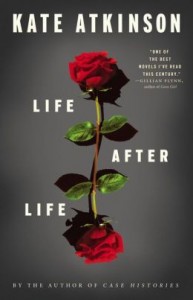 Wildly imaginative, and filled with scenes so vivid that the reader cannot help but participate in the story as it unwinds, Life After Life engages the reader from the outset with the novel’s seemingly contradictory premises: first, that everything is real and nothing is real; and second, that everything changes and nothing changes. Irony rules. As the book’s title confirms, this is a novel in which there is a life after life: A character’s fate is revealed in the novel in one place but is then revisited and rewritten in new scenes later in the novel, creating a new fate or fates. The characters change as they move forward obliquely, learning from each set of new, changed circumstances as reality merges with fantasy to create a new reality in a new dimension. To bring these themes to life (and give them new vitality), the author creates a unique structure. The dates of the various chapters jump around between 1910 and 1967, and more strikingly, one chapter, “Snow,” appears eleven times with the same date – February 11, 1910 – throughout the book. Each “Snow” chapter contains the same basic situation, the birth of a baby, involving the same characters, yet the described events have different, sometimes contradictory, outcomes. Five chapters named “Armistice” all occur on Nov. 11, 1918, the end of World War I, and like the “Snow” chapters, present the same characters but, once again, provide new and different angles to the story and its outcomes.
 People, including Ursula, sometimes die again and again, only to have their stories revised to save them, a technique which allows Atkinson to show simultaneously the sudden shifts of fate that can mean life or death (one of her main themes) and also to develop the effects on characters (and readers) which these opposing outcomes have, a unique way to broaden the scope of the novel while retaining the same characters.
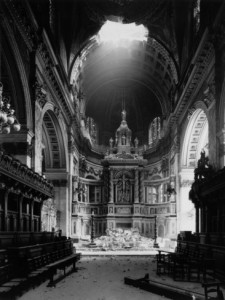
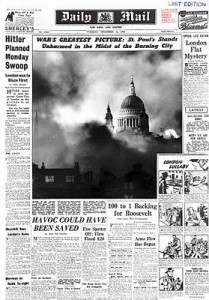 rall understanding of these larger disasters. The reader empathizes with the repeating characters, celebrates their lives, rejoices when, against odds, they cheat death in a retold tale, and understands the kaleidoscope of events and emotions which big events and big wars create.
 ALSO by Kate Atkinson:
  Helen, a young croupier on the night shift at a London casino, is traveling home during the wee hours in a taxi shared with two co-workers. When they stop at a traffic light, two men, obviously homeless and perhaps drunk, arrogantly step out from the curb just as the the light is about to change and walk slowly, at their own pace, across the street, seeming to dare the stopped cars to move when the light turns green. Wild-looking, scraggy, and rather frightening, one man makes Helen pay attention, though she hunches down in the back of the taxi to avoid being seen. “Brian, it was Brian,” she thinks in astonishment, “her [older] brother Brian,” whom she has not seen for twelve years. Stunned, she silently begins to make excuses for “Brian’s” behavior at the street crossing, applying her memories of Brian’s mild personality to the behavior of the younger of the two strange men on the street. She ignores taxi driver Danny’s boastful, profanity-laden announcement that he would have “taken them on” with a weapon he has hidden beside his seat if anyone had messed with him.