“There were twenty of us in my barracks…twenty boys. And only two came back. One who went mad, and myself. But that doesn’t mean we survived [the war]. I don’t think I did survive it. I may not be buried in a French field but I linger there. My spirit does, anyway…There’s a difference between breathing and being alive.”—Tristan Sadler
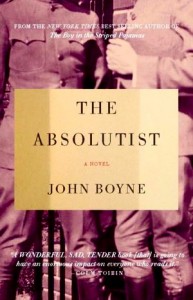 Although a major part of The Absolutist centers on the horrors of World War I, Irish author John Boyne has created a novel which goes beyond the typical “war story” and becomes also a study of character and values. This broader scope allows the novel to appeal to a wider audience interested in seeing the effects of war on the main character, Tristan Sadler, throughout the rest of his life. More a popular novel than a “literary” novel in its appeal to the reader, Boyne has carefully constructed the plot with alternating time settings – before, during, and after the war – to take full advantage of the elements of surprise. The author often hints at personal catastrophes or dramatic events in one part of the novel, creating a sense of suspense and foreboding, then reveals these secret events in grand fashion in another part, keeping the pace so lively that it is difficult for the reader to find a place to stop.

The novel begins with Tristan Sadler, now twenty, arriving in Norwich, England, on an undescribed personal mission. The war has been over for nine months, but Tristan still has many issues to resolve, among them nervousness and stress-related trembling, particularly of his right hand and index finger. Though he “hasn’t been well” for the past three years, he leaves London for this meeting in Norwich, only to find upon his late arrival that his room in a lodging house is not ready. To pass the time until the room is cleaned, Tristan walks around the town, reminiscing about his past, and in so doing, sets up some of the themes and symbols that pervade the novel.

Norwich Castle
He circles Norwich Castle, but does not go inside: “Castles such as this, after all, were nothing more than the remains of military bases where soldiers might camp out and wait for the enemy to appear. I did not need to see any more of that.” Though he is an agnostic, he goes inside Norwich Cathedral, “not so much for [the] religious aspect – but for the peace and tranquility it offered within.” Most importantly, on leaving the cathedral, he sees the bust and the grave of Edith Cavell, “our great nurse patriot, who had helped hundreds of British prisoners of war escape from Belgium,” only to be captured in 1915, tried by the Germans, executed by firing squad, and ultimately declared a heroine and a martyr. Tristan feels “a great sense of joy at discovering her grave.”

A butcher shop, similar to the one belonging to Tristan’s father, complete with sawdust on the floor, is a symbol paralleliing the carnage of war.
Flashing back three years, the author then presents Tristan as a seventeen-year-old who has been thrown out of home and family. Having refused to join his father in the family butchery, he lies about his age and volunteers for war. With no one who cares whether he is alive or dead, he trains as a soldier at Aldershot under Sgt. James Clayton, a sadistic leader, totally committed to the war and to the killing. After ten weeks’ training, his group of twenty men is transported to France. Among his few friends in the trenches is Will Bancroft, the son of Rev. Bancroft, vicar of the cathedral in Norwich.

Norwich Cathedral
When Will dies in France, something we know from the opening pages, Tristan writes to Will’s sister Marion, arranging to go to Norfolk to return all the letters she wrote to Will while he was overseas. Once he has arrived, however, Tristan is unsure whether he has done the right thing. Marion is tense and quarrelsome, and wants him to talk with her parents. Tristan, nervous to start with, is terrified. “Why did I come here?,” he asks himself. “What was I thinking? If it was redemption I sought, there was none to be found. If it was understanding, there was no one who could offer it. If it was forgiveness, I deserved none.” More mysteries are suggested at the meeting with the parents.
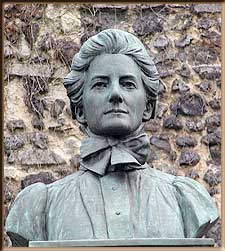
Bust of Edith Cavell
As the action of the novel moves back and forth between Tristan’s actions in Norfolk in June, 1919, and in France between July and September, 1916, the author creates suspense by having the characters in 1919 refer to events from 1916 which the author has not yet introduced, leaving the reader to wonder what new mysteries underlie Tristan’s visit. Some of these mysteries also revolve upon Tristan’s memories of his own childhood, some of which connect with what happens in France. Two characters in his group in France prove to be conscientious objectors, one of them still waiting for his approval from the army. These characters, who discuss their beliefs with Tristan, are sometimes assigned to be as stretcher-bearers, one of the most dangerous jobs of all, since they are exposed to German bullets the minute they leave the trenches. Many of them die, but they have dared to challenge the “moral absolute” of war and do not fire their guns, preferring the moral absolute of peace. Tristan challenges nothing, hoping only to survive so he can return to real life.
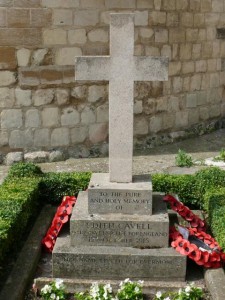
Grave, Edith Cavell, Norwich Cathedral
Though author Boyne provides plot twists galore, the pattern of the plot structure itself becomes a bit predictable after awhile, with constant unexplained references leading to mysteries which are then reconciled to reveal important information. At times, the reader may feel manipulated, his/her feelings held captive by the author until the time arrives to reveal another surprise. Any big questions about character arise from information withheld, rather than, more subtly, from contradictory information which the reader acquires from observing a character’s long-term behavior and then reconciles for him/herself based on the characters’ continuing actions. In fact, the first “surprise” of the novel is one that most readers will guess almost immediately. Tristan’s appearance in the conclusion as an eighty-year-old man, brings his life (and the author’s themes) up to date, as he reviews his decisions and behavior, but it also feels contrived.
The novel propels itself with exciting scenes while also presenting thoughtful contrasts between “absolutists” totally dedicated to a point of view which will allow for no compromise, and those who see compromise as essential to survival. The many thematic symbols (Tristan refusing to work in the family butcher shop but enlisting in the army, Edith Cavell vs. Tristan in ideology, and a conscientious objector vs. Sgt. Clayton) provide reminders of the dangers and difficulties that can arise whenever these issues become questions of morality or theology. Though the novel is very serious, with no humor to leaven it, The Absolutist is riveting, and a fast read.
ALSO by John Boyne: THIS HOUSE IS HAUNTED, A LADDER TO THE SKY
Photos, in order: The author’s photo by Murdo Macleod is from http://www.guardian.co.uk
Norwich Castle appears here: http://www.yourvillage.flyer.co.uk
A butcher shop, similar to the one belonging to Tristan’s father, complete with sawdust on the floor, is from http://kindredfootprints.blogspot.com, a symbol which parallels the carnage of war.
Norwich Cathedral is from http://www.art-history-images.com
The bust of Edith Cavell, an absolutist who saved hundreds of soldiers in Belgium and was martyred for her work and beliefs, is on a monument at Norwich Cathedral: http://www.oldcity.org.uk More information about Edith Cavell appears on this site.
The grave of Edith Cavell at Norwich Cathedral: http://gallery.nen.gov.uk
ARC: Other Press
 The child of Ashkenazi Jews who escaped to Jerusalem just before the outbreak of World War II, Amos Klausner (the author’s original name) grew up in a scholarly family which encouraged his precocity. His great uncle Joseph was Chair of Jewish History at Hebrew University of Jerusalem and wrote his magnum opus about Jesus of Nazareth. His father read sixteen or seventeen languages, wrote poetry, and had an enormous library, while his mother spoke four or five languages, could read seven or eight, and told elaborate stories.
 As the book moves back and forth in time, the author comments about his writing, the people who influenced him, and his “pickpocketing,” his “stealing” of the lives of real people in order to invent stories about them. His observations about Israel, its leaders, its never-ending wars with the Arabs, and his experience as a resident of a kibbutz for more than thirty years broaden the scope and provide insight into one man’s life in this developing country. Obviously a huge achievement for Oz personally, this is also a huge contribution to the understanding of the growth of a Jewish homeland and to an understanding of how Oz became the writer he is. Much more detailed and leisurely than Oz’s novels, this is slow but satisfying reading for those who admire his novels.
 The author’s photo by Colin McPherson/Corbis appears on
  Using documents and photographs that have never before been available, along with private diaries and interviews with some of those who knew Idina Sackville, author Frances Osborne creates a lively, readable, and well researched biography which attempts to understand what aspects of Idina Sackville’s early family life might have helped create a person so flamboyant, sexually adventurous, and hedonistic that she became world famous, just for being who she was. The author has special reason to ponder this subject. When she was thirteen, The Sunday Times (London) began a serialization of James Fox’s White Mischief, a detailed account of Happy Valley and the British aristocrats who had participated in the “mischief” in Kenya. The author and her twelve-year-old sister Kate devoured each installment as it came out. “Was this the secret to being irresistible to men,” she wondered, “to behave as this woman did, while ‘walking barefoot at every available opportunity’ as well as being ‘intelligent, well-read, enlivening company’?” One afternoon, with a twinkle in his eye, her father told his embarrassed wife Davina that it was time for her to come clean. Davina had to admit to her daughters that she was the granddaughter of Idina Sackville, and they themselves were Idina’s great-granddaughters.


 The remains of the house “Clouds,” which Idina built during her fourth marriage (to Donald Haldeman), now belongs to a multi-generational Kikuyu family with different family groups living separately in the various wings.
  Martin Scobie, David Hughes, and Fred Privett, all age eighty-five, have just been admitted to the nursing home of St. Christopher and St. Jude following the bizarre crash of their three ambulances at the intersection in front of the facility. Admitted for their recuperation, they must share a small single room in which the light switch can only be reached by leaning across one of the beds. Some furniture has been removed to accommodate the extra beds, and the wardrobe, blocking a window, is inaccessible because of the third bed. Even if they had a view through that window, however, their accommodations would not be much improved. “Immediately outside the window was a mass of dusty green foliage of the kind which grows outside kitchens and hotel toilets…The leaves, moving in endless trembling toward and away from one another, gave an impression of trying to speak or to listen but always turning away before any tiny message could either be given or heard,” a detail emblematic of all life at this nursing home, which “specializes” in non-communication, not just between staff and patients, but between staff and each other, and among the patients themselves.
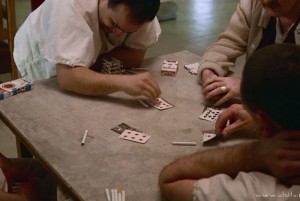
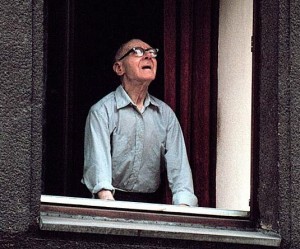 Unfortunately, it appears that the deck is stacked against all of these people and the other residents of the home. Some critics have even suggested that this novel is reminiscent of One Flew Over the Cuckoo’s Nest. Though several of the old-timers do get up in the middle of the night to play raucous, cut-throat card games in Room 3, just down the hall from Mr. Scobie and the others in Room 1, the games are not fraught with the kind of horror one sees in Cuckoo’s Nest. Lt. Col. Price, the brother of Matron Hyacinth Price, always loses “big” at those card games, but there seem to be few penalties for losing. The home and the staff, however insensitive they may be, are far from being psychopaths like Nurse Ratched. Though the Matron herself does demand total allegiance, and is unsympathetic and clearly determined to get each of the patients to put all his/her money into the home’s accounts (to make life “easier” for them), she is neither as intelligent nor as evil as Nurse Ratched.
 good times, but as their memories come flooding back and become all-important to them, the patients, unfortunately, have no one to share these with. Each lives in his own world, and the nursing home itself increases the sense of impersonality and dehumanization by not allowing anyone to use first names in address or conversation. Mr. Scobie does not even enjoy his music anymore, and as he remembers the images which used to be inspired by the music, he also remembers that in his younger, healthier days, he had thought that he “would preserve images of rapture somewhere inside him for those times ahead when he would need to be comforted.” But now, here at St. Christopher and St. Jude, where he needs to be comforted, “there’s no dignity…the only memories existing for him were the sad and painful. He could not recall anything from those treasures he once thought he was putting away safely for later.”
 suggestions remain suggestions, however, with alternative explanations for behavior still possible, and as some characters pass away, the transience of life, and even more importantly, the transience of their memories raise inescapable questions for the reader regarding his/her own life. Jolley is a world class author, capable of creating serious questions and developing the biggest of the world’s themes within small settings and scenes, and I can hardly wait to read the next book being released, MISS PEABODY’S INHERITANCE. Persea Books has announced its intention to release in the US all of Elizabeth Jolley’s works, and I will be first in line! She is a new Favorite!
 Those who have loved author Elizabeth Taylor’s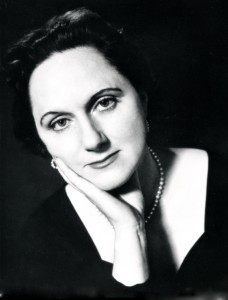

 Such an egocentric focus can be somewhat wearing on the reader, since it allows for very little character development. Though we come to know Angel extremely well, she remains one-sided and shallow, unconcerned with the everyday niceties that make social life successful – a not even slightly likable character who does not change significantly and whose success one cares about primarily because it moves the plot. Even through two world wars, Angel’s focus is on Angel and not on the outside world. “I would not lift a finger to help the war in any way,” she announces, declaring her pacifism as an excuse. As her fortunes change over more than forty years, Angel remains resolute, and it is in her resolve that she becomes more than just a satiric main character and becomes almost admirable. Similar in style and focus to authors