“There was something about [Quirke] that [Sylvia] felt she could trust. It was not that he seemed particularly warm or sympathetic. Quite the opposite, in fact. She felt he was the kind of man she could speak to precisely because of a certain coolness, a certain stoniness, she detected in him….indifference.”
 Fans of the previous four novels in the Quirke series by “Benjamin Black,” the pen name of Booker Prize-winning author John Banville, will celebrate the publication of this sixth novel of the Dublin-based series, set in the 1950s. Continuing all the main characters from previous novels, Black spends little time rehashing the sometimes sordid history of their relationships. Instead, he picks up where he left off with A Death in Summer, with few references to the characters’ backgrounds from previous novels.
Quirke, a Dublin physician at the Hospital of the Holy Family, is still running the pathology lab, and he has finally resolved an old wound by reuniting with his wary daughter Phoebe Griffin. Brought up as the child of Quirke’s stepbrother Malachy and never informed until recently as to her real  parentage, Phoebe is somewhat leery of Quirke, not really knowing how to treat him or what he expects. Quirke, a long-time friend of Police Detective Inspector Hackett, is still available for private consultations with him, especially when the real reasons for a death may be in dispute, and he has no objections to accompanying Hackett on investigations or calls to bereaved families when they involve conversations with Dublin’ elite. Quirke is well known and has been part of that social group, whereas Hackett is more comfortable with his buddies at the pub.
Both Hackett and Quirke become involved with an investigation at the beginning of this novel when Victor Delahaye, the main partner in Delahaye and Clancy, an old company with a flourishing automobile repair business, invites the young son of his partner Jack Clancy to accompany him on a sail. Young Davy Clancy hates sailing, and has no idea why Jack, whom he does not know well, makes such an issue of having him as the only passenger. This trip does not make Davy like sailing any better. When he and Delahaye are far from land, Delahaye pulls out a gun and kills himself. Davy, terrified by the death, the blood, and the horror of having witnessed such a ghastly scene, inexplicably throws the gun overboard, then has to wait with the exsanguinating body until he is rescued by a passing boat. Quirke, upon examining the body, confirms that the bullet had to have been self-inflicted, and he accompanies Inspector Hackett when he interviews the not-so-bereaved family.

The bay from the side of Slievemore, the place where Victor Delahaye and Davy Clancy went for a sail.
The remainder of the novel involves the search to discover why Victor Delahaye committed suicide, but a major complication arises (as it always does), when yet another death occurs at sea, this one far more complicated.
Black’s style has always been to keep things simple throughout and to write clear, concise prose, and no reader will have trouble keeping track of the characters, their motivations, and how their actions evolve from within. At his most incisive, Black has always placed those characters firmly within the 1950s milieu of Dublin society, allowing the action to turn on personalities and their predicaments. Here he develops insights into the Delahaye family, which includes Mona, Victor’s much younger, acquisitive wife; Victor’s handsome and amoral identical twins, Jonas and James, and Victor’s unmarried sister Marguerite (Maggie), conveying their values or lack of them. The Clancy family, smaller, consists of Jack’s benighted wife Sylvia and their timid son Davy, who seems unable to perform an assertive act. All the men in both families have lovers, adding to the turmoil, and the Delahaye twins are also friends with David Sinclair, Quirke’s assistant, who happens to be Quirke’s daughter Phoebe’s lover.

Mainie Jellett (1897 – 1944) was the first Irish artist to paint in the abstract style. One of her paintings adorned the Delahaye living room.
While these characters are being introduced, Quirke himself is also dealing with issues. His long-time problems with alcohol continue, though he seems to be gaining better control over them, and his love life is a constantly changing melodrama. He is anxious to restart a previously failed relationship with a woman he now believes he loves.
Those new to the series may become completely absorbed in the mystery and its revelations about characters, but those who have read the entire series so far (and I’ve read them all) may wonder, sadly, if the series has played itself out. The new characters are static and verge on stereotypes, and Quirke fails to grow or develop in new ways. The expected twists in the story do come with the kind of suddenness one expects of such mysteries, but they are simple twists, uncomplicated, and many readers may figure out some of the “surprises” – and the ending – before they occur. Vengeance can often be complex, and it is certainly a major motivating factor here, but the sometimes elegant simplicity which Black has made a trademark in the earlier novels, becomes merely simplistic here.
Also reviewed here: A DEATH IN SUMMER, THE BLACK-EYED BLONDE, CHRISTINE FALLS, THE SILVER SWAN, EVEN THE DEAD (Quirke)
Photos, in order: The author’s photo appears on http://www.benjaminblackbooks.com/aboutauthor.htm
A view of the bay from the side of Slievemore, where Delahaye was Commodore of the Yacht Club and where he took Davy Clancy on his sailboat: http://www.docbrown.info
Mainie Jellett (1897 – 1944) was Ireland’s first abstract artist. According to http://www.askaboutireland.ie, which was also the source of this photo, “Her work was influenced by French Cubism and she spent some time in Paris , with fellow abstract painter Evie Hone, learning from French artists Andre Lhote and Albert Gleizes.”
ARC: H. Holt
 With this candid Prologue, author Edmund De Waal attempts to dispel any misgivings a reader might have about reading this book, which is the story of five generations of an impossibly wealthy family, their collection of art, their enormous houses, and especially their collection of over two hundred, antique Japanese netsuke, tiny sculptures which were originally used as fasteners for the purses that Japanese men wore around their waists. The book could easily have become the “sepia saga” the author has disdained in the Prologue. He offers even more caveats, too, emphasizing that this is not going to be a melancholy book, though the family lost virtually everything during World War II. “Melancholy,” he says, “is a sort of default vagueness, a get-out clause, a smothering lack of focus,” and he wants to convey, in discussing the collection of netsuke which he has inherited, that they are not only real and tactile, they are “small, tough explosion[s] of exactitude. [They] deserve this sort of exactitude in return.”
 His decision to write this “exacting” book comes when he realizes “that I can either anecdotalise [the netsuke story] for the rest of my life…or go and find out what it means.” He has heard himself at dinner “entertaining” guests with the story, and he is embarrassed by his own behavior: “[The story] isn’t just getting smoother, it is getting thinner,” he observes. “I must sort it out now or it will disappear.” Giving up his work as a highly recognized, world-class potter for several months (which eventually grows to be almost two years of intermittent research), he determines to discover his family history and the history of his netsuke.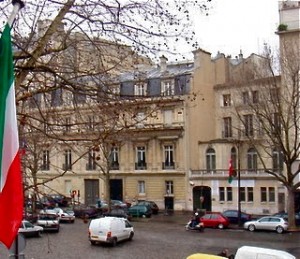
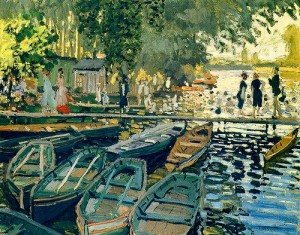
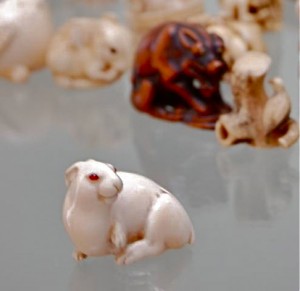 business, he writes art commentary for the Gazette, which he eventually buys. The author does not hide the fact that Charles, as a character, does not much appeal to him at this stage – he thinks him “ridiculously affluent, very self-directed, and much, much too rich for his own good,” a feeling the reader shares. Charles is, however, active among artists and writers, including poet Jules Lafourgue; Proust, for whom he was a model for Swann; Renoir, who presents him in black coat and hat in the background of the “Luncheon of the Boating Party”; Monet who may also have used him in the same costume in the center of “Les Bains de la Grenouillere”; Degas, from whom he bought several paintings; and Manet, from whom he bought a painting of a bundle of asparagus. Eventually, he acquires forty major impressionist paintings displayed three deep on the walls of the newly built house. Always in the forefront, he is one of the first to absorb a new spirit sweeping the art world with the opening of Meiji Japan – “japonisme,” with its “air of eroticized possibility.” Eventually, he acquires thirty-three black lacquer boxes, an assortment of Japanese erotica kept in vitrines, and an incredible, two hundred sixty-four hand carved netsuke, which were already antiques when he bought them. These netsuke, the author emphasizes, “were the first things that have any connection to every day life.”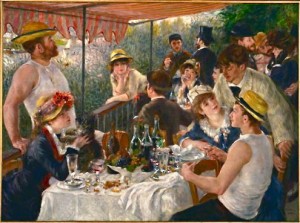
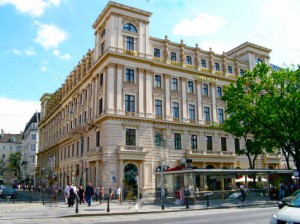
 Daniel Silva, who was a journalist for years before he became a novelist, has always taken care to create plots that relate directly to political and historical realities. The involvement of the papacy in the Holocaust and their efforts to hide it, the indoctrination and training of an American terrorist in Yemen, the actions of a Russian oligarch and lethal arms dealer, and the attempts of a former obersturmfuhrer, now living in Vienna, to wipe out all traces of the Holocaust have all been subjects of his thrillers. This novel, however, comes closest to dealing with immediate issues of world politics, illustrating clearly and unambiguously some of Israel’s most pressing difficulties with its Arab neighbors and confirming our worst fears for the future of the Middle East. In doing so, Silva goes way beyond the facts that we all understand from the media, elucidating the complexities and the commitments of both the Arabs and the Jews to preserving “their own” land and especially Jerusalem.
 sputin” and “the true power behind the papal throne,” brings Allon to the site of the death. Claudia Andreatti appears to have committed suicide by jumping from the walkway around the base of the dome, the highest dome in the world. Both men conclude that this death was probably murder, something they intend to keep quiet. Claudia had been investigating the provenance of the Egyptian and Etruscan artifacts stored at the Vatican, and she may have uncovered evidence of a major plot to bring stolen antiquities from Lebanon, Syria, and Egypt into Rome, with the money from their sales being laundered through Vatican accounts to benefit unknown outside sources.
 nt in which a Palestinian state would be created in the Gaza strip. The Palestinians would also gain ninety-six percent of the West Bank. “The Temple Mount plateau, sacred to the three Abrahamic faiths, would [be] included in the Palestinian state, while the Western Wall and the Jewish Quarter of the Old City would remain under Israeli control.” Ehud Barak accepted the terms, but, in a surprising turn of events, Arafat did not. “President Clinton was remarkably candid about his feelings toward the man whose ‘colossal mistake’ had denied him a historic foreign policy achievement. ‘I am a failure,’ he told Arafat during a bitter telephone conversation. ‘And you have made me one.’ ”
 Alice Thomas Ellis (real name: Anna Haycraft) belonged to that brilliant group of twentieth century British women who entertained and enlightened the world with their writing in the 1970s and 1980s. This group, which also included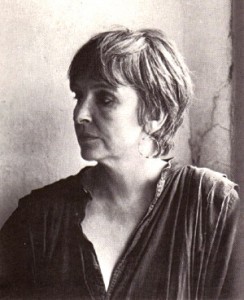
 on, and he steals liquor and makes lewd, sexual overtures to Rose and Ermyn. Other townspeople mock the family and even break windows.
 Revealing most of her information about character through their actions and unusually clever dialogue, Ellis presents a series of intimate dramatic scenes, usually between two characters whose conversations and reactions to each other’s comments show the author’s psychological insights – parents and children miscommunicate, married couples avoid issues, friends tell each other what they want to hear. Not a word is wasted in this very sly and beautifully detailed story filled with irony.
 Seventy-year-old Harry Chapman has just been admitted to a hospital for diagnosis and treatment of an illness from which he has been suffering alone at home. Confined to bed for the foreseeable future, Harry, a writer, cannot help sharing his thoughts and “suppositions” with the reader and sometimes the hospital staff, recreating conversations and bringing family members, friends, and literary characters to life. But Harry does not stop there. Books, poems, plays, and paintings are also a vivid part of his on-going reality, and some of Harry’s favorite literary characters and his most admired fellow writers cross the borders of reality and fiction to work their way into his memories of real people and real events. His attention constantly jumps around, but it is through these seemingly random memories, stories, favorite poems, and observations about life that author Paul Bailey succeeds in bringing Harry to life and creating a “real” person for the reader.
 arry’s recollections, however, are gloomy memories of his dour and hurtful mother Alice, “the perpetual dampener of every prideful feeling, her bottomless bucket of ice-cold water perpetually at hand.” Though he also remembers his father’s last day alive, during which his father sees the ghosts of his mates in the trenches of war, it is his mother whose constant presence so upsets him. “It was because he was here – trapped, and dependent upon nurses and doctors – that his restless mind was taken up with old slights, old scores, old barriers to his once longed-for liberty,” he explains to the reader. And as he asks Dr. Pereira to cure him, he is surprised to be answered by Pip, whom he asks whether he ever married Estella in Great Expectations. He recalls visiting the cemetery in Calcutta where one of Dickens’s sons was buried; remembers Henry IV, Part I, in which he once acted; calls up Jack Hawkins to act as his own lookout, instead of Long John Silver’s; and remembers the friend who introduced him to Babar and Celeste, at whose elephant wedding he imagines Fred Astaire dancing with Celeste (whom Astaire compliments, saying that she has “a finer feel for the music, for the rhythm, than Ginger Rogers”).
 The play on words of the title, with the reminders of George Chapman’s ground-breaking translations of the Iliad (1598) and Odyssey (1616) and of romantic poet John Keats’s “On First Looking Into Chapman’s Homer” (1816), establish the fact that Harry Chapman’s stay in the hospital is his own odyssey, and though his memories do not seem to have one-to-one parallels with the voyage of Odysseus, they are as varied, traumatic, and even, sometimes, as captivating for him as those of Odysseus in his twenty years of wandering. Because Harry is bed-ridden for the entire duration of the novel and is not fully lucid during his stay, the reader must filter and process his reminiscences in order to understand and participate in his life.
 books of the past, like Treasure Island; to famous paintings; to actors and entertainers from fifty years ago; and in one case, to Wimbledon stars of the past. Harry’s need to be loved is almost palpable, and as the reader shares his memories and envisions him-/herself in circumstances similar to Harry’s, the novel takes on a poignancy which cuts through all the intellectual posing to Harry’s inner core. Ultimately, author Paul Bailey has created a novel in which Harry becomes an everyman on an odyssey, one in which he seeks answers to life’s most basic questions of what life means and whether the journey has been worthwhile.