Note: This novel was WINNER of the Pulitzer Prize for Fiction in 2010, in addition to being WINNER of the National Book Critics Circle Award, the LA Times Book Prize, and the Salon Book Award.
“A dog barking hoarsely. The lowing of trucks over bridges. The velvety night in his ears. And the hum, always that hum, which maybe wasn’t an echo after all, but the sound of time passing.
th blu nyt
th stRs u cant c
th hum tht nevr gOs awy”
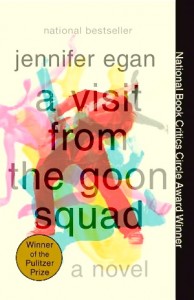 Despite the extraordinary literary recognition which this book has garnered, I had not really been very tempted to read it. A “genre-bending,” post-modern novel about the rock music business over the past thirty years seemed so far from my interests that I’d decided to leave it and its reviews to others who are fans of that music. Then I read the Guardian (UK)’s list of the favorite novels of British authors for 2011 and discovered this novel at or near the top of the list of no fewer than five major British authors, including John Lanchester, David Lodge, and Roddy Doyle. Doyle, never one to mince words, delivered the “closer” with his assessment: “Exhilarating, funny and … brilliant. Jennifer Egan’s novel… is so good, so original, so surprising and wonderful – it’s just absolutely fuckin’ brilliant.”
And the book is truly funny and original and brilliant. Lovers of experimental writing will find Jennifer Egan’s approach to story telling, including seventy-five pages of PowerPoint presentations about life in the 2020s, to be unique, and for that alone, the book would be captivating. Fortunately, she also manages to create several fascinating characters who echo and re-echo throughout the short-story-like chapters, even when the narrators change constantly.

The novel opens and closes with the focus on Sasha, the kleptomaniac assistant to Benny Salazar, a band player and rock music producer in New York, and Alex, her timid date. They and a wide variety of other characters reflect the values and goals of the music business, which like film and photography, are eventually considered to exist in an “aesthetic holocaust” as a result of the “digitization which has sucked the life out” of creativity. Time becomes a major theme here as characters move in and out of the action:
““Time’s a goon, right? You gonna let that goon push you around?”
“I’ve never heard that. ‘Time’s a goon?'”
“Would you disagree?”
“No.”
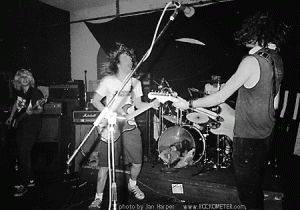
Short Dogs Grow, at Mabuhay Theatre. Photo by Ian Harper
As the chapters and the ensuing action introduce many more characters in many different locations, including the Mabuhay Gardens nightclub in San Francisco, where Dirk Dirksen, the real nightclub manager known as “the Pope of Punk,” calls Bennie regarding hiring the Flaming Dildoes, of which reclusive Scotty Hausmann is also a member and composer; Africa on safari, where Rolph and Charlene are accompanying their father, music producer Lou, who is now running safaris; Naples, to which Sasha has run away at age seventeen, and where her academic uncle Ted Hollander searches for her two years later; and finally the desert in the southwest in 202_, where the children of some of these characters are talking about their parents’ growing-up years and their music. Seventy-five pages of PowerPoint presentations, appropriate for the period and taking place in the future, add contemporary identification with the stories of these characters. The more time passes, the more obvious it becomes that regardless of the times and the ways in which young people rebel, that rebellion is a fact of life.
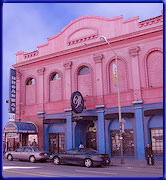
Mabuhay Gardens, San Francisco
The “novel,” often akin to a collection of short stories, is original and intriguing, its focus on the specific and unique, sometimes at the expense of the universal, but Jennifer Egan holds it all together and keeps her reader engaged with a series of characters who are different from the norm and committed to goals we can all understand. Ultimately, the “goon” of time and the characters’ desire to be creative within it coalesce, and “th stRs u cant c” continue to inspire succeeding generations.
The scenes and action, presented as a collage, bring the characters and their children to the future. By 202_, employees of business are “handset employees,” people who are “paperless, deskless, commuteless, and theoretically omnipresent,” due to the internet. Creating audiences for concerts becomes a question of creating “blind teams” of “parrots,” people who will spout what they are paid to spout in order to generate attention for an event, a process regarded with “ethical ambivalence.”
 The most difficult aspect of this book is the constant change of point of view and change of time as the chapters unfold. It is sometimes difficult to figure out who is speaking, where the action is taking place, and whether the character who is the speaker at any time is one whom the reader has seen before. The interrelationships among them can become complex, but as a rule, they help to bridge the action between what has happened in the past and what is happening at the time of the new chapter. If anything, there are too many characters of too little importance, thematically, but as the conclusion connects all the past to the future, ten years from now, the author makes her points vividly. The final scenes reinforce the author’s positions regarding the fate of the characters and the business to which they have devoted their lives. The passage of time comes into play once again, giving new insights into what happened in the past as seen from the “present” and the future at a concert starring a reclusive star from the past. Unique and intriguing.
Photos, in order: The author’s photo is from http://www.theatlanticwire.com
A performance of Short Dogs Grow at Mabuhay Gardens may be seen here: http://www.rockometer.com
Mabuhay Gardens in San Francisco is shown on http://www.rockandrollroadmap.com
This large collection of solar collectors suggests what Allison and Drew saw on the walk they took into the desert in the southwest in 202_. What used to be lawn is now desert, and the solar collectors are necessary for power. http://www.thecuttingedgenews.com
 Always an astute observer and subtle writer about human nature, Anita Desai is at her best here, creating a group of three novellas, each of which reveals the interplay between a main character dealing with universal issues and a second character (sometimes more) who sees the world and its values quite differently. The result is a book that feels almost sacred, in the sense that it is morally serious and filled with thematically weighty stories. The themes in these stories, however, are often subtle – revealing unspoken lessons on many levels – neither moralistic, obvious, nor absolute. In all the novellas, the main character, approaching the end of a problem, might well conclude that what s/he wants, “[is] dead, a dead loss, a waste of time,” a statement actually made in the final novella, “The Artist of Disappearance.” For the involved reader, however, “the loss” is not the point. What the reader gains is a new appreciation of the small joys and great sorrows which fill the lives of plain people in rural India trying to find beauty and, perhaps, the fulfillment of dreams within
 an overwhelming reality. All the characters want to preserve something beautiful and important to them, but all must persevere against forces which consider their own goals to be more important than those of the people with whom they are dealing. Ultimately, each main character becomes an “artist of disappearance,” either physically, emotionally, or spiritually.
 The old man has been working for almost all of his life for the same family, but they are all either dead or missing now. The family’s only son, educated abroad, has traveled the world, collecting objects which he sends to his mother for her enjoyment. After her death, the objects continue to arrive, and the old servant and his assistant, create a house-museum for these “obsolescent” objects—stuffed animals and birds, miniature paintings from Persia and the Mughal Empire, and antique weapons of war, among other things. The final gift from the son is the one which the old man loves most, but it requires a great deal of maintenance, and he wants the government official to accept the other valuable museum objects as a gift to the country and allow him to preserve this one final gift, which has “provided him with the purpose of his life.” The servant and the official live in different worlds and have difficulties communicating.
 The results are predictable, and the effects on Prema Joshi’s modest life are significant.
 Ravi has been creating a hidden garden which represents the essence of beauty for him, as long as it remains private.
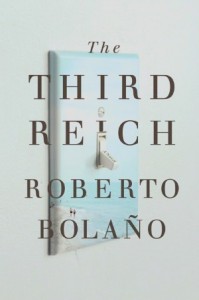 An early novel written in 1989 and found among the papers of Chilean novelist Roberto Bolano after his premature death in 2003, The Third Reich, is an odd but often mesmerizing story of obsession—specifically with the playing of a war game based on the actions taken by the German Reich during World War II. Udo Berger, the German national champion of this highly competitive and addictive game, is a young man, barely out of his teens, when he and his lover, the gorgeous but shallow Ingeborg, take a vacation to the Costa Brava, where Udo used to vacation as a child. They stay at the Hotel Del Mar, the small hotel where his family stayed, and where he has vivid memories of Frau Else, the hotel’s owner, a lovely woman about whom has had childhood fantasies and longings.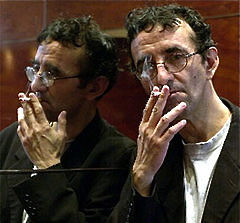
 While Udo is involved with all this, real life is taking place in the real world. One of the other characters disappears and is presumed dead, the women face possibly life-threatening crises and assaults, and suggestions of real, on-going evil pervade the action on all levels.
 Anyone who is already a fan of Jo Nesbo and his nail-biting Nordic noir mysteries will enjoy this non-stop, action-packed continuation of the Harry Hole series. Many of the familiar characters (and enemies) are back as Harry is persuaded to return from Hong Kong, where he has been spending his “hiatus” from the Oslo Crime Squad in an alcoholic haze. He is now in debt to the Hong Kong Triad, which as taken his passport to prevent his leaving without paying his debts. Three gruesome murders have taken place back in Oslo while he has been gone, however, and investigators are exploring the possibility of yet another serial killer on the loose. Harry Hole is the best in the business in tracking down serial killers, having just resolved the case of