“My husband and I are like two strangers who happen to meet coming out of a clinic where they have received treatment involving some physical unpleasantness. Both embarrassed, reading each other’s minds, conscious of an uneasy, embarrassing intimacy, wearily groping for the right tone in which to address each other.”
 Hannah Gonen is only thirty when she makes this observation about her husband Michael. A young woman living in Jerusalem in the late 1950s, she has been married for ten years to a man she pursued and married when she was in her first year at the university and he was a graduate student. Michael, who describes himself to Hannah as “good…a bit lethargic, but hard-working, responsible, clean, and very honest,” eventually earns his PhD. degree in geology and begins work at the university, but Hannah, who has given up her literature studies upon her marriage, soon finds married life—and Michael himself—to be tedious. Her only child resembles Michael in personality, a child rooted in reality, who “finds objects much more interesting than people or words.”
Writing in short, factual sentences, which come alive through his choice of details, author Amos Oz, often mentioned as a Nobel Prize candidate, recreates Hannah’s story of her marriage, a marriage which may or may not survive. Hannah and Michael married in 1949, shortly after Israel gained its independence, and the author often uses Hannah’s battles for independence and control of her life to reflect the growing pains of a new land, determined  to defend itself and protect its integrity. As their family backgrounds unfold, the personalities of Hannah and Michael and their behavior within the marriage are seen in a wider context. Hannah, who yearns for excitement, draws on her rich store of childhood memories and often escapes into a dream world. Michael, hard-working and pragmatic, remains a geologist, firmly connected to the earth.
After their child is born, a year after the marriage, it is Michael who usually takes care of him and washes his diapers. Hannah, mired in depression, says she is “contracted, withdrawn into myself as though I had lost a tiny jewel on the sea bed.” Gradually, she becomes more and more unstable, more and more depressed and hysterical, until she makes herself ill, a condition which she sees, ironically, as offering her some freedom. “I had lost my powers of alchemy, the ability to make my dreams carry me over the dividing line between sleeping and waking,” she explains. Despite Hannah’s self-pity and hysteria, Michael, the logical, reliable, unexciting husband retains his composure, so much so that Hannah wonders, “When will this man lose his self-control? Oh, to see him just once in a panic. Shouting for joy. Running wild.”
 As the marriage and Hannah’s sanity appear to deteriorate, the author’s use of symbols gives depth and universality to the story. Hannah often imagines a glass dome over herself and her family, and wishes only that it remain transparent, not cloudy. She remembers the childhood games she played with Arab twins in her neighborhood, bossing them around, and she now fears they will wreak their vengeance on her. She imagines warships and a search for Moby Dick on the Nautilus. Even the changing seasons parallel Hannah’s state of mind, with much of her story taking place in the autumn.
Rich with imagery and dense with symbols, this novel, first published in 1968 and recently republished in paperback, depicts two characters who deal in different ways with crises in their lives and marriage. Though the novel is set in Jerusalem about fifty years ago, the issues with which these characters are dealing are as pertinent today as they were then, and the emotional implications are as affecting . Psychologically true, the novel achieves rare universality, even though the reader may not empathize completely with Hannah, who is so often self-indulgent, or Michael, who, though reliable and honest, has so little imagi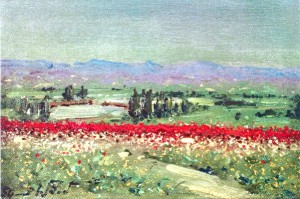 nation. Beautifully realized, My Michael, which shows Hannah’s possessiveness and need for control even in the title, depicts an immature woman who does not know who she herself is when she joins her life to that of someone else. Whether she and Michael learn to move beyond themselves is for the reader to decide.
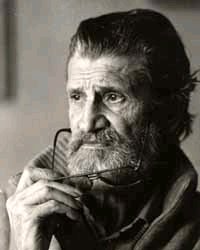
Photos, in order: The author’s photo by Natalia O’Hara, appears on http://www.praguepost.com
The photo of Jerusalem at sunset is from http://grahamsdownunderthoughts.blogspot.com
The painting of “Kibbutz Kfar Ruppin, 1950” is by Ludwig Blum (1891 – 1974), known as the “Painter of Jerusalem.” It is part of an exhibition held at the Museum of Biblical Art in New York from October 28, 2011 – January 15, 2012. http://mobia.org
ALSO by Amos Oz: A PANTHER IN THE BASEMENT (on my list of All-Time Favorites), SOUMCHI, THE RHYMING LIFE AND DEATH, A TALE OF LOVE AND DARKNESS and SCENES FROM VILLAGE LIFE, JUDAS
 Born among poor fisherfolk in Gillingham in Kent in 1564, William Adams’s family moves to Limehouse, a Thameside district of wharves and shipyards, when he is twelve, so it is not surprising that he himself eventually seeks his own future on the sea, despite its hardships and the less than encouraging survival rate for crews that sign on for long trips. Reports touting the riches of China, Africa, India, the Spice Islands, South America, and other exotic and far-off lands have been arriving in England regularly, inspiring trading companies and adventurers to seek their fortunes by mapping new sea routes to new countries, and, in the process, establishing new trading posts, acquiring new markets for their goods, and bringing new goods and wealth back to England. England’s enemies, the Spanish and Portuguese, are also seeking routes to the same lands and markets, however, compounding the dangers of the sea, for which there is only limited knowledge of navigation, with the dangers spawned by greed – being captured by the Spanish or Portuguese – a certain death sentence. Ship captains have always been able to obtain crewmen for dangerous and risky journeys into the unknown, however, a fact that probably says as much about living conditions for the poor in England as it does about any desire for adventure.
 After an apprenticeship as a shipwright, Adams takes to the sea at age 23, commanding a supply ship carrying food and ammunition to the English fleet as it battles the Spanish Armada, and, later, trading on the Barbary Coast. When he eventually hears rumors that a Dutch company is seeking pilots for a fleet of five ships going to the Spice Islands in the East Indies, he signs on, bringing his brother, too. Though the risks are high, “the potential rewards are enormous. The ship sets out on a route around South America in order to avoid the Spanish and Portuguese in and around Africa. At the end of nineteen catastrophic months, the now 36-year-old Adams and twenty-four desperately ill and dying crew members arrive in April, 1600, at the south end of Japan, the first Englishmen ever to do so.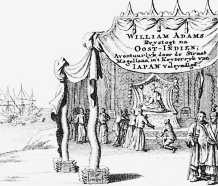
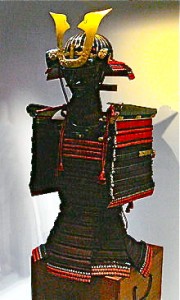 m is an extremely readable, scholarly study of the opening (and in 1637, the closing) of Japan to western trade. Using many primary sources, Milton creates an exciting story of how Japan comes to be “discovered,” what its values and culture are, and why the intrusion of the west and the possibility of trade are eventually rebuffed. The contrasts Milton sets up throughout the biography attest to his appreciation of 17th century Japanese society. Though he clearly does not agree with the sense of quick justice, the immediate executions, and the brutality and torture carried out by the Japanese in the name of justice, he shows his admiration for their courage and sense of honor, their loyalty and respect for authority, their beautifully constructed and aesthetically pleasing gardens in Kyoto, the grandeur of the palace in Edo (now the Imperial Palace in Tokyo), along with more mundane characteristics, such as their concern for hygiene and bathing, their medical practices (including acupuncture), their care for their appearance and cleanliness, their careful food preparation with its emphasis on freshness and healthiness, and their quiet self-control. The obvious contrasts to the mores of western society show how the hierarchical, non-individualized focus of the Japanese led to a more community-oriented society with a much higher level of “civilization” than that of the adventurer-traders, who were out for personal benefits, no matter the costs to their host country.
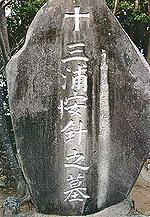 model for James Clavell’s Shogun, I found him far more true to life and interesting in this book. Neither romanticized nor idealized, he exists here as a man with flaws, often speaking in his own voice. His life as a seaman and his life in Japan, are fascinatingly portrayed, attesting both to Milton’s scholarship and his imagination as he recreates successfully the two cultural and social milieux in which Adams spent his two very different lives.
 Having won the Whitbread Award in 1989 for Gerontius, a literary novel about composer Sir Edward Elgar, James Hamilton-Paterson has written most recently in a completely different vein – three wild, off-the-wall novels starring Gerald Samper, an aesthete with a love for gourmet food, clothing, and cutting edge social commentary. Samper is, however, something of an ass, a man so self-absorbed and so convinced of the importance of his (as yet undiscovered) “mission” in life that he “lurches from crisis to crisis,” never pausing for reflection. Despite these unsympathetic qualities, however, Samper cannot help but amuse and intrigue readers as he involves us in his whirlwind activities and invites us to join him on the rollercoaster of his life.
 permanently removes Millie from his life, leads to astonishing sales of his book, and results in a high price for the movie rights. At the end of Amazing Disgrace, however, Samper has his own misfortune – during his 50th birthday celebration with friends at his home on a Tuscany hillside, an earthquake sends his house plummeting down the hillside, ending as a pile of rubble.
 be grateful that he did not embrace cannibalism when he contemplated the nutritional slogan to “Eat your Greens.”) And a facetious remark Samper made while being evacuated from the site of his now-vanished home – that Princess Diana had appeared in a vision and warned him and his guests to abandon the house just seconds before disaster struck – has led to hordes of pilgrims descending on his destroyed property. A makeshift shrine there soon becomes a grotto, and the local mayor and the comune see the tourist potential for marketing the site.
 once. His startling use of unique similes and metaphors (elderly, retired nuns described as “midget creatures like worn-out bats,” for example) make Samper’s commentary and opinions about his surroundings a delight to read. Providing perspective on Samper’s life is his British companion Adrian, whose regular e-mails at the end of each chapter update a friend on Gerald’s latest (absurd) fiascos.
 This breezy commentary by Inez Pereyra, wife of Ernesto, belies her initial shock at discovering a lipstick love-heart, saying “All Yours,” inside her husband’s briefcase and her realization that her husband of seventeen years is probably having an affair. From Inez’s point of view, things have been stressful in the month leading up to this discovery. The housework, she explains, has been “exhausting” because she wants everything to be “perfect,” but life has been bearable, and she has not wanted to go looking for trouble (as her mother did, to her own misfortune). Ernesto has been coming home late, working on weekends, and avoiding her, and except for school meetings involving a senior trip for their daughter Lali, he has been physically AWOL for most of the month. For Inez, selfish and deliberately obtuse, however, “The truth is…why confront Ernesto with some big scenario, when this woman’s going to be history in a week anyway?”
 do,” she tells the reader. “I couldn’t exactly step out from behind the tree and say ‘Shall I give you a hand, Ernesto?’ ” Believing that “what Ernesto and I had to do now was to put this episode behind us and move on,” Inez decides to help out and save her marriage in the process. Without telling Ernesto what she is doing to hide the accident and give him an alibi, Inez gets to work on his behalf, seeing him as “a monkey with a gun. Really dangerous…If I didn’t grab the reins, we’d be lost.”
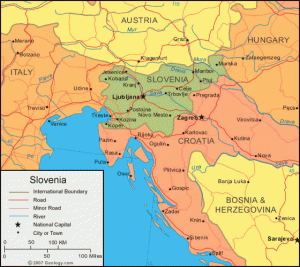
 Opening with a brief preface, purportedly written in Ljubljana, the capital of Slovenia, and in Barcelona between 1973 and 1974, the novel’s author describes himself as a “copyist,” asserting that he is trying to make sense of daily notes found in a soldier’s old green canvas rucksack containing “dog-eared exercise books, leaflets, bits of cardboard, scraps of paper covered with an untidy scrawl.” Jakob Bergant-Berk, the soldier who penned these notes during Slovenia’s World War II battles against the Germans and Italians has also included “several selected sayings, quotations, maxims, [which he] entered in the notes, sometimes for no apparent reason, and sometimes as a integral part of them,” and the author/copyist apologizes for being unable to “include in this book even a quarter of the accumulated hodgepodge.” The notes, he says, were obviously made at different times and later bound together, and include sense impressions which show the soldier to have had a highly developed aesthetic sense, even amidst the traumas of war. “The night we call cherry blossom night. A tree – stars like the petals of the white blossom, shooting stars. Over Suha Krajina. A minuet.”