“At around two or three in the morning, a gentle breeze came up the river, and the window and the roof of the mill were suddenly covered by a dense, yellow rain. It was the dead leaves from the poplars falling, the rain which, autumn after autumn, day after day, slowly destroyed and corroded the plastered walls, the calendars, the edges of letters and photographs, and the abandoned machinery of the mill and of my heart.”
Julio Llamaz ares will win many new readers with this powerful and richly atmospheric novel, a classic in Spain for the past twenty years, but only recently available in English translation. Capturing the love of an old man for his land and for the village in which he and his ancestors were born, it is also a study of the inexorable effects of time and the pressures it exerts on isolated communities and the human inhabitants who lack direct connection with a wider world.
Told from the point of view of a now-elderly man who, along with his faithful, unnamed dog, is the last remaining inhabitant of Ainielle, a (real) crumbling village in the Pyrenees, the novel details his physical and emotional deterioration as he observes the parallel collapse of the town, “whole buildings kneeling like cattle,” the village itself a mangled and sad “unburied corpse.” His wife Sabina, who had remained with him after all the other inhabitants gradually departed, has now been dead for ten years, and as the novel opens, Andres believes that this is the last day of his life. Using the future tense, he describes what he believes the men from the nearest town, whom he sees approaching at night across the valley, will discover when they arrive in Ainielle for the first time in ten years to retrieve his corpse. Though they would have remembered and recognized the old church, they will not know it n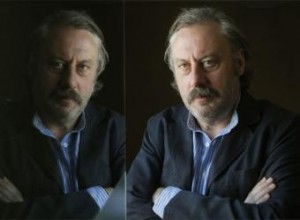 ow, he believes: “They will stare from afar at the bramble-infested portico, at the rotten wood, the sunken roof and the solid bastion of the belfry that still rises up from the devastation and ruin of the church like a stone tree, like a blind Cyclops whose sole reason for surviving is to display to the heavens the outrage of its now empty eye.”
Gradually, Andres reveals the history of the village and of his own family, capturing his own desolation. But the reader, like Andres, begins to question the reliability of Andres’s memory and to wonder whether the solitude has unhinged him. “Perhaps I dreamed or imagined it all in order to fill up the abandoned, empty time with dreams and invented memories,” he suggests. “Have I simply been lying to myself all this time?”
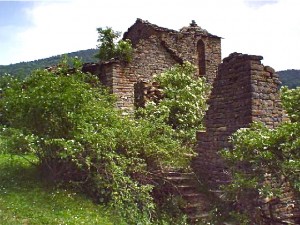
Derelict church of Ainielle
To keep from losing his grip on reality, he has consciously adopted the memories of all the previous inhabitants of the village, reliving over and over again their stories, the events from their lives, and their squabbles and joys as he has wandered around the nettle-choked town and visited the houses which are now mostly collapsed ruins.
In time, his weariness and disorientation cause him to lose “all notion and memory of the days. I was no longer capable of remembering what had happened the day before, or even if that day had really existed, nor of feeling within me, as I had always felt, the intermittent flux of the hours running with the blood through my veins. It was as if time had suddenly stopped.” Not surprisingly, he begins to see ghosts, which keep him company and help him pass the time as he awaits his death.
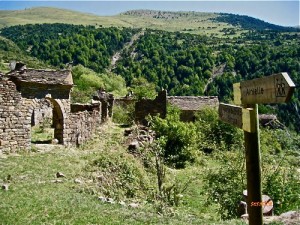
The old village
His confrontations with ghosts–of his mother, his three children, and Sabina–slowly reveal his life as a family man, along with his disappointments, his sometimes self-defeating behavior, and his never-ending desire to keep alive the village in which his ancestors had worked the land. “[But] after all these centuries, people had raised their eyes from the ground and noticed the poverty they lived in and realized that there was the possibility of a better life elsewhere.” He knows that when he dies, any remaining vestiges of the village and the way of life to which his ancestors dedicated their own lives, will disappear from the face of the earth.
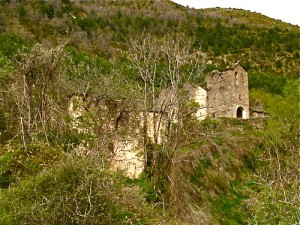
Another view of the old village
With only one character, the conflict which sustains most novels must come from within Andres, and the climax, which usually comes about as the conflict is resolved, is problematic. In revealing the facts of Andres’s life in Ainielle through his memories, however, Llamazares is able to use those memories to add color, variety, and a sense of reality to what would otherwise be an old man’s interior monologue. The conflict, we see, is a conflict between an old man and the forces of change, between Andres’s reverence for the past and the other residents’ hopes for the future. Since Andres has already told us that he will be a corpse when the men from the nearest town arrive from across the valley (and obviously unable to tell us about their arrival), Llamazares cleverly brings about a climax by having Andres tell us what he has done in preparation for his own death and what he believes the approaching visitors will see on their arrival.
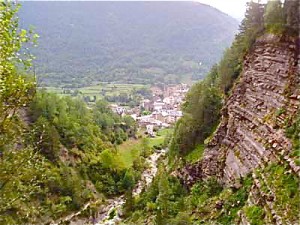
Throughout the novel, the nature imagery is breathtaking. Realistic and grounded in the stark reality of farm life in a poor, nearly dead village, Nature becomes almost a character here, as Andres sees parallels between the inner forces which have driven him to become the last human in Ainielle, and the passage of time and the seasons–deep snow, the rushing water of spring, and the falling leaves, which he sees as “the yellow rain.” Intensely visual and full of homely images, the novel is a haunting memorial to those people who are incapable of change as time brings about changes against their will. As the reader contemplates Andres’s imminent death, it is impossible not also to consider those aspects of the past and those values which are also lost from our heritage when the memories and experiences of the elderly are not preserved, when old villages disappear, and when future generations do not care.
Photos, in order: The author’s photo appears on http://www.elpais.com
The old church in Ainielle, by Marcos Broc, is from http://www.virtualtourist.com
The photo of the old town, by Sesasica, is from http://www.panoramio.com
The second photo of the old town, by Oriol Morgades, appears on http://www.panoramio.com
The pathway which the men from the village will have to take to reach Ainielle is shown on the photo by Zgzme! on http://zaragozame.com
Note: Many of these photos were taken by people hiking in the Pyrenees, and there are sometimes additional photos on the sites listed here for those who may be interested. That would have made the old man happy.
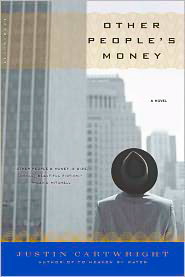 Julian Trevelyan-Tubal, the second son of Sir Harry, is now the eleventh generation of Tubals to have run the family’s bank, an old and prestigious institution which has now, not surprisingly, fallen victim to the same deteriorating economic forces as every other bank and investment company in London and around the world. With Sir Harry in Antibes, where he is recuperating from a stroke, which has left his speech impaired, Julian has been responsible for managing the “firm.” His older brother Simon had, after the death of their mother, rejected most of his family, along with his obvious role in the company, by traveling the world—“the hippy Tubal or the hairy heir.” It was left to Julian to keep the business all together, though “It is not so easy to be born rich in a world where everything that surrounds you from birth is old and beautiful and patinated, a world where you are steered, like it or not, towards the family business.” Julian’s role as heir apparent is even more complicated than usual, since his father “never
 understood that to produce a decent return you need financial instruments that banks of deposit never dreamed of. The cosy world, in which, for example, undisclosed assets could be left undeclared and untaxed, had changed for ever.”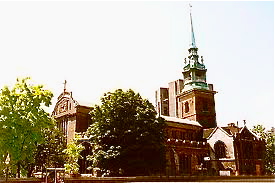

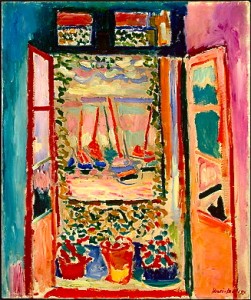
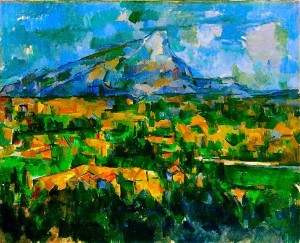
 ximately sixty pictures of Mont Sainte Victoire, which he saw from his house. Sir Harry was credited with owning three Cezannes, one of which, a special favorite, was of Monte Sainte Victoire:
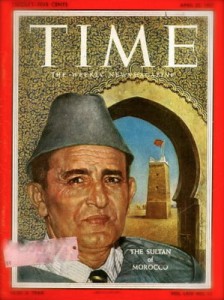
  in its depiction of the desire of Islamic populations to establish sovereign Islamic governments and free themselves from tyranny in North Africa and the Middle East, this 1955 novel should have been a wake-up call to the western world half a century ago when it was written. Paul Bowles (1910 – 1999), an American expatriate author, musician, and screenwriter who lived in Morocco for over fifty years, was an eyewitness to the uprisings which occurred there in 1954 after the French deposed the much-loved Sultan Mohammed V. Morocco had been occupied jointly by the Spanish and French since 1912, when they divided the country into two spheres of influence and ruled as colonial powers, establishing their own more modern cities adjacent to those of the native population and imposing their own values and rules upon them.
 among western powers. As one young Moslem* explains here, “If [we] cannot have freedom, at least [we] can have vengeance….Whatever you [infidels] make for us will be a spiderweb, an ankabutz, and may God, who forgives all, hear my words, because it’s the truth…”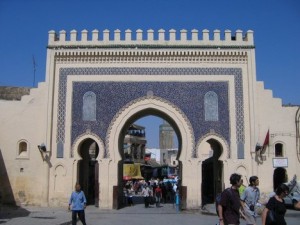


 Nordic Noir, there’s a new guy in town—at least someone new to me. K. O. Dahl (Kjell Ola Dahl), a highly respected and prize-winning author in Norway, has just had a third novel published in the U.S. Written in 2000 as the first of a trilogy, and followed by The Fourth Man (2003) and The Man in the Window (2005), all three novels have now been published in English by Minotaur.
 Though some elements of the mystical appear in Part I as Katrine and her friend share a story about a ring, which becomes symbolic later in the novel, the narrative is straightforward. Most of Part II is less a narrative than a series of dialogues, as Inspector Gunnarstranda and Det. Frolich begin interviewing everyone who might have had contact with Katrine, leaving it up to the reader to process and keep track of all the disparate elements they are investigating. Virtually all the characters have something to hide, often having to do with their sexual escapades, and all of them lie. The mysteries of Katrine’s life involving her real parents, her foster parents, her sad inability to find true mentors, and her search for peace through drugs and sex, become the major focus of the rest of the book.
 Occasional flashes of humor appear: Gunnarstranda is pelted by tomatoes when he goes to interview people at the drug rehab facility; a character comments that those who overdo the tattooing “look as though they have been made in a factory”; and paunchy Det. Frolich, objecting to his mother’s invasion of his apartment to clean it, tells her that he needs quiet to think, to which she responds, “Go think somewhere else! Stomach first—out you go.”
 in turn, limits the excitement and the reader’s involvement. The ending does come as a big surprise, but that surprise stretched the limits of plausibility, at least for me. I was hoping for that “ah-ha!” moment, which the best mysteries have, but though I found this an enjoyable book, I did not find that magic moment here.
 Anyone who enjoys mysteries is surely familiar by now with the growing list of Nordic authors who specialize in crime and all its horror, but these authors do not write purely for macabre sensation (though the macabre is not unknown to them). All are writers with larger themes and scopes, and many use repeating characters who keep the reader involved as they solve new crimes and reveal more and more personal aspects from their own lives. For Stieg Larsson, it was journalist Mikael Blomqvist and his computer expert friend Lisbeth Salander who became repeating characters. For Henning Mankell, it is Kurt Wallender.
 features Harry Hole, and Karin Fossum, the most psychological of the authors, repeats with Inspector Sejer. All of Camilla Lackberg’s novels take place in her own hometown, Fjallbacka, a rural Swedish fishing community in which a large number of the town’s characters play a role.