“I longed for a way of life in which people made it a priority to look into each other’s eyes and communicate, soul-to-soul, uninterrupted, like in that Zulu warrior greeting we’d practiced in happiness class. I yearned for meandering conversations about all things important, all things banal. Bhutan, I imagined, might be as close as you could get on earth to what I’d been craving…”
When Lisa Napoli,  a journalist who has worked for public radio and CNN, attends a cookbook party in New York City, her friend Harris introduces her to a singularly attractive man. His handsome friend, Sebastian, is about to accompany him to Bhutan to do research for an article for Gourmet magazine. Napoli soon discovers through conversations with the two men that Bhutan is “the happiest place on earth” a place that is proud of its “Gross National Happiness Index.” In the midst of a midlife crisis herself, Napoli feels she has “been there, done that” for too long in the same job, adrift socially after the breakup of a long-term relationship. Now forty-three and childless, she reluctantly returns to her job at her home base in Los Angeles. Three weeks later, however, she receives an e-mail from the attractive Sebastian, asking her if she’d like to go to Bhutan to help with the start-up of a radio station, Kuzoo FM. With scarcely a second thought, she obtains a six-week leave of absence from her job and takes off for Bhutan, a Himalayan kingdom known as the Land of the Thunder Dragon.

The book which results from this trip and the four additional trips that she takes between January, 2007, and the present, is as much a search for peace in her own life as it is a story about the happy world of Bhutan. The country, as she describes it, appears to be one in which time has stood still, the only purely Buddhist country in the world, with stringent rules about who may visit, and why, and about who may leave, and why. Ruled by a benevolent and much-loved king and his four queens (all sisters), the country has few telephones, fewer cars, no electricity in rural areas, and an “almost institutionalized resistance to conspicuous consumption.”
Shortly before the author arrives in the capital of Thimphu in January, 2007, however, she reads on-line that the fifty-year-old king, Jigme Singye Wangchuck, who has been on the throne since 1972, has abdicated in favor of his son Jigme Khesar Namgyel Wangchuck, aged twenty-six. The older king’s plan had always been to establish a constitutional monarchy, and during his own reign, he had continuously (and voluntarily) given up power to councils of advisors. This k ing, who was educated abroad in India and England, believed that by passing the rule on to his son, that the son would reign for a few years before democratic elections would be held and a true constitutional monarchy would be established. His son, educated at Andover and Cushing Academies in Massachusetts, at Wheaton College in Massachusetts, and eventually at Magdalen College, Oxford, and therefore well familiar with western life, is given the job of bringing the country into a more modern reality (with more TVs, radios, computers, the internet, etc.), while still preserving the values which make Bhutan the “happiest country on earth.”
Perhaps it was already too late to preserve these values when Lisa Napoli arrived. There she found that the people’s ideas of the United States (at least the people who lived in the capital and had access to TV) were based on what they saw on pop TV programs from the US. The people at her radio station were well familiar with Oprah and hoped that they could have a radio call-in show “like King Larry’s.” One of the young women at the station surfed the net for the Neiman Marcus Web site so she could see Burberry purses, and Sex and the City videos are watched avidly, readily purchased through India. Yet many people still wear traditional dress (at least on holidays), the Buddhist priests still are called upon to do blessings and pujas, a nd houses are decorated with paintings of ten-foot phalluses, the “logic” being that “When you have a phallus painted on the house, people will be too ashamed to look and to covet what they don’t have. In this way the phallus wards off evil spirits.”
After giving straightforward “travel guide facts” about Bhutan, the author then confesses that she has fallen in love with the country. “Timing and circumstance collided to ignite this love affair. It didn’t hurt that I had a lifelong fascination with anyplace in the throes of evolution…In many ways Bhutan was a start-up…an ancient, once-secluded kingdom transitioning now at warp speed. A new king, a new democracy about to dawn, a new constitution.” With little pause and less anal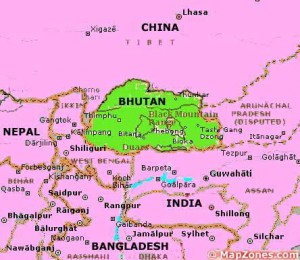 ysis, however, she then states that “The twin cultural influences of technology and media were spreading rapidly, challenging and eroding Bhutan’s very foundation.” How and why this is happening so quickly in a culture which she has described as having firm foundations in deeply held core values remains an unanswered question, and whether this erosion can be stopped is not addressed.
Throughout the story, the author, ever the journalist, gives the facts and figures about the country and its people, and about how she adapts to life there, but she appears to be an observer, rather than a real participant in a rich culture on the verge of being lost. Ultimately she decides, after her five short visits, that she has found all she has needed in Bhutan for the time when she needed it. It is a bit of a letdown for the reader to realize that she has mined the experience as much as she intends to. The book offers thinly developed factual data about Bhutan, and a good deal of information about the author’s own personal crisis, but she seems ready now to put all that behind her and move on , “going for a walk outside in the California sunshine.” Ultimately, the reader is left full of questions about the “real” Bhutan, the real “happiness” of its people, and how well the country will adapt to the changes which seem about to envelop it.
Photos, in order: The author’s photo appears on http://marketplace.publicradio.org
The US- and Oxford-educated new king is now thirty-one years old. http://www.ask.com
Members of the Royal Family await the coronation of Jigme Khesar Namgyel Wangchuck in 2007. Perhaps his mother and the three other queens are the women on the right. All the participants are wearing traditional dress: http://www.dailymail.co.uk
The map of Bhutan is from http://kids.mapzones.com
The primary food of Bhutan, according to the author, is emadatse, made almost entirely of hot peppers. http://read-it-forward.crownpublishing.com
A YouTube trailer of Taking the Middle Path to Happiness may be seen here:
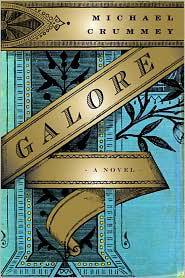 s sensitivity to words and images, and a ballad-singer’s awareness of cadences and narrative tension, Michael Crummey creates a rich novel of Newfoundland from the nineteenth century through World War I. Deftly combining the brutal realities of subsistence fishermen with the mythic tales that give hope to their lives, he traces the lives of two families through six generations in Paradise Deep and the Gut, rural areas worlds away from life in St. John’s. With its huge scope in time and its limited scope in location, the novel honors the characters’ resilience as they struggle to survive during times of extreme privation (and six months of nearly paralyzing winter), while it also celebrates the stories and long-held myths which give interest and even hope to their lives.
 however, “[a] head appeared…a human head, the hair bleached white.” Suddenly, “Froth bubbled from the mouth and the corpse began coughing,” scaring away all but Devine’s Widow, the respected (and feared) old lady of the community, and her granddaughter Mary Tryphena. Though he reeks of fish, a condition which continues for his entire life no matter how often he is washed, the albino, who is a mute, is given a shed to live in on the widow’s property. Named “Judah,” a combination of Jonah and Judas, the man is completely solitary, blamed at first for the poor fishing, then celebrated when he rows out with the men on a fishing trip and the luck for the entire fleet changes, with more squid caught than they can eat. The next week the cod return.
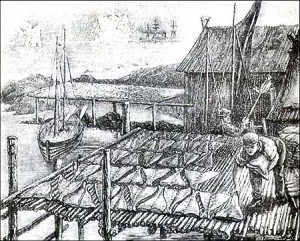 The lives of the interconnected Devine and Sellers families, usually enemies, show the changes in the community over the next generation or two. A new priest from the Church of England changes the “rules” of the community, and in a darkly humorous episode, a body is stolen and reburied several times between the Catholic and the Protestant graveyards. A Catholic “cathedral” built for Fr. Phelan, collapses, and later burns, and a new Protestant church is built. Prices for the fishermen’s catches fluctuate, and King-me Sellers, a local judge, merchant, and government representative, cheats them out of their profits and their land. The old myths get forgotten, and Judah’s reputation declines. By the mid-1870s, there is a new priest and an archbishop “with an air of enthusiastic fasting about him.” And still the poor remain poor, and often starving. This is a time of “extravagant misery and want.”
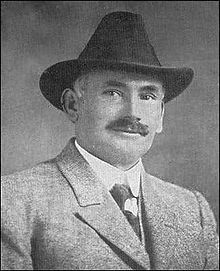 ears after that, as some of the original characters, now elderly, and their descendants, along with a new physician, Harold Newman, continue the themes and the family histories. Fishing is so depleted that the men now go to Labrador from May till September or October, leaving their families to fend for themselves for up to six months at a time. Politics becomes a fight between the Catholics and Protestants. The family of King-me Sellers, now led by Levi, continues to cheat the fishermen, and eventually a Fishermen’s Protective Union, led by William Coaker, is fought for and formed. The FPU is expected to change the face of politics and daily life by building wharves, warehouses, a school, a hotel, and offices on the waterfront. The passage of a law of conscription leads to the formation of a Newfoundland Regiment for World War I.
 t’s always fun to reread a novel that was a favorite fifteen years ago and discover that it’s just as much fun the second time around. Winner of both the Pulitzer Prize and the National Book Award in 1994, The Shipping News is set primarily in Newfoundland, the ancestral home of Quoyle, a widower from New York, and his aunt, Agnis Hamm, who return to Newfoundland with Quoyle’s two young daughters to try to create new lives. Quoyle, with minimal experience as a newspaper man in New York, gets a job at the local newspaper, the Gammy Bird, at Killick Claw, recording the weekly shipping news, doing features on visiting ships, and covering local car wrecks. Agnis continues her business of upholstering ship and yacht interiors, and Quoyle’s little girls settle into school and daycare.
 is often bleak, and its population must deal with violent storms, winters lasting six months, few connections to the outside world, and sudden death at sea, all of which Proulx describes in vivid and moving passages. But survival in this world also inspires kinship among its residents and a kind of dark-humored resignation which is even more vividly depicted. All of Proulx’s characters wrest grim humor from life’s tragedies, buoying their spirits (and those of the reader) as they soldier on, refusing to engage in self-pity, no matter their difficulties. As irony piles upon irony, their resilience shines through, making this novel both a story of harsh reality and one of inspiring strength.
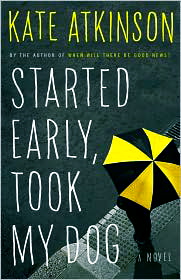 r good Kate Atkinson’s three previous Jackson Brodie novels have been, they were just the warm-up for this one. Though they are often called “mysteries” because the main character, Jackson Brodie, is a private investigator, Atkinson’s novels are far more character-driven than the norm, and more literary in execution–intriguing on several levels simultaneously. In the course of the three previous novels (



 ystery, Kate Atkinson’s third Jackson Brodie novel grows instead out of the terrible traumas that children and young people must endure when people they love die violently. So marked are they by their sudden tragedies, that they never really escape their pasts, and spend the rest of their lives wondering “when will there be good news.” Five separate plot lines evolve and begin to overlap here, and in each of these plots the main characters are all needy people hiding an inner loneliness from which they would like to escape. In the first plot, Joanna Mason Hunter is a physician living in Edinburgh, the happily married mother of a one-year-old, a woman who appears to have it all, but thirty years ago, she escaped a slashing attack which murdered her mother, sister, and baby brother. Though she seems to have put her past to rest, the murderer of her family is about to be released from jail.