“They were never bored with each other. They might hate each other, at least, Irene might hate Gil, while he had no idea how much he hated Irene because he was so focused on winning back her love. He really did hate her…He couldn’t see it or experience this hatred but it was there.”
In this rel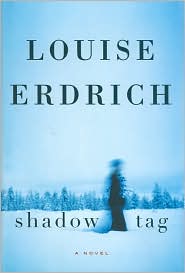 entlessly domestic novel about a failed marriage, Louise Erdrich changes her focus from grand themes and the on-going history of Native American cultures to a microscopic analysis of the interactions of two people who have failed, not just in their marriage, but in virtually all their other relationships. Gil, a well-recognized, almost-great artist, is thirteen years older than Irene, who had been his student and model when she was in college and he was a teacher. Devoting virtually his entire career to paintings of Irene, he has depicted her from her almost-innocent twenties to her present life as a heavy-drinking mother of three who despises him for dominating and controlling every aspect of her life. The more angry she has become and the more passionate she has been in her rebellion, the more dramatic Gil’s portraits of her have become, with a recent one selling for six figures. Irene, who gave up her PhD studies when she married, is far more flexible, easy-going, and even irresponsible than the controlling Gil, and it is she who is closer to the children, who range in age from thirteen to six.

Living in a three-story house in metropolitan Minneapolis, Gil and Irene lead a comfortable life, their three children all in private schools, and Irene with enough time to work on a new PhD thesis, this one on George Catlin, the American artist who traveled the west in the 1830s and 1840s making portraits of Native Americans from as many tribes as he could find. Irene is three-quarters Native American; Gil is one-quarter, at most, yet both consider themselves Native Americans. Both have grown up in families without fathers, in homes which have not stressed their culture, and neither seems to have developed any inner resources or community ties to help deal with the crises they face on a daily basis in their crumbling marriage. Gil is strict, harsh, and even violent, with the children and with Irene; Irene is emotionally unable to leave him, though she says she has not loved him for the past six years. She finds solace in drink.

George Catlin portrait from the Nelson-Atkins Museum in Kansas City
When Irene discovers that Gil has been reading her private Red Diary, which she keeps in a file cabinet in her basement office, further proof of his need to control, she decides to take revenge, deliberately fabricating stories to shock and hurt Gil. She also opens a safety deposit box in town and makes regular trips to it to write the truth in a Blue Notebook that she has deposited there. Gil, who has always wondered where Irene goes when she is not at home, and suspects she is having an affair, soon becomes convinced not only of the affair but of the possibility that at least one of his children is not really his. As the point of view rotates from the Red Diary through the Blue Notebook to the dramatic observations of a third person, the intensity of the conflict escalates, eventually revealing such intensely personal nastiness that the reader begins to feel uncomfortable, almost voyeuristic.
Erdrich, as always, includes motifs and patterns throughout the novel which add to its significance, and here the use of shadow is pervasive. Gil often escapes to the Minneapolis Institute of Art just to sit and contemplate a painting there by Rembrandt, the master of shadow. The painting is a fine, detailed portrait of Lucretia, who, according to Livy, chose death over dishonor when she was raped by the son of the ruler. The portrait shows her in the process of disemboweling herself in front of her father and husband. By contrast, the gift paintings given by various tribes to Irene’s thesis subject, painter George Catlin, when he painted the chiefs, were all one-dimensional and contained no shadows at all. Catlin himself, however, was told that he brought shadows to the tribes when their lives changed for the worse through the introduction of European inventions (and disease). The differences in artistic preferences and styles are visual reminders of the differences in thinking and personality between Gil and Irene. In the most obvious shadow symbolism, the family spends a moonlit night outside in the snow playing shadow tag. The lack of shadows is symbolic in the conclusion.
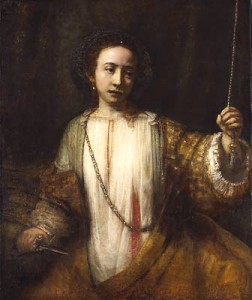
Rembrandt’s “Lucretia” (holding the dagger in her right hand) is at the Minneapolis Institute of Art
Whereas many other Erdrich novels soar with theme, this novel is firmly grounded in domestic torments and tribulations, created with such emotional intensity that I could not help wondering about the degree to which this novel might have sprung from Erdrich’s own marriage difficulties. Others have stated outrightthat the novel is semi-autobiographical. The novel is hard to read, almost too personal, too open (and it would still feel that way even if it were completely fictional). As the conflicts develop and emotions run high, the reader is constantly aware that there are many possibilities for ending the novel and resolving the difficulties in this marriage and family. Erdrich’s choice of conclusion will disappoint many readers.
Notes: Also by Louise Erdrich, reviewed here: THE PAINTED DRUM, THE ROUND HOUSE, LAROSE, THE SENTENCE
The photo of Louise Erdrich is by Dawn Villella of the Associated Press, and appears with a New York Times review of Louise Erdrich’s The Red Convertible, a story collection published in 2009. www.nytimes.com/2009
The George Catlin portrait is from the Nelson-Atkins Museum in Kansas City: www.nelson-atkins.org.
For those interested in the autobiographical aspects of this novel, Salon has an article here about the marriage of Louise Erdrich and Michael Dorris: www.salon.com/april97
 rt-thumping experimental novel which bursts the bounds of the usual genre categories, British author David Peace creates an impressionistic story of a real Tokyo bank robbery and the deaths of twelve bank employees on January 26, 1948. A man representing himself as a doctor investigating a case of potentially fatal dysentery in the neighborhood appears at the Shiina-Machi branch of the Teikoku Bank just after closing time. He says he must inoculate all the employees in the bank against this disease, and decontaminate all the documents and money that an infected man may have touched. He explains how he will give each person two different medicines and shows them how to roll up their tongues for the first liquid so that the medicine will not hurt their teeth or gums. After one minute, he gives them all the second liquid. Two minutes after that, sixteen victims, writhing in agony, have fallen unconscious, and twelve of them die, poisoned with cyanide. The physician then removes the day’s receipts and disappears.
 omon-like structure for the novel, featuring twelve different narrators who provide information about the crime in the manner of a traditional Japanese ghost-story-telling game. This game begins with the “shadows” of twelve narrators lighting candles together–a detective, a female survivor, an American physician, a practitioner of the occult who lives in a shrine, a journalist, a businessman/yakuza gangster, a Soviet investigator of war crimes, the man convicted of the murder, and others. Each tells his own horror story regarding the bank robbery, after which he blows out his candle, creating a darker and darker atmosphere for successive “Candles.” When the final narrator blows out his candle, the participants are sitting in blackness, waiting for ghouls to appear and the abyss to open.
 Sometimes the novel feels like a long canon, or “round,” while at other times one can only think of a grand operatic chorus. Sometimes four or five different speakers reveal information simultaneously (often within the same sentence). Each speaks as if in a soliloquy, talking over the other characters and interrupting their sentences to include their own thoughts. It is a uniquely powerful technique which requires the reader’s “willing suspension of literary expectations,” and it can be both exhilarating and challenging. The author does not always distinguish between his real people and his ghostly shadows, and often a reader may be unsure who is speaking during these long “canons.” A remarkable section described as The Ninth Candle (“The Thirty-Six Wounds of a Second Detective”) contains“five acts” within the section–far more an opera than a play. The cumulative effect of this complex technique may frustrate those who are just looking for a good mystery but will delight those who enjoy clever literary techniques and a broad thematic scope.
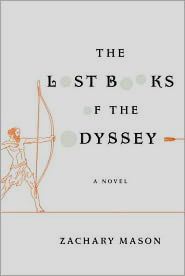 Mason’s newly published version of this story, by contrast, takes a post-modernist approach – casual, playful, earthy, and even scatological. At one point in Mason’s version of The Lost Books of the Odyssey, Odysseus muses about the fact that “I was ideally suited to be a bard, a profession fit only for villeins, wandering masterless men who live at the pleasure of their landed betters, as my father reminded me when I broached the idea. He and his men would say things like, ‘We are here to live the stories, not compose them!’”
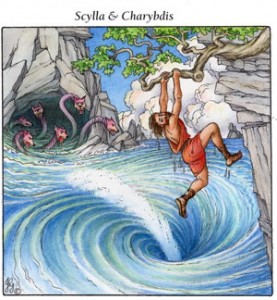 e men whom he finds occupying his cave when he returns home, and the payment they give him. Odysseus also marries during his twenty-year absence from Ithaca. Mason also gives several different accounts of Odysseus’s return home – in one, Penelope is a “shade,” a ghostly presence whom he cannot touch. In another, she has given up waiting for him and found another husband. At other times, she is described as still bedevilled by the suitors. In yet another, Odysseus returns to find his entire city abandoned.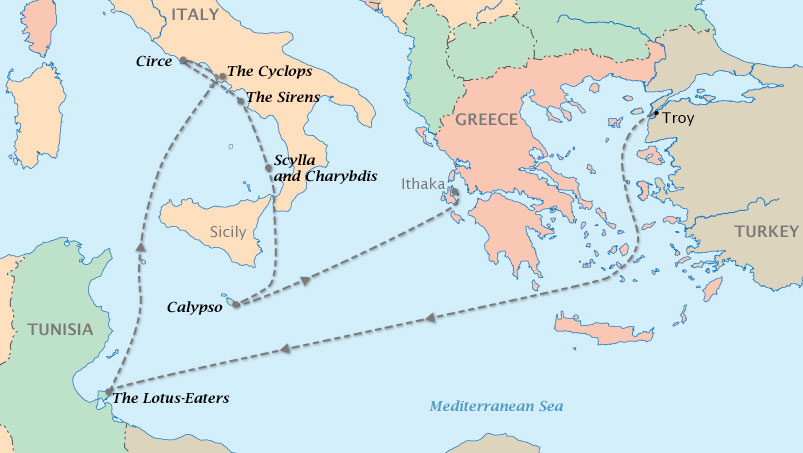
 f the Inspector Erlendur series, Gold Dagger Award-winner Arnaldur Indridasson creates a challenging and thought-provoking mystery by revisiting the political complexities of Iceland during the height of the Cold War in the 1970s and 1980s. At this time, many Icelandic young people were resentful of the US presence and its huge naval air station in Keflavik, accusing the US of “spreading filth.” While the US and NATO were using this base for strategic defense against possible USSR aggression, many students, often from poor families, were accepting the chance to study in East Germany at the University of Leipzig, then returning home with their socialist and communist messages. For Inspector Erlendur Sveinsson, busy solving contemporary crimes, this past history has been unimportant, but when an earthquake leads to the unexpected draining of Lake Kleifarvatn, a skeleton, weighed down with a Russian transmitter, emerges from the depths, a large hole in its skull. With no other evidence available, Erlendur’s only hope of identifying the remains rests with his investigation of missing persons from the late 1970s and 1980s.
 led with the dark stories which envelop its numerous Icelandic characters, the novel reflects main character Erlender’s terse style, his abbreviated dialogue, and his no-nonsense approach to life. Author Indridason develops suspense about the old murder and its connection to the students from the outset and builds it carefully, as bits of information gradually arise in both the present and the past plot lines. The point of view of a mysterious ex-student who has talked about the murder at the beginning keeps the suspense high, and as all the students come to terms with the differences between their idealistic expectations and the reality of their lives in East Germany, their increasing desperation becomes understandable. A first-class mystery set in an unusual time and place, The Draining Lake is an exciting continuation of this series and the characters who keep it fresh.
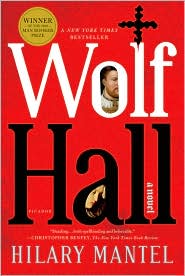 s never “written the same book twice,” a writer of literary fiction who is so versatile and original that she defies genre. Though this novel is a thorough and detailed look at the British court and its players from 1529 – 1535, it is so different from the traditional “historical novel” in its themes, massive scope, detailed character development, careful research, and lack of romance that it becomes its own genre, closer to fictionalized biography than to the blood and thunder bodice-rippers that sometimes characterize “historical fiction.” This novel is realistic, with no compromises of actual history for the sake of story, but it succeeds in being lively, often humorous, filled with exciting scenes, and peopled with fascinating characters from Henry VIII to Sir Thomas More and Thomas Cromwell.
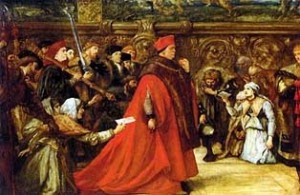
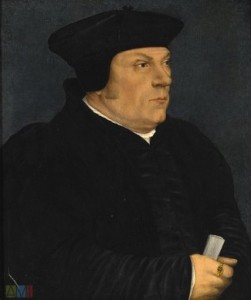 imate stories within this grand scale, making Cromwell a sympathetic hero for much of the novel as he loses most of his family to the “sweating sickness,” informally adopts several young men, non-family members, who need a patron and guide, tries to do well by Cardinal Wolsey and acts to protect him as much as possible when he is dismissed by the king. “How did it come to this?” Cromwell wonders. “My lord [Cardinal Wolsey] kneeling in the dirt. How could it happen? How in the world?” The reader soon sees the reasons in detail, participating in the trial details regarding Katherine’s marriage to Henry VIII as Wolsey argues unsuccessfully on behalf of Henry before the papal legate, Cardinal Campeggio. The seriousness of the loss is obvious from the fate of Wolsey, and Cromwell, whose fate has been tied to Wolsey’s, must scramble to preserve his own place in Parliament where he might be able to argue against any actions they might introduce there against Wolsey. When Cromwell eventually becomes the king’s chief minister in 1532, he manages to find a way to get Henry’s marriage annulled, and the rest, of course, is history. The novel ends while Cromwell is still acting for Henry, helping in the dissolution of monasteries and does not suggest his eventual fate.
 A novel dealing with issues as complex as these cannot be dealt with in any small way, and Mantel takes the time and space she needs to develop the issues clearly while also giving depth to her characters. The list of chapters at the beginning gives the dates of the actions and helps prevent confusion, and a cast of characters, organized by the places in which the characters live or work, clearly identifies their alliances and allegiances. A genealogical table of the Tudors and of the Yorkist claimants to the throne helps keep the royal succession in perspective. A serious analysis of British history, as well as a novel of immense scope and detail, Wolf Hall is a monumental achievement on every level.