“The city spread out below, dark brown studded with flashes of light that bounced off the open windows…we could make out a strip of sea past the dark haze that stretched from the sandbars of Frische Nehrung to the cliffs at Adlershorst, and we knew for certain that the city would stand forever.”
Danzig, a c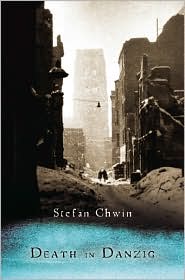 ity with German roots that go back to the fourteenth century, remained under the control of Germany for more than five hundred years—until the Treaty of Versailles in 1919 removed Danzig from German control, made it a Free City under the League of Nations, and gave Poland permission to use it as a port called Gdansk. One generation later, however, the rise of the Nazis and National Socialism in Gdansk gave Hitler the excuse he wanted to invade Poland to reclaim the city that Germany had always considered its own. The Russian offensive during the last months of World War II drove the Germans out of Gdansk at the same time that the Poles who had been living in the eastern territories came flooding back into the city.
Stefan Chwin, a highly acclaimed Polish novelist from Gdansk, for whom this is the first novel translated into English (by Philip Boehm), focuses on Danzig/Gdansk as it adapts to the comings and goings of its changing citizenry during the tumult of 1945. Imbuing the city with the aura of a main character in this darkly impressionistic novel, Chwin shows us that no matter who is officially in control, the city somehow survives, a permanent monument to the endurance of the communal spirit and the ability to adapt. Meticulous descriptions of the smallest aspects of daily life—home furnishings, buildings, neighborhoods, and life at the port—turn the city into a living, breathing entity, battered by changes of fortune, perhaps, but still functioning and still providing a home to a changing population.

Most of the action takes place at #14 and #17 Lessingstrasse, later Grottger Street, two buildings which house the main characters of the novel, who change, like the city itself, from German to Polish. With the hasty departure of most of the German residents, the Polish refugees simply move into their empty houses and use their furniture and furnishings. Catalogues of one family’s belongings and later references to these objects in the hands of different owners provide a sense of continuity and attest to the stability of the city itself.
The characters are finely drawn, unique beings with stories of their own, though the stories are not necessarily interrelated. As in real life, many of these stories involve personal secrets which are not fully revealed, even to the reader. Hanemann, a former lecturer at the Anatomy School, serves as a bridge between the German and Polish residents of the city. A German himself, he does not leave the city when he has the opportunity to do so, remaining on the dock, for reasons even he does not understand, as his friends and neighbors depart. Hanemann has had a passionate relationship with Louisa Berger, a young woman with whom he spent an idyllic time at an out-of-town hotel, and their love has governed Hanemann’s feelings. Her fate leaves him “frozen in [a] state of slumber, half-alive, [in a state of] hibernation that took his soul and anesthetized it against the voice of the world.”
Piotr, the young Polish b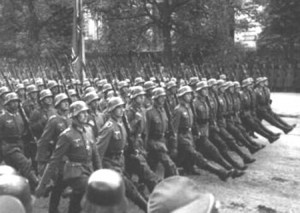 oy who becomes the narrator, and his family move into the empty apartment beneath Hanemann when the previous owners return to Germany and Piotr’s family is driven out of Warsaw. Hanka, a young Ukrainian woman, sometimes suicidal as a result of unspeakable atrocities she has apparently endured, joins Piotr’s household, and later, a mute child moves in. Hanemann teaches German to Piotr and sign language to the mute child, enabling them to communicate in new ways, even as the danger of revealing their inner thoughts grows more pressing under postwar communist rule.
Throughout the novel, numerous parallels occur between lovers and their destinies and the city and its destiny. Hanemann often refers to the joint suicide of the German poet Kleist and his lover Henriette, and later the suicide of the Polish artist and writer (identified in the notes as Witkacy), who killed himself after rendering his lover unconscious so that she could not stop his suicide. Hanka, too, has attempted suicide, but like Witkacy’s lover and the city of Gdansk itself, she has survived, though she, like the city, has had to adapt to changed circumstances.
 Breath-taking in its language, its ability to create vibrant portraits of people and places, its minute examination of household objects, and its love and faith in the enduring qualities of the city itself, Death in Danzig is a fascinating, though unusual novel, one in which plot is far less important than the daily lives of those who inhabit it. Leisurely in its development, the novel creates an impressionistic time capsule in which the city becomes the only constant.
Notes: The author’s photo appears on http://www.polishbookclub.org/History.htm
The photo of the German invasion is from http://www.polishamericancenter.org/70thAnniversary_WWII.html
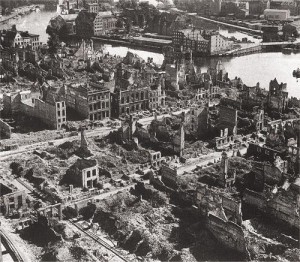
Destroyed Gdansk city center, 1945: http://blog.globeforum.com/2009/09/10/gdansk/attachment/1945/
 g the journeys of Captain James Cook, author Tony Horwitz writes a fast-paced, fascinating, and often very humorous account of his “walk” in the footsteps of Captain Cook, an explorer he obviously admires and whom he attempts to understand and make understandable to his readers.
 ble as a personality because of his friendship with
 Fascinating as a biography of the complex Captain Cook, as a lively record of the age of exploration, as a modern adventure to “romantic” south Pacific islands, and as research on cultural anthropology, this is an exhilarating and fast-paced narrative, one which will reward careful reading and cause the reader to examine the dubious results of “civilization.” Horwitz obviously enjoyed his research, and the reader will, too, however vicariously.
 50, when Ricardo Somocurcio first meets Lily, a “Chilean” exotic who has recently joined the teenage social scene in Lima, Peru, he is fifteen, sure of only one thing—that she is the most bewitching creature he has ever known. His young infatuation eventually develops into a lifelong obsession, and his story of how Lily dominates all aspects of his romantic life for more than forty years shows both the mysterious power of unconditional love and the peril of misplaced devotion.
 Ricardo, for his part, seems content to work as a translator, travel the world in that role for UNESCO, and live what would be, to most people, an empty life without reciprocated love. He sacrifices any kind of long-term happiness in a “normal” relationship for the excitement she occasionally brings to him, unable to stick to his vow that the next time she shows up, he will refuse to respond to her (a trait which may make him an annoying protagonist for some readers).
 oal of the Weber-Vedder research team goes way beyond the single-minded documentation of one species: they study not only the life of the mountain gorilla, but also their changing habitat and the needy humans who share it. Amy Vedder is a biologist, her husband Bill Weber a social scientist, and their multidisciplinary approach to conservation offers a fresh look at opportunities to create win-win situations for both the animals and the humans who live near them.

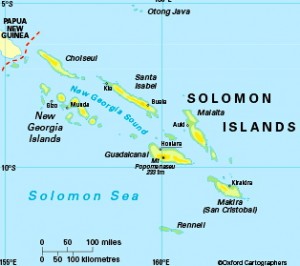
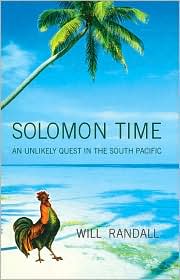 ll Randall, though a high school French teacher for ten years, is really just a kid–thirty-two years old, to be sure, but still young in his attitudes, in his responses to people, and in his views of what life, and his own life, in particular, are all about. Unsophisticated and incurious, he has seemingly let life happen to him, sometimes complaining about his job and the usual teacher/student/ administration problems, but never taking action to change his life. Or not, at least, until his friend Charles suggests that he give up his job and go to the Solomon Islands.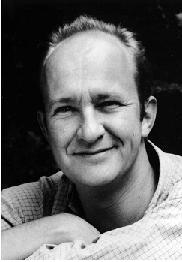
 mor, this is light, entertaining reading-Randall is far more interested in telling a story than in contemplating his inner growth or making weighty observations about what he has learned. He pokes fun at himself and at the one or two “villains” he encounters as he sets up the chicken-business, and since life is pretty much the same on a daily basis, he concentrates on expanding specific, amusing episodes from his stay, rather than developing any deep or universally meaningful conclusions about them. His decision to return to England, in fact, comes suddenly, with no fanfare and even less explanation. He merely says, “More than once during my stay in the Solomons I had almost felt that we were [one big, happy family], but there was now a part of me that wanted to see other family and friends, and also wanted to find out how I would now react to the place from whence I had come.” Only fifty-four words later, he is on the jetty telling the leader of the village that he is going home, offering no further reflections on his life there or clues about what he has learned and why he has chosen this particular time to leave.