“We will defer only to the brute force of guns. Maybe the answer lies in [Somalia’s] history since the days of colonialism, and later in those of the Dictator, and more recently during the presence of U.S. troops: these treacherous times have disabused us of our faith in uniformed authorities—which have proven to be redundant, corrupt, clannish, insensitive, and unjust.”
Returning to So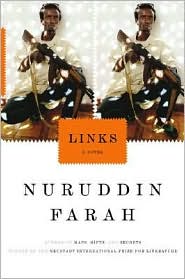 malia twenty years after he was imprisoned and then sent into exile, Jeebleh arrives at a remote Mogadiscio airport now under the control of a major warlord. He has come from his adopted home in America to help Bile, his oldest friend from childhood, find and rescue his kidnapped daughter and a friend. Bile is affiliated with a warlord in the south of the city, but Jeebleh may be in a particularly good position to help him if the child has been taken by a rival, since he belongs to the same clan as the warlord controlling the north. The political situation is so tangled, however, that at times no one really knows who is allied with whom.
As he travels around the ruins of Mogadiscio, once a beautiful city filled with educated people, Jeebleh comments to an acquaintance: “This city is a disaster. I haven’t met anyone who openly disapproves of what’s happening, and yet the fighting goes on and the clan elders continue soliciting funds for repairing deadly weapons.”
His acquaintance explains, “Here we don’t think of ‘friends’ anymore. We rely on our clansmen…sharing ancestral blood….Every clan family feels that it has to form its own armed militia, because the others have them. The elders, almost all of them illiterate and out of touch with your and my sense of modernity, spend their time trying to raise funds from within the members of the blood community. In truth, it’s all a pose, though, and everybody knows that the elders are doing this to make sure they seem important.”
As he searches for his mother’s unrecorded grave and tries to help Bile recover his daughter Raasta and her little girlfriend, he finds himself becoming divided, emotionally and culturally. Here, in the surroundings in which he grew up, he feels like someone looking at the outside world from inside Somalia, but the environment in which he grew up has changed, just as he has changed from living in the United States, and as he contemplates these changes, he also feels like an outsider looking in. His life is constantly in danger, he is often followed, he sees people gunned down “for fun,” and he has no idea who is friend and who is foe. Unfamiliar with the political territory in which he is operating, he is not sure how, if at all, he will be able to extricate himself from Mogadiscio, even if he succeeds in finding Bile’s daughter.
It is not accidental t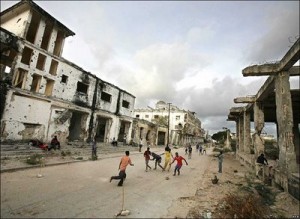 hat Jeebleh has received his doctorate for a book he has written on Dante’s Inferno, the symbolic parallel for the existentialist nightmare he sees in Somalia. “We are at best good badmen or bad badmen,” a Somali tells him as he tries to navigate the minefield of loyalties in Mogadiscio. As Jeebleh tries to figure out whether his friend Bile is one of the “good badmen” or “bad badmen” and whether Bile’s half-brother in the north is involved in the kidnapping, we learn about the family history, Somali culture and history, and the mysterious associates of various warlords who want to “help” Jeebleh.
The novel is filled with high tension as various characters, including Jeebleh, are pulled in different directions by circumstances over which they have no control. His enigmatic dreams and nightmares are much like the reality of life in Mogadiscio, where the vultures are now tame because they are so well fed by the violence. “A cynic I know says that thanks to the vultures, the marabous, and the hawks, we have no fear of diseases spreading,” one of Jeebleh’s contacts says. “My cynical friend suggests that when the country is reconstituted as a functioning state, we should have a vulture as our national symbol.”
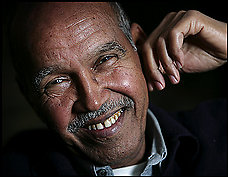
Author Farah’s own background as an exiled Somali makes this novel particularly vivid, and the cultural conflicts and the pressures placed on Jeebleh’s family loyalties ring with truth. As he represses his American values and makes some major decisions as a Somali, Jeebleh becomes part of the story of Somalia, “I’ve taken sides and made choices that may put my life in danger.” Stressing that it is “only when there is harmony within the smaller unit,” i.e., the family, that “the larger community finds comfort in the idea of the nation,” Farah creates a taut novel in which the tensions within the family are a microcosm of the tensions within the country. Realistic in its descriptions and allegorical in its implications, Farah’s novel is a breathtaking and sophisticated study of violence and betrayal certain to receive international recognition.
Notes: The author’s photo by Melina Mara appears in http://www.washingtonpost.com
The children playing football in a devastated street appear on http://carleslopezbtx.blogspot.com/
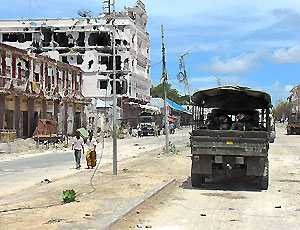
Street scene in Mogadicio: http://www.lastampa.it
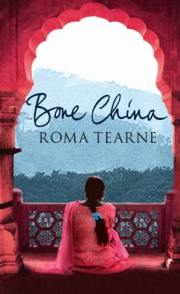 r Roma Tearne, who fled the civil unrest in her native country when she was ten, revisits the years leading up to the Sri Lankan Civil War (1983 – 2009) and its effects on families in her second novel, Bone China. In this novel, she is more interested in family issues than in politics, focusing on the lives of a Tamil Catholic family as it faces the inevitabilities of violence and warfare on their small island nation. Her previous novel,
  arious movements competing for attention in the small island country in the years immediately after World War II. The Tamils, who have been dominated by both the British and the more favored local Sinhalese, plot their revenge on those they perceive responsible for their previous misery. The Sinhalese plot their own responses. Violence is inevitable.
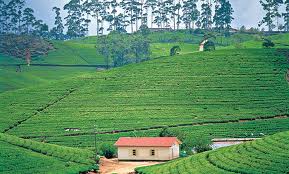 ant family saga involving all these characters, and though they tend to be somewhat stylized in personality and somewhat predictable in their behavior, she succeeds in keeping the action moving and the picture of life in Sri Lanka developing, even as the violence is taking its course and irrevocably changing the face of the country. Not surprisingly, the characters who have gone to England discover in Part II that their dreams have been unrealistic. “In this country, ambition alone isn’t enough,” they learn. “You need much more than ambition here.” Only one character is able to make the transition between the old life in Sri Lanka and the new life in England.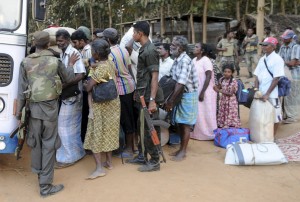
 heo Saramajeeva, a successful writer and film-maker in London, has returned to his native country, Sri Lanka, seeking solace in his spiritual “home” following the traumatic death of his Italian wife. The civil war is on, and Sinhalese government soldiers patrol the roads and beaches. Though Theo, a Sinhalese, sees much evil in his own people and much good in the enemy Tamils, he does not fear violence to himself–he believes that reason can triumph, given a chance. In a separate plot line, Vikram, a Tamil boy soldier-killer, is adopted by a Sinhalese at age twelve and provided with schooling and a better life, but his guardian is gone for years at a time, leaving Vikram virtually on his own. Remembering the terrible deaths of his family, he soon finds his own spiritual “home,” once again, among the Tamils–both the separatists and those who want more than a separate state–Tamil domination of the entire country.

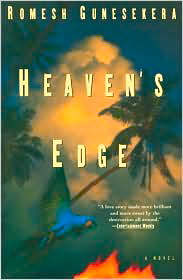 Edge is unique–it is not a romance, not a war chronicle, not a religious allegory, not a plea for ecological responsibility, and not science fiction, though it contains elements of all these genres. Marc, a young college graduate from London, has returned to an unnamed island, much like the author’s island of Sri Lanka, on a mission to connect with his father’s memory. His father, a military pilot, left the family in England when Marc was a very young child and returned to the island where he died while on a mission. Marc’s doting grandfather, who raised him, never understood what drove his son to return to the very island he himself had escaped.
 Sometimes enigmatic and even a bit preachy, the novel is at once magical and nightmarish, full of myth and allegory at the same time that it offers haunting, cautionary tales about the past and the use of violence to change the present and affect the future. Echoes of Adam and Eve and the Garden of Eden, the fall of man, legends about peacocks and leopards, and episodes telling the importance of love and respect pervade the novel, giving it immense color and depth. Clearly a pacifist, Gunesekera says, “The art of killing cannot be our finest achievement…Nothing is inevitable.”
 When Albert Pharoan makes this statement to Golda Myerson, she doesn’t hear a thing. “She shudders, as if she’d received an electric shock. She would like to kill him.” A Russian Jew who has arrived in Palestine by way of Milwaukee, Golda Myerson (later Meir) is bound “in an organic way to the earth,” working on a kibbutz in 1923, and feeling as if her arrival in Palestine is a return to her ancestral “home.”
 affair takes place during major policy decisions by the high-powered leaders with whom Golda associates, well described here, but Nassib’s point of view is different from that of most western “founding-of-Israel novels.” Nassib points up the weakness of the British governors, emphasizing that their vacillation between promoting a Jewish homeland and back-tracking to avoid trouble among the Palestinians is a major factor in the hostilities, and their ill-conceived withdrawal when tensions are at their height contributes to the bloodshed. Massacres of Jews by Arabs are described here, but so, too, are the less publicized, but equally bloody, massacres of Arab peasants by the militant Jewish members of Irgun. Extremists on both sides come under fire as Golda and Albert try to keep love alive.