“One mustn’t have human affections–or rather one must love every soul as if it were one’s own child.”
Graham Green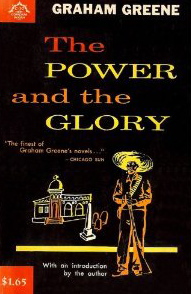 e’s most elaborate and personal examination of the good life–and the role of the Catholic church in teaching what the good life is–revolves around an unnamed “whiskey priest” in Mexico in the 1930s. Religious persecution is rife as secular rulers, wanting to bring about social change, blame the church for the country’s ills. When the novel opens, the church, its priests, and all its symbols have been banned for the past eight years from a state near Veracruz. Priests have been expelled, murdered, or forced to renounce their callings. The whiskey priest, however, has stayed, bringing whatever solace he can to the poor who need him, while at the same time finding solace himself in the bottle.
Constantly on the move, the priest suffers agonizing conflicts. His sense of guilt for the past includes a brief romantic interlude which has produced a child, and though he recognizes that he is often weak, selfish, and fearful, he still tries to bring comfort to the faithful. Pursued by a police lieutenant who believes that justice for all can only occur if the church is destroyed, and by a mestizo, who is seeking the substantial reward for turning him in, the desperate priest finally decides to escape to a nearby state in which religion is not banned so that the police will stop killing hostages taken in the villages he has visited.
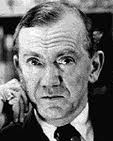
The police pursuit of the priest is paralleled by their pursuit of a “gringo” murderer, a man so base that he thinks nothing of murdering children, yet the priest even sees value in this man’s life, and when the gringo, the mestizo, the lieutenant, and the priest finally come together, Greene’s philosophical and religious analysis reaches its climax. For all their faults, the priest is often heroic, the murdering gringo still has a soul worth saving, the mestizo (a Judas figure) offers the priest a better chance to see God, and the lieutenant eventually sees the priest as a human, not simply as a symbol.
Greene’s novel is beautifully constructed–intricate, filled with symbols and parallels, yet often sensitive and moving. Though the action moves through an almost unremittingly bleak landscape and the sense of dread is positively palpable throughout, the novel eventually reveals the “power” and the “glory” of faith. In this sense, the novel is as much a philosophical and religious tract–specifically an examination of the Catholic faith–as it is a human story. While some may find the novel dogmatic and the priest’s agonized self-examination sometimes tedious, others will find the novel uplifting and inspiring.
Notes: The film version of this novel stars Alec Guiness, Maureen O’hara, and Burl Ives.
Also reviewed here: OUR MAN IN HAVANA
and THE THIRD MAN
 Written originally as the outline for the screenplay of the famous 1949 film of the same name, Greene sets the story in Vienna just after World War II, employing the sectors established by the conquering British, Americans, French, and Russians to provide tension, mystery, and an almost palpable aura of menace as residents and visitors alike must deal with four different governments, four sets of officials, and four collections of laws as they move throughout the city. With massive bomb damage, the city is still emerging from devastation. Black markets, selling everything from food to penicillin, abound.
 or saw the traffic accident that killed Lime and observed three men carrying Lime’s body from the scene. Only two of those men have been identified–the third man has vanished.
 kly humorous, the novel is a curiosity among Greene’s entertainments, since this story was never written to be a novel at all. Intensely visual in its descriptions and action, it lacks the characterization and thematic focus which one associates with most of Greene’s work. The novel’s dialogue, rather than narrative, conveys the story, as it does in the film, and the setting in a war-torn city adds to the sense of danger and drama. Certainly not one of Greene’s “finished” novels, it is still fun to read, especially when one is familiar with the even better film of it, directed by Carol Reed and starring Orson Welles, Joseph Cotton, and Trevor Howard. Of particular interest to those studying writing and film-making, Greene’s novella is full of wit and dark theatrics, and includes everything from a chase through the sewers to a love story.
 d by the [London] Daily Telegraph as “a criminally neglected British author,” Patrick Hamilton wrote nine novels from the 1920s through the early 1950s, along with the famous dramas of Rope and Gaslight, and though he earned the admiration of a host of famous authors, from Graham Greene and Doris Lessing to Nick Hornby, he never achieved the popular success he deserved, either in his own time or throughout the twentieth century. In this decade, however, virtually all his novels have been reprinted in both Europe and in the US, and he is finally beginning to be recognized for his astute observations about his times and for his insights into the minds of his characters.
 akes place inside George’s head, is strong and emotionally affecting, and though many contemporary readers will be frustrated at George’s passivity in the face of Netta’s abuse, few will fail to empathize. Based in part on his own life, the novel is an intense psychological drama written by a man who became an alcoholic at a young age, after being disfigured in an accident. Frequently developing passionate but unrequited attachments, he wrote about these women in his novels. Famed actress Geraldine Fitzgerald was recognized as the model for Netta Longdon, something her obituary confirms.
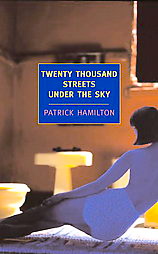 If you have never heard of Patrick Hamilton, you are not alone. Described by the[London] Daily Telegraph as “a criminally neglected British author,” Hamilton wrote nine novels from the 1920s through the early 1950s , along with the famous dramas of Rope and Gaslight. Almost Dickensian in his sympathetic attention to London’s poor and struggling classes, Hamilton’s base of devoted admirers includes such notables as J. B. Priestly, Graham Greene, John Betjeman, Doris Lessing, and most recently Nick Hornby, according to the [UK] Independent. Now, however, Hamilton may finally be gaining the widespread public recognition he so richly deserves. Three of his novels have been re-published to wide acclaim in the US since 2006– two of them by the New York Review of Books and one by Europa Editions–and a similar revival has occurred in the UK.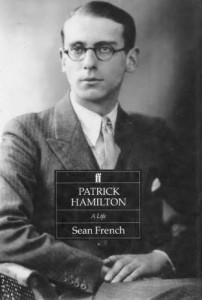
 “
“ The Siege of Pleasure,” the second novella, is Jenny’s story, detailing her descent into prostitution. In delightful understatement, the author confirms that “It is doubtful whether Jenny could be said to be the owner of either character or conscience.” Though she has come to London to work—and finds a job as maid to a pair of hilarious old women and their deaf brother, which gives some much-needed comic relief—she soon becomes interested in being a “mannequin” and responds to a meeting with someone she thinks can help her. The “victim” of a “glass of port” while out with friends, Jenny wakes up the next morning in a strange bed—her very gradual intoxication and equally gradual loss of control depicted with agonizing slowness.
 “Plains of Cement,” the final novella, concentrates on the homely but loving Ella, the barmaid at The Midnight Bell, a woman in her late twenties who is a “little mother” to the late-at-night patrons. Hopelessly in love with Bob, who “loved her because she was a good woman and loved the other because she was a bad woman,” Ella soon finds herself being courted by Mr. Eccles, a much older man with a healthy bank account. Though he sometimes suggests that they are engaged, Ella is not sure: “If [his attention] was a feather in her cap, what a miserable feather!” Mr. Eccles, both peevish and demanding, soon attempts to take over her life, “superadding Religion to all the other mental thumbscrews and tortures,” he has applied. As Ella tries to find an escape, her plight elicits the greatest of empathy from the reader.
 With its ironic title, suggesting that the lives of the denizens of The Midnight Bell are as far “under water” as Captain Nemo was in the Nautilus, this novel explores three desperate characters with sensitivity, care, and genuine emotion. The overarching problems of alcohol in two of the sections parallel the alcoholism of the author, while the development of the characters and the author’s ability to involve the reader are enough to overcome the superficially trite plot lines. A rediscovered classic of the 1930s.
 oth Ian McEwan’s Atonement and Michael Frayn’s Spies in its plot, this 1953 novel, recently reprinted, tells of a pre-adolescent’s naive meddling in the love lives of elders, with disastrous results. Set in the summer of 1900, when the hopes and dreams for the century were as yet untarnished by two world wars and subsequent horrors, this novel is quietly elegant in style, its emotional upheavals restrained, and its 12-year-old main character, Leo Colston, so earnest, hopeful, and curious about life that the reader cannot help but be moved by his innocence.