“They don’t get the pleasure out of life that they might.”
When “the Euro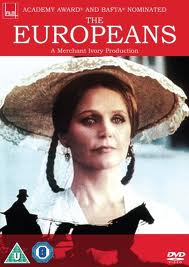 peans” arrive unexpectedly to stay at the New England home of their strait-laced cousins, the Wentworth family, the conflicts between European and American values, so often highlighted in the novels of Henry James, are quickly established in this 1979 Merchant-Ivory film. Screenwriter Ruth Prawer Jhabvala stays close to the tone, themes, and action of the James novel as she brings to life a strict and pious New England family which is suddenly exposed to a whole new way of life. Felix Young (Tim Woodward), a charming and energetic European artist/actor/traveler, without prospects in Europe, has accompanied his sister Eugenia, Baroness of Munster (Lee Remick), to America while her marriage is being dissolved. Here, where no one knows them, Eugenia believes that “natural relations,” as opposed to the “artificial relations” of Europe will prevail.
Young Gertrude Wentworth (Lisa Eichhorn), always the most iconoclastic member of the family, is immediately smitten by Felix, finding him a welcome relief from the earnest but stuffy Rev. Brand (Norman Snow), who has been courting her. While Felix and Gertrude are discovering each other, Eugenia works her wiles on the Wentworth men, focusing both on Clifford (Tim Choate), the young son and Wentworth heir-to-be, and on neighbor Robert Acton (Robin Ellis), flirting and awakening them to new and exciting possibilities.
The late autumn foliage sets off the Federal Period homes (the exterior being the Barrett House in New Ipswich, NH, and some interiors from the Salem [MA] National Heritage site), all perfectly maintained and appropriately furnished, which serve as the setting for the action, and the cinematography (Larry Pizer), shows off naturally beautiful outdoor scenes (some of which take place in an elegant antique gazebo), along with dreadful rains and mud. The original score by Richard Robbins is one of the film’s highlights–romantic without being cloying, and often haunting. Jill Eichhorn, as Gertrude, is charming as she represses her sense of fun at the beginning and then lets go, under the influence of the captivating Felix.
 Well photographed, winningly scored, and beautiful to look at, this early Merchant-Ivory film is a lovely entertainment, but it does have two weaknesses. The father (as played by Wesley Addy) seems unrealistically puritanical, especially for a man who reads the transcendentalists, lives only seven miles from Boston, and is a Unitarian (not a dogmatic denomination). And Lee Remick, as Eugenia, is too mature for the role. In her mid-forties when she makes this film, her serious flirting with twenty-ish Clifford does not ring true, nor does her calculating manipulation of the family. Lacking the depth of the novel, the film is a wry and often humorous look at mid-19th century life.
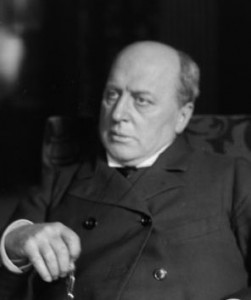
Notes: The photo of Henry James, part of the George Eastman Collection, appears on http://centerforfiction.org
The Barrett House photo is from Wikipedia.
The film poster is from http://dealoz.co.uk
Also reviewed here are six more Henry James novels and DVD editions. For the listings, click on the tab for Authors or Titles at the top of the Home page.
 medieval bowl, created from a single perfect crystal, has, despite its appearance, a flaw–a crack which reduces its value. Henry James, author of the novel on which this Ruth Prawer Jhabvala screenplay is based, uses the gilded bowl as a metaphor for love and marriage, focusing on two couples, whose overlapping relationships and marriages prove to be as fragile and damaged as the bowl. Produced by Merchant-Ivory and sumptuously filmed by Tony Pierce-Roberts on locations in Italy and England, the film brings the intensity of the psychological conflicts to life.
 Director James Ivory inserts old kinescope films and newspapers of turn-of-the-century America into the film to illustrate the on-going contrast between life in America and life in Europe, a constant James theme, as Verver builds his new American museum of European treasures. Lovers of Henry James will find this film faithful to James’s intents, while those less enamored of his convoluted literary style may be inspired to read him because of the psychological sophistication of this plot–and this film.
 When Isabel Archer, a bright and independent young American, makes her first trip to Europe in the company of her aunt, Mrs. Touchett, who lives outside of London in a 400-year-old estate, she discovers a totally different world, one which does not encourage her independent thinking or behavior and which is governed by rigid social codes. This contrast between American and European values, vividly dramatized here, is a consistent theme in James’s novels, one based on his own experiences living in the US and England. In prose that is filled with rich observations about places, customs, and attitudes, James portrays Isabel’s European coming-of-age, as she discovers that she must curb her intellect and independence if she is to fit into the social scheme in which she now finds herself.
 As the setting moves from America to England, Paris, Florence, and Rome, James develops his themes, and as Isabel’s life becomes more complex, her increasingly difficult and emotionally affecting choices about her life make her increasingly fascinating to the reader. James’s trenchant observations about the relationship between individuals and society and about the effects of one’s setting on one’s behavior are enhanced by the elegance and density of his prose, making this a novel one must read slowly–and savor.
 of the most seductive of all ghost stories, Turn of the Screw is not a tale for young people inured to Halloween I and II or Tales from the Crypt. It is a sophisticated and subtle literary exercise in which the author creates a dense, suggestive, and highly ambiguous story, its suspense and horror generated primarily by what the author does NOT say and does not describe. Compelled to fill in the blanks from his/her own store of personal fears, the reader ultimately conjures up a more horrifying set of images and circumstances than anything an author could impose from without.
 eter Quint, have corrupted the souls of little Flora and Miles and have won them to the side of Evil. The children deny any knowledge of ghosts, and, in fact, only the governess actually sees them. Were it not for the fact that the housekeeper, Mrs. Grose, can identify them from the governess’s descriptions, one might be tempted to think that the governess is hallucinating.
 a suspenseful but enigmatic Victorian version of a Faustian struggle for the souls of these children. The ending, which comes as a shock to the reader, is a sign that such struggles should never be underestimated. As is always the case with James, the formal syntax, complex sentence structure, and elaborately constructed narrative are a pleasure to read for anyone who loves language, formality, and intricate psychological labyrinths. (As is obvious from the reviews on Amazon by high school students, however, these literary “charms” may be less alluring to those on whom they are imposed as required reading.)
 Hossein Amini has abandoned the dense prose and convoluted syntax of Henry James’s most complex and difficult novel and created instead a fresh, emotionally nuanced, and psychologically astute script, nominated for an Academy Award. With a remarkable cast, breathtaking cinematography (Eduardo Serra), and a soft background score filled with strings, harp, and piano (Edward Shearmur), Director Iain Softley has created a magnificent film that succeeds in being emotionally affecting, intellectually stimulating, and aesthetically rewarding, a film in which every element contributes to a satisfying whole.
 succeeding scene, bridges framing action on the canals, and a dramatic use of darkness and light. The Oscar-nominated costuming (Sandy Powell) adds to the mood and atmosphere, with the music providing an effective bridge between scenes. Every aspect of the film works, and not a word or gesture is wasted in this quietly presented drama of great power.