“I just wish I was more of a Human Being.”
The cruelties o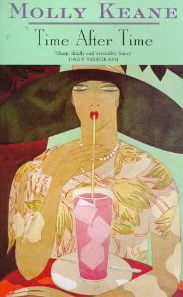 f life, both deliberate and accidental, play out with delicious irony in this very dark precursor to the modern noir novel. An elderly brother and his three aging sisters, all physically and emotionally maimed, are required, under the terms of their mother’s will, to share the rapidly deteriorating family estate, Durraghglass, near Cork, Ireland. April, the only sister who ever married, is totally deaf but refuses to acknowledge it. May, with a grossly deformed hand, compensates by making “artistic” pictures out of scraps of tweed–and by incidental shop-lifting.
June, severely dyslexic, actively manages the “farm.” Jasper, blinded in one eye by June in a childhood accident, runs the moldy kitchen and makes gourmet meals out of scraps, sometimes even borrowing from the dogs’ meals to improve meals for the family. Each of the Swift family members, firmly controlled by “Mummie” and her memory, leads an almost totally isolated, secret-filled life, unable to share feelings or care for anyone else.
Their already precarious lives are tested with the unexpected arrival of Leda, a formerly glamorous, half-Jewish cousin from Austria, whom they all thought “perished in some cold, unnamed camp, most likely. Who wants sordid details?” Leda, once April’s best friend, bears grudges that hark back to her teen years, when her closeness to the family was deemed threatening to April’s mother and she was summarily removed from Durraghglass, never to return. With subtlety and cleverness, author Keane slowly reveals elements of Leda’s background and her connections to the family, using the dialogue, often at cross-purposes and always mordantly humorous, to reveal information, motivation, and character simultaneously. Irony builds upon irony as Leda’s actions and remarks, often misunderstood, succeed in turning one sibling against another.
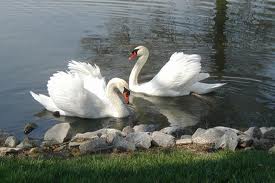 The myth of Leda and the Swan plays constantly in the background, with numerous symbolic references to the swans on the pond at Durraghglass and to Leda’s swan-like preening. The Swifts, to continue the bird imagery, are no competition for Leda. As the tension of this domestic drama ratchets up and Leda wreaks her havoc, fate has a few ironies left in store. Unexpected resolutions, equivalent to those of a Greek tragedy, bring the novel to a wickedly satisfying close.
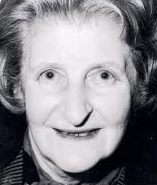
Notes: The author’s photo appears on http://www.irishtimes.com
The swan photo is from http://freepages.genealogy.rootsweb.ancestry.com
 eneally’s Booker Prize-winning, fictionalized biography of Oskar Schindler memorializes a member of the Nazi party who endangered his own life for four years, working privately to save Jews from the death camps. A playboy who loved fine wines and foods, he was also a smooth-talking manipulator (and briber) of Nazi officials, as well as a clever entrepreneur, already on his way to stunning financial success by the early days of World War II. Nowhere in Schindler’s background are there any hints that he would one day become the savior of eleven hundred Jewish men and women.
 Presenting episodes from the lives of some of the “Schindlerjuden,” Keneally highlights their humanity, creating moments of high drama. Characters such as Leopold Pfefferberg and factory manager Itzhak Stern move in and out of the narrative, illustrating graphically the extent to which their lives depend upon Oskar Schindler, while the constant intrusion of sadistic SS commandant Amon Goeth in Schindler’s life shows the fragility of their security. Other stories, of people who just missed being saved by Schindler, highlight the arbitrariness of fate–chance–in their (and our) lives.
 l, Keneally stresses the importance of bearing witness and testifying to the atrocities. In one of the novel’s most moving passages, Schindler and his lover ride horses to a ridge where they can view the expulsion of the Jews from the Krakow ghetto, watching, horrified, as old or crippled laggards are murdered in front of Jewish children. “They permitted witnesses because they believed the witnesses, all, would perish, too.” Later, Schindler works with a Zionist rescue organization, secretly going to Budapest to testify about the hidden death camps.
 er a character with whom the reader can identify. Keneally’s meticulous research and his portrait of Schindler after the war, beloved by Jews but at loose ends personally and professionally, make this novel an unforgettable study of character and time.
 has achieved more notoriety for its sex scenes (shocking in 1930, when the book was written) than for its character studies, Lady Chatterley’s Lover focuses on the affair between Constance, the “sturdy” young wife of Clifford Chatterley, and the gamekeeper of the Chatterleys’ estate in the remote midlands. Constance, who married Clifford a month before he left for World War I, has become his caretaker since his return from the war, paralyzed from the waist down and impotent. A writer who surrounds himself with intellectual friends, Clifford regards Connie as his hostess and caregiver and does not understand her abject yearning for some life of her own.
 sidered to be D. H. Lawrence’s most autobiographical novel, Lawrence’s main character, Paul Morel, is a frail, artistic boy, having more in common with his mother than with his coal miner father. Paul’s mother had some education before she married the once-attractive Walter Morel, but he eventually succumbed to alcohol and a bleak life in the pits, and Paul’s older brother became the mainstay of the family. When he left for London and later died, his mother transferred her dependence from him to Paul.
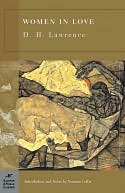 1920 and often regarded as D. H. Lawrence’s greatest novel, Women in Love is the complex story of two women and two men who scrutinize their lives and personal needs in an effort to discover something that makes the future worth living. The personal and social traumas of post-World War I, combined with the rise of industry and urbanization, have affected all four main characters, often at cross purposes as they explore love and its role in their lives. Intensely introspective and self-conscious, each character shares his/her thoughts with the reader, allowing the reader to participate in the inner conflicts and crises that each faces.