“I am a failure as a feminist woman. I am a failure as a perfectly ordinary woman as well, I am too clever – I said that to Emelie once when I was drunk, she got angry with me, really angry, she looked at me as if I was a traitor. I have always felt like a traitor. I am a traitor in every camp because I don’t really need other people. That is the greatest betrayal of the sisterhood, an awareness that you have no need for it.”
 The intensely self-conscious narrator of this novel is nowhere nearly as self-aware as she would have her readers believe. A young woman who works in the local hospital cafeteria in Norrkoping, Sweden, to pay the rent on her small apartment, the narrator believes that she is “more than the situation in which [she] finds herself when [she] is wearing [her] ugly uniform.” Unlike her fellow employees of the hospital, she has attended college, leaving, she says, because she never knew she was expected to do any more than learn facts, and she “had gone all the way through high school without really learning the skill of abstract thought,” something that more insightful people learn as part of growing up. She believes that her leaving was not her fault, and she is now at loose ends. She has few female friends, even among those people she knew in college. “I cannot get away from the notion that all forms of sisterhood would mean lowering myself to an inferior level,” she believes, an attitude which does not endear her to other women.

As the story line begins, Swedish author Therese Bohman chooses incisive details to illustrate her speaker’s life and thoughts, often using images that reveal far more than the speaker herself recognizes. Showing off her “knowledge” for the reader, for example, she describes her love of Baudelaire, whom she regards as “lonely”; she imagines Dostoevsky’s “man from underground” as part of her own social group, believing that he would have been “more fun to hang out with than the rest of the group”; and she refers pointedly to Thomas Mann’s Death in Venice and The Magic Mountain, which she has just started reading. She thinks she wants to be a writer like them, but in the meantime, she amuses herself by flirting with the doctors who come into the cafeteria, “particularly the tall handsome consultant [Dr. Carl Malmberg]” with whom she imagines a romantic story. She “sees” him in her studio apartment, “examining my books, impressed by what he sees.” She handles the issue of her ugly work uniform by wearing a fake tan on her arms, a few drops of perfume on her throat, and pretty underwear “which I sometimes allow a glimpse of through the white, shapeless blouse, a hint of lace around my breasts,” a reminder that she is “more than the situation in which [she] finds herself.”
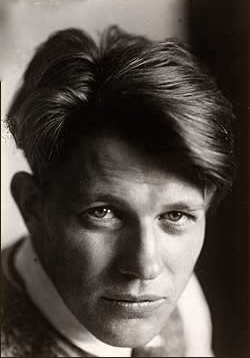
Harry Martinson, Swedish winner of the Nobel Prize for Literature in 1974, seems to have a special message for the narrator regarding her writing.
On her refrigerator, the speaker keeps a photo of Harry Martinson, a Nobel Prize-winning Swedish author – “handsome, young, leaning forward, with lovely thick hair,” conveying an inspiring “personal” message for the narrator and would-be writer: “If I could do it, you can do it.” A few pages later, as she is walking along the waterfront, however, she observes the statue of Moa Martinson, wife of Harry. Moa, an author of proletarian literature, seems to “looking right through everything around her. “She can see that I want to go to bed with her husband. Traitor, that is what she thinks of me.” Before long, Dr. Malmberg, a Senior Consultant, rises to the obvious bait dangled by the narrator, with the expected results. Older and married, he is in her bed not long after offering to drive her home. For her, “It is as though my whole existence has grown bigger, deepened, acquired both a greater darkness and a greater light…a pulsating bass line beneath everyday life.” However adult she thinks she may be as a result of her sexual experience, she can hardly wait to share the news with two fairly casual friends, an irony for someone who has just experienced “the one aspect of life which others don’t talk about.”

Moa Martinson, wife of Harry, also seems to have a message for the speaker. “Traitor, that is what she thinks of me,” for wanting to seduce her husband.
From this point on, the nature of the speaker’s affair becomes more complicated (and resistant to description without including spoilers). As clichéd and immature as the speaker’s observations are, and as frustrating as she may seem to people reading this review, the author has big plans for her and her role in the story, and few, if any, readers will be disappointed as the novel develops. Bohman paves the way for some of the surprises by including even more ironic details which the speaker does not recognize, and her immaturity serves as a literary device which makes her decisions regarding her affair suspect from the outset. The behavior of Carl Malmberg, on the other hand, becomes the crux of the developing action. He has promised nothing, has enhanced the speaker’s life, and has given her hope for the future, though not necessarily with him. She, however, sees herself as a wife-in-waiting, willing to do whatever is necessary to get what she wants.

The narrator lives within walking distance of the Ostgota Theater, Sweden’s largest regional theater. Photo by Hedwig.
The turning point regarding the speaker and her expectations comes without warning – a total surprise, necessary for the plot though a bit challenging to the novel’s realism. After the first shock of discovery about this “elephant in the room,” however, most readers will probably be delighted by the way the author handles the new development. As the naïve narrator becomes more and more manipulated by an outside force, the reader simultaneously hopes that she emerges without major psychic damage and wishes for her to make some grownup decisions of her own. Fortunately, author Bohman does not leave her audience in suspense. The denouement and the resolution tie up all the details and “turn the page” for the main characters, bringing satisfaction to even the most jaded reader.
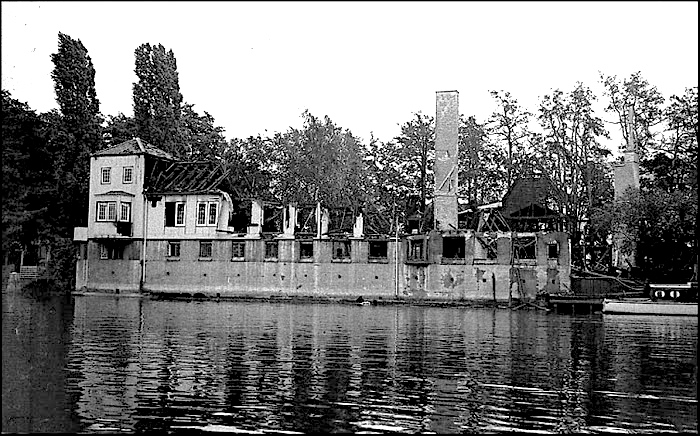
The dance hall on Stromsholmen, the little island in the middle of the Motala River in Norrkoping, was destroyed by fire in the 1930s. The narrator thinks dancing here would feel like dancing on the Titanic, an ironic commentary on her own situation with Carl Malmberg.
What makes the twists work is the author’s total control of the narrative. Few people will identify with the speaker-narrator – she is too naïve and too self-important for readers to root very strongly for her success – and the author recognizes this. What she does is provide hints, ironies, and hidden meanings within all the events occurring to the narrator which the reader may catch but which the narrator misses, creating tension in which the reader, sometimes knowing more than the narrator, hopes that the action will resolve itself as it should, while the narrator bemoans the complications. Even a detail as seemingly innocent as the 1930s fire in the dance hall on Stromsholmen, the little island in the middle of the Motala River, Norrkoping’s Ile de la Cite, carries its own ironic hints for the future: The speaker, imagining herself dancing there, sees “the lights reflected in the water as it races past on its way out to sea…it must have been like dancing on the Titanic.” The narrator’s fate is sealed – maybe.

The speaker enjoys walking around, beside, and over the river on Norrkoping’s waterfront.
Photos, in order: The author’s photo appears on http://www.svb.se
Swedish author Harry Martinson won the Nobel Prize for Literature in 1974. The narrator keeps his picture on her refrigerator because he is so handsome and because she believes he has a message for her: http://www.lekti-ecriture.com
Moa Martinson, wife of Harry, is a proletarian writer who has also been a loom worker on the waterfront. She is memorialized by a statue on the waterfront (by Peter Linde), and the narrator believes that she, too, has a message for her: “Traitor.” She can see I want to go to bed with her husband. Photo from https://commons.wikimedia.org
The Ostgota Theater is the largest regional theater in Sweden. Photo by Hedwig on Hedwig’s blog, a site with many gorgeous photos of Norrkoping, the site of this novel. Here is her blog: https://kadermo.files.wordpress.com/
Stromsholmen, the little island in the middle of the Motala River in Norrkoping, was destroyed by fire in the 1930s. The narrator thinks dancing here would feel like dancing on the Titanic, an ironic commentary on her own situation with Carl Malmberg. “Lights reflected in the water as it races past on its way out to sea…It must have been like dancing on the Titanic.” http://www.nt.se
The speaker enjoys walking around, beside, and over the river on Norrkoping’s waterfront. https://www.routeperfect.com/
ARC: Other Press
 The woman who manages to get herself into the tree with her suitcase is not a typical protagonist, nor is she even typical of the people we come to know within the book as it develops. Beatriz Yagoda, sitting in her tree in the south of Rio, is a successful, middle-aged literary novelist, and she does not sit in the tree for very long. That night she disappears, and five days after that, her translator, Emma Neufeld, living in Pittsburgh, receives an e-mail from a stranger asking if she is aware that the woman for whom she has translated two novels is now missing in Brazil. Leaving her long-time lover, who has been planning their wedding, Emma immediately takes off to join Beatriz’s adult children as they try to find Beatriz somewhere in Rio or its environs. They all believe that Beatriz has an unfinished novel hiding somewhere, but when they check her computer, they discover not only the mysterious novel, with pages of what appears to be code, but evidence that Beatriz has spent over six hundred thousand dollars that she does not have, gambling on-line. Soon everyone is looking for Beatriz – her family, her translator, her publisher, and the loan shark who will stop at nothing to recoup the huge sum Beatriz owes him.




 celandic author Yrsa Sigurdardottir’s prize-winning noir thriller features several murders, all of which take place aboard a large yacht which has been traveling from Portugal to its base in Reykjavik during a gale. This “locked boat” mystery, similar to the “locked room” mysteries pioneered by Edgar Allen Poe and Wilkie Collins, involves characters “locked” in a place from which they cannot escape, and when a murder takes place, both the victim and the killer are among the characters known to each other and to the reader. The author provides hints and clues throughout as the murders take place, encouraging the reader to become emotionally involved in the search for the killer, as possible motivations for murder are discovered for virtually all the characters. Sigurdardottir takes this a step further, keeping her murderer and her suspects on the “locked boat,” while adding an investigator on shore, after the fact – Thora Gudmundsdottir, a lawyer/sleuth who has been hired at the behest of a devastated family.




 Among South American authors, Claudia Pineiro is one of my unabashed favorites, at least in part because the expectations she creates in her readers combine with her sense of irony and dark humor to deliver clever plot twists and sudden narrative shifts. The conclusions of her novels always leave me with a smile on my face – tricked again. Like her three previous novels which have been translated and released in English (by Bitter Lemon Press – see links below) this novel too, is full of surprises. Pineiro always provides depth to her work, vividly depicting the values of her society and the ethical conflicts which often haunt her main characters. Dishonesty and crime certainly play strong roles in her plots, but she is less concerned with depicting violence and gore than in illustrating the interplay of good and evil in her characters’ lives; she writes with a light tone, almost of self-mockery, not characteristics one usually associates with “crime writing.” Here, however, the author also introduces a dramatically altered narrative style, one which allows her to expand her themes and the vision of the world as seen by her characters.




 to be published in English, German author Christopher Kloeble creates a thematically complex novel in which he examines the most crucial aspects of everyday life for several families over several generations as they try to figure out who they are and what their roles are within their own family histories and in the histories of others close to them. Though most thoughtful people reflect on their parents and siblings and their own roles within their families as part of their growing-up process, the relationships in this novel are not as clear-cut as they are in most readers’ lives. Even the question of who is your father or who is your mother does not inspire an automatic answer for some of the characters here. As Kloeble examines three generations of characters in two story lines, from the aftermath of World War I to the present, the exact nature of their connections is often hidden, not only from the reader but also from the characters themselves.






.jpg)