“Sixteen, I reflected, biting into a stolen pie. By this time in her life, my sister Mary had been pregnant. Ovid had dedicated his life to poetry. Queen Elizabeth had seen a suitor beheaded. Romeo and Juliet were dead. Whereas I, Margaret Lucas, was nothing if not in health, no single true adventure to my name.” – Margaret Lucas, 1639.
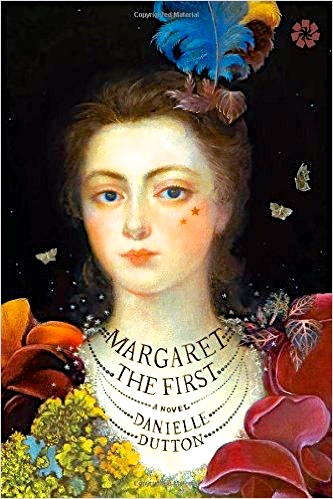 However bored Margaret may be at the age of sixteen, her life, like the lives of everyone else in England, is about to change: war is on its way, with Parliament working to annul the powers of the king, who responds by taking up arms against his people. Oliver Cromwell, an intense Puritan, is about to lead the “Roundheads,” or Parliamentarians, into fierce battle against the crown, and everything Margaret has ever known is about to be challenged. A member of the high aristocracy who has known nothing but elegance in home, dress, and manners, she will soon become an attendant of Queen Henrietta Maria, wife of Charles I, whom she will follow into exile when the Queen and her court leave for France and the court of Louis XIV. It is in Europe where her life begins to take shape and where she will be exposed to new ideas in science, philosophy, and writing. In this period in which the role of women like Margaret has been carefully circumscribed, she will create and live through many adventures of her own making, challenging the social fabric of her class and her country.
 In this remarkable and insightful novel, author Danielle Dutton recreates the life of Margaret Lucas (1623 – 1673) from her teen years until her death years later. From her exile in France with the Queen of England to her marriage to William Cavendish, an older widower who patiently accepts her unusual views of life and, eventually, her growing need for independence, Margaret shines here as a modern woman, one with whom the reader identifies because she feels so familiar, so modern. Despite the fact that as the Duchess of Newcastle she and her husband associate with kings, queens, philosophers, artists, and writers, Margaret is shy and vulnerable enough to make a modern reader hope for her success, despite some of her disastrous missteps and chronic inability to put herself into the shoes of others and to see herself as others see her. The history of the period, which the narrative wears lightly, focuses clearly on Margaret and her personal goals, and as the chronology slides smoothly from the civil war to the Restoration and eventually to Margaret’s career as a writer, the reader recognizes that it would actually be possible for a woman like Margaret to become an iconoclastic feminist recognized for her talent in the world in which she lived almost four hundred years ago.
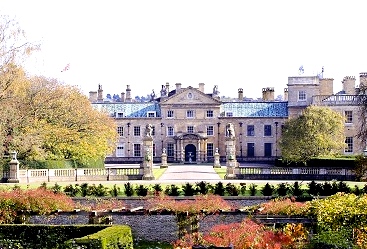
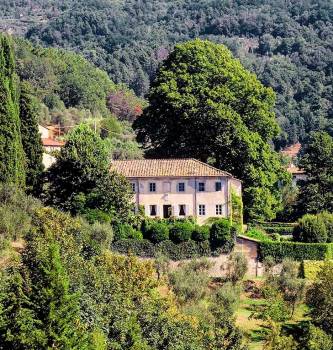
Welbeck Abbey, William Cavendish’s primary home before the Civil War.
William Cavendish, whom Margaret marries in Paris in 1645, makes no pretenses about his political and financial difficulties when they are married. The owner of the partially restored Bolsover Castle, built in the 12th century in Devonshire, and of a country estate built on the site of Welbeck Abbey in Nottinghamshire, Cavendish has seen his property in England, like that of other aristocrats, seized by the Puritan government. In debt, he still finds elegant living accommodations in Paris and elsewhere among friends with large European estates. A dramatist in his spare time, Cavendish is described as a “world-class host,” a patron of Ben Jonson and John Dryden, and a friend of writers like Thomas Hobbes, Robert Boyle, Rene Descartes, John Evelyn, Samuel Pepys, and dramatist Richard Flecknoe. Their lives involve balls and galas for kings, queens, and other European royalty, many of them held at their own rented quarters, and thanks to their elaborate lifestyle, the reader gets no sense that Cavendish is truly penniless until well into the novel.
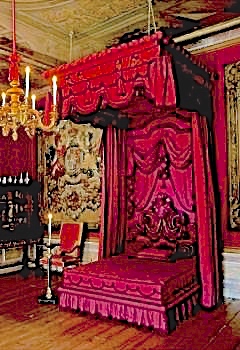
“It was the century of magnificent beds. Beds like ships from China, or beaded purses, a cloud of scented silk. Now an elaborately embroidered brocade curtain exposed my arm….” – Margaret on her wedding night.
Before long, Margaret becomes frustrated, however. Childless, she has few outlets for her energy, and since she is inherently shy, she does not mix well socially and is largely ignored. The one area in which she has limitless energy lies in her writing. Untutored, and, she admits, not an expert in spelling and grammar, she nevertheless spends hours writing, then locking away her creations. “Why must grammar be like a prison for the mind?” she wonders. “Might not language be as a closet full of gowns?” Occasionally, when they have learned guests, she forgets her “place” and interrupts the intellectual conversation among the men visiting, after which she feels compelled to disappear, embarrassed, into her own world. Eventually, as the political winds change, Margaret is able to return to London, though William cannot, at this time, and his brother begins buying back William’s inherited estates so that they can bring in some revenue while William remains in debt in France.
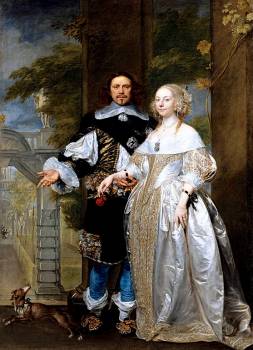
Portrait of William Cavendish and Margaret, in their maturity, by Gonzales Coques
Alone in England, Margaret decides to publish some of her writing without asking anyone for advice. Though one person indicates, regarding the author, that “there are many soberer people in Bedlam,” William turns out to be proud of her, and the book becomes required reading in London’s fashionable parlors where the ladies like to snigger at it. Eventually, after receiving encouragement from someone she admires, she opens her chest of other writing, revisits it, and then publishes again. When William finally returns home to England after the Restoration, he finds his two estates ruined and in need of major repairs, and he and Margaret return to Welbeck Abbey in Nottinghamshire and begin work on the estate and the rest of their lives. She continues her writing, and with The Blazing World, considered the first science fiction novel, she becomes bold, even planning to send a copy to the king. Her confidence veers toward arrogance sometimes, and at one point William hears her telling their guests that “if the schools do not retire Aristotle and read Margaret, Duchess of Newcastle, they do her wrong and deserve to be abolished.”
The saga of Margaret, her insecurities, her boldness, and her furious passion to write, regardless of the writing’s reception within her own society, reveal a modern approach to a writer’s goals and sense of commitment, the willingness to do what is necessary at all costs. The novel feels real and contemporary, though Margaret was real almost four hundred years ago. Dutton’s own writing here is like magic, erasing time and societal expectations in favor of the pure act of creation. And as Margaret becomes the first woman ever to be invited make a presentation before the Royal Academy of London, a feat not duplicated for two hundred more years, readers will celebrate her stamina in the face of her wide reputation in London as “Mad Madge.”

Bolsover Castle in Derbyshire, built originally in the 12th century and partially restored by William Cavendish’s father, is about a day’s drive from Welbeck Abbey.
Photos, in order: The author’s photo is found on http://www.amazon.com
Welbeck Abbey in Nottinghamshire, William Cavendish’s primary home, before it was confiscated by the Puritans, is seen on http://www.hha.org.uk/
“It was the century of magnificent beds. Beds like ships from China, or beaded purses, a cloud of scented silk. Now an elaborately embroidered brocade curtain exposed my arm….” – Margaret on her wedding night. This bed from early 17th century England, is actually located now at Het Loo in the Netherlands. http://www.whilethepaintdries.com
The portrait of mature William and Margaret Cavendish by Gonzales Coques is found on http://projectvox.library.duke.edu
Bolsover Castle in Derbyshire, built originally in the 12th century and partially restored by William Cavendish’s father, is about a day’s drive from Welbeck Abbey. http://www.yellowtom.co.uk/
ARC: Catapult.Co.
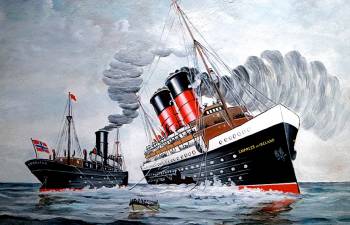
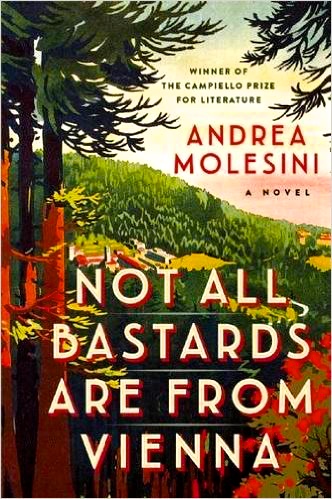 Following the crushing defeat of the Italian army in 1917 by the Germans during World War I, the Villa belonging to the Spada family in Refrontolo, just north of Venice, is requisitioned by the German army and stripped of all its valuables. Crude, victorious soldiers, drunk on their power, delight in tormenting the owners, tearing up cupboards, smashing the contents, and even riding horses inside the Villa until they are stopped by officers in charge. The safety of young females is constantly at risk, and the rules of civilized behavior have been suspended. As one character says, “War and loot are the only faithful married couple.” Living at the Villa which the family has occupied for generations, are the speaker, Paolo, age seventeen, an orphan who has lost his parents and other immediate family in the sinking of the Empress of Ireland in 1914; his grandfather Guglielmo Spada; grandmother Nancy; unmarried aunt, Donna Maria, who acts as the house manager; Teresa, the imaginative cook; and Loretta, her daughter, in her early twenties. Living in a house nearby are the red-haired Giulia Candiani, who has returned to her place of birth because of an indiscretion, a woman who has bewitched Paolo; and her tenant, Grandma Spada’s “Third Paramour,” Pagnini, who occupies a basement room there.

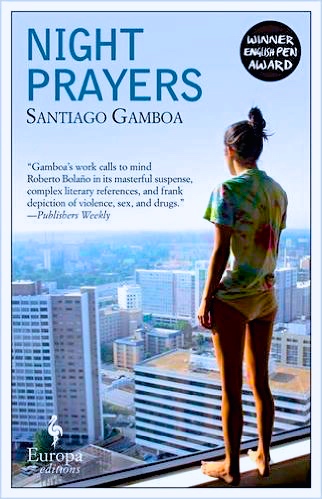 Recognized as one of the most exciting young novelists in Latin America, Santiago Gamboa of Colombia has written a novel which defies easy labeling. Filled with non-stop action and much like a thriller in its ability to generate and maintain suspense, it is also a sociological illustration of crime on a grand scale, a study of institutionalized corruption and violence in more than one country, a look at the interactions of one middle class Colombian family trapped in the complex social milieu of Bogota, an unusual love story of a brother and his nurturing sister who depend on each other for love, and ultimately, a story of innocence and overwhelming guilt, as felt by more than one character. Scenes set in Colombia during the rule of Alvaro Uribe (2002 – 2010) provide insights into that country’s political challenges and the power of its drug trade and are balanced by scenes in Thailand, where the often sadistic interpretation of “justice” bears little relationship to anything most of us have ever known. Ultimately, Gamboa’s wide-ranging plot lines keep the reader moving at a rapid pace, hopping from country to country – from Colombia and Thailand to India, Japan, and Iran, and back.




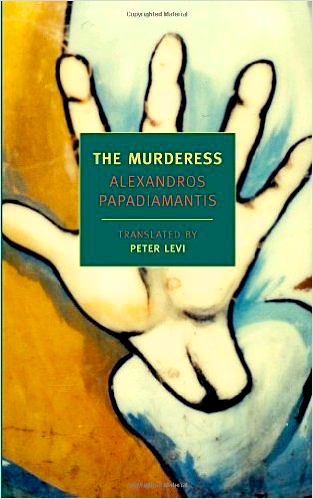 Written in the 1890s and first published in 1902, The Murderess by Alexandros Papadiamantis focuses on Hadoula, a poor woman of “scarcely sixty,” who has done little in her life other than serving others. As she explains in the opening chapter, she served her parents when she was a child, and, at seventeen, she became a slave to her husband and her children after that. Now she is slave to her grandchildren. Her eldest daughter Delcharo has just given birth to an infant who has been sick since its arrival, and Hadoula has been using the step of the fireplace beside the baby’s cradle as her pillow, watching over the sick child every night for two weeks, almost without sleep. Living in a rural area of the island of Skiathos in Greece, two hundred fifty kilometers northeast from Athens, Hadoula has few, if any, resources to improve her life, and even fewer resources to enable her to help her daughters make better marriages than she herself did. With seven children, including three daughters, she will be expected to provide significant dowries for the girls in terms of goods and property. Recently, the custom has evolved that a large cash donation is also expected before the family of the prospective husband will accept a bride for their son. Her two older sons are not able to help her out – they have emigrated to the west and are no longer in touch – and her husband, Iannis Frankos, is useless. Since he is not even able to add a simple sum, the only way Hadoula can get money for the house is to collect his salary herself, to make sure he has not been cheated by his employers, or trick him into giving her his earnings so she can count them. She often steals from him. That is better, she believes, than letting him spend everything he has on drink.