Note: Ismail Kadare became the first WINNER of the Man Booker International Prize in 2005 for his complete body of work.
“In [Gjirokaster] there were eleven former vezirs and pashas of the Ottoman Empire, four former overseers of the sultan’s harem, three former deputy managers of the Italian-Albanian banks, fifteen ex-prefects of various regimes, two professional stranglers of heirs apparent…not to mention three hundred former judges and more than six hundred cases of insanity: a lot for a medieval city now striving to become a communist one.”
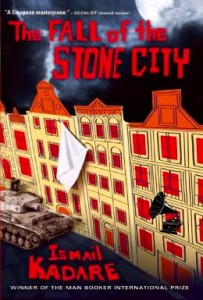 Writing of Albanian life in Gjirokaster, the city of his birth, during World War II and its aftermath, Ismail Kadare creates a deceptive novel which looks, at first, as if it is going to be a simple morality tale. “Deceptive” is the operating word here, however. There is nothing simple about this novel at all, perhaps because Kadare, constantly under the gaze of Albania’s communist officials in his early years, always had to invent new ways to disguise what he really wanted to say without being censored. As a result, he began writing in a style akin to post-modernism, creating a literary soup which mixed fact and fiction, past and present, reality and dream, truth and myth, and life and death. By mixing up time periods, bringing ghosts to life, repeating symbols and images, and leaving open questions about the action of a novel, he was able to disguise the harsh truths of everyday life and the horrors of past history. That style continues in this novel from 2008 (newly translated by John Hodgson), despite the fact that Kadare was granted political asylum in France in 1990.

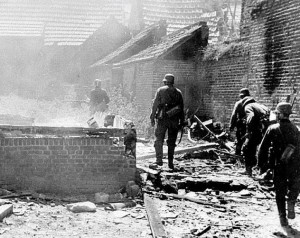
The novel starts simply enough. It is 1943. The Italians, who have ruled over Albania since 1939, have decided to retreat, ahead of the German invasion from Greece. Gjirokaster, at the southern tip of Albania, is one of the first cities the Germans come to in their attempt to “liberate” the country and restore their “independence.” Life in Gjirokaster is chaotic, at this point. The communists from “Red Russia” are making noises and recruiting support; hostile, nearby towns with ethnic Serbs are already under German control; people are fleeing into Gjirokaster from the mountains, and the nationalists want all foreigners out. As the German column enters the city, someone fires on the advance team. No one is hurt, but the Germans plan reprisals: “The [Byzantine age] city was to be blown up…Being blown into the air and made to leap and caper – all this was women’s stuff. In short, the stone city, so proud of its manly traditions, had been marked out to die like a woman.”
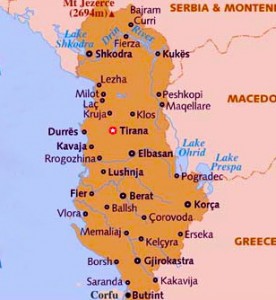
Gjirokaster is in the far south of the country. Click on map for an enlargement
Soon after the Germans enter the city, however, the townspeople hear the music of Strauss, then Brahms, emanating from the gramophone at the home of Big Dr. Gurameto (not related to Little Dr. Gurameto, also a surgeon but of a different political persuasion). Colonel Fritz von Schwabe, commander of the German division and bearer of the Iron Cross, has called upon his “great friend, from university, my closest friend, more than a brother to me” – Big Dr. Gurameto. Soon word is leaked to the city that a hundred citizens held as hostages, including Jakoel the Jew, will be released. The city will not be bombed. The details of how all this came about will be the subject of gossip in the city for a decade.
Part II takes place in 1944, as the German Army retreats from both Greece and Albania, at the same time as the communists are arriving to take their place. Nationalists are arrested, as are some of the patients at the hospital, including some who have just had surgery. As one patient, arrested while under anesthesia, later observes, “All hell [has] been let loose in the city while [we were] absent…The times have moved on. Hours, days are passing and we are still stuck somewhere…Out of time. In reverse or minus time.” That image repeats years later, when word arrives that Stalin is going to visit the city: Time “was not just suspended, as it had been for the anaesthetized hospital patients nine years before; it was going backwards at great speed,” making the narrative of the two Drs. Gurameto even more complex to follow. The dinner between Big Dr. Gurameto and Col. von Schwabe is, once again, the subject of an investigation.
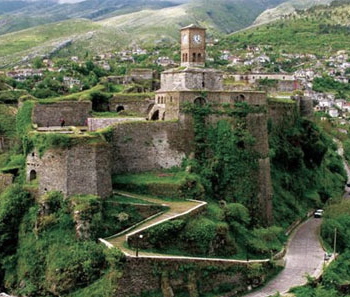
Castle at Gjirokaster, begun in the 12th century, and containing the Cave of Sanisha
This image of patients anesthetized and in surgery becomes a repeating symbol. Big Dr. Gurameto often has dreams in which he is a surgical patient being operated on by himself, and Col. von Schwabe comments on the fact that the doctor once operated on him: “You brought me back to life, but to your own misfortune.” Surgeries, of course, leave scars, which also reappear in the imagery. Old stories, like folk tales, reoccur: In one, a young boy is sent out to invite a stranger to a dinner, gets frightened of the idea of ghosts as he passes a graveyard, throws the invitation into the graveyard and runs off. Later a dead man shows up at the dinner. In another motif, the ghost of Sanisha, the sister of the violent eighteenth century Ottoman ruler Ali Pasha Tepelene, appears more than once as a woman with a pale face and long dress. Part III features the story of the Cave of Sanisha, “universally imagined as the deepest and most terrifying dungeon of the city’s prison, which was housed in the ancient castle [of] Gjirokaster.”
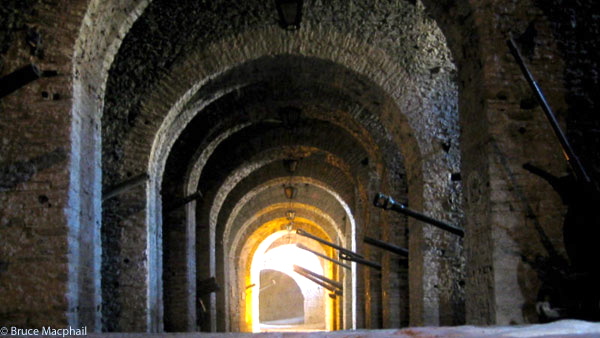
Byzantine arches at the Castle, photo by Bruce Macphail
Other readers may be as baffled as I often was, as they try to figure out what Kadare wants us to take at face value, what may be symbolic or mythical, and what events are “real” in one place but mythical in another. The many chronological shifts, details taken out of time, and characters who might be real, or ghosts, or walking dead left me unsure where the author was going and why. The tone of the novel is not consistent, putting an additional burden on the reader: Part One, dealing with the dinner of Dr. Gurameto and Col. von Schwabe, feels like a morality tale. The author’s style is quick and to the point, but keeps the reader at a distance, as an observer, rather than as a participant in the narrative. Part II, which takes place a year later, begins as a history lecture about Albania’s many political changes, before it shifts to an almost farcical style about the communists, and then leads to the gruesome interrogations and tortures which dominate Part III.
The author himself seems to have recognized the problem of coherence, since he inserts himself into the narrative in the concluding pages. “Here is what happened,” he states, before going back to 1953 and bringing events, and some surprises, up to the present. His explanation of what happened feels “real,” but even that explanation still contains Kadare’s trademark combination of fact and fiction, reality and dream, truth and myth, leaving me, at least, with questions about what “really” happened here. Perhaps that was the author’s point.
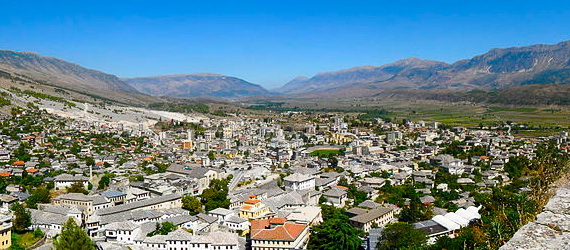
The Stone City and surroundings
ALSO by Kadare: THE ACCIDENT and THE DOLL: A PORTRAIT OF MY MOTHER
Photos, in order: http://www.dailymail.co.uk/
The map of Albania is from:http://www.lonelyplanet.com Gjirokaster is at the southern tip of the country. View is from the Castle.
The Castle of Gjirocaster, which also includes the Cave of Sanisha, built by Ali Pasha Tepelene, is also from http://www.jitourism.com/
The photo of the arches at the Castle and additional information from photographer Bruce Macphail may be found on http://www.balkantravellers.com
The panorama of Gjirokaster appears on http://en.wikipedia.org/
ARC: Grove Press
 Illustrating this collection of anecdotes about twenty world-famous authors with startling photographs, Javier Marías, one of Spain’s most respected contemporary authors, shares personal oddities about each of them. Here he presents individual mini-bios as if they were short stories, “enhancing” some details (though all details are said to be true) and minimizing others, bringing literature’s icons to life, showing them with all their warts and blemishes. Some of these tales have the feel of secret histories, those stories that the authors’ publicists (if, indeed, such animals had existed at the time) would try to suppress. Yet Marías writes with humor, not with bile—and in most cases with actual affection, the three exceptions being James Joyce, Thomas Mann, and Yukio Mishima.
 With this unique metaphor for life itself, Zachary Karabashliev creates a darkly humorous, entertaining, and compulsively readable novel so full of life that it bursts its way through several different genres. First, it is a love story, though in this case, it is a love story gone awry: the main character, also named Zack Karabashliev, has been living alone, miserably, at his home in San Diego for the past nine days, his wife having left him. It is also a story of the immigrant experience, in that Zack and his wife Stella met as students in Varna, Bulgaria, in 1988, and came to the United States as graduate students, working at several different kinds of jobs until they finally found financial, if not personal, success. The novel also becomes a quest, when Zack, in despair over the absence of Stella, decides to drive to New York to meet friends, traveling from California through the southwest and across the Mississippi and Midwest, stopping at small towns and bars along the way and observing how others live their lives. What makes this novel most unusual, however, is that it is also a well-developed metaphysical exploration of what it means to be alive, how we see our lives in the continuum of time, and where and whether happiness and an appreciation of beauty fit into the picture at all.


 Simon Greenleaf Howe, owner and editor of the Red Paint Register, has been living in rural Red Paint, Maine, for most of the twenty-five years since he graduated from high school there. “[A] town sign wasn’t really necessary. People didn’t just happen upon Red Paint. If you took the spur road off the interstate, you probably already lived there and knew where you were going.” With his wife Amy, a psychiatric therapist, and his eleven-year-old son Davey, who is at a rebellious age, Simon enjoys the relatively bucolic environment and his ability to run his own life and job. So little happens in Red Paint, in fact, that Simon is thinking about a new tagline for the Register: “Nothing Happens—and We Report It.” But something has happened, and something more is about to happen, not just the high school’s 25th Reunion, which is scheduled in a few weeks, but a threat to Simon’s own life related to events that occurred twenty-five years ago.
 As the novel opens, Simon reveals to his wife that he has hired a new employee who previously worked for a Portland newspaper and was a former farm team player for the Red Sox. Most recently, however, the man has been unemployed – serving a six year term in the jail in Warren for an assault on a woman. Appalled at Simon’s lack of curiosity about this crime, Amy, not surprisingly takes the side of the woman victim, wondering aloud if the victim, too, has a new job, “that is, if she’s gotten over the trauma of being sexually assaulted by your new hire.” The new employee has told Simon that there are two sides for everything, but Amy feels such crimes are too damaging to women to be forgiven and she refuses to meet him. Whether or not he will be able to start a new life in Red Paint is an open question, as the author introduces his themes of crimes, atonement, and forgiveness.
 Soon after, Simon receives the first of what will eventually number six postcards from around the country, none of them signed, but gradually hinting at some terrible deed that Simon committed in the past. Simon has no idea what it is. As the cards are mailed from closer and closer cities, first from the Salt Lake, and then from Chicago, Philadelphia, Boston, and Portland, Simon and Amy become more stressed and more impatient with each other. The final postcard, proclaiming “It’s Bigger in Maine,” is hand-delivered, and the message demands that Simon meet with the sender on the dock below the local Bayswater Inn during the 25th reunion celebration.


 A fast-paced plot, a setting that is both horrific and familiar, a mixture of fantasy with traditional religion, and unusual characters dealing with pressing political, economic, and moral issues capture one’s attention from the opening pages, as author Michele Roberts keeps the reader moving swiftly through the French countryside from 1931 – 1945. Jeanne Nerin, the daughter of a widowed mother who works as a laundress and housekeeper, and Marie-Angele Baudry, the daughter in the family for whom Jeanne’s mother works, are the only two full-time boarders at a convent school, as the story opens. Nine years old, they are there because Jeanne’s mother has been hospitalized, leaving Jeanne without someone to care for her, and because Marie-Angele’s pregnant mother now has no one to do the laundry and heavy work in the Baudry household. Marie-Angele is quick to point out that Jeanne is at the convent as a “charity case” with other people paying for her fees, one of numerous such comments which do not endear her to Jeanne. In addition, Jeanne’s mother was Jewish before she converted to Christianity under the sponsorship of Mme. Baudry, who feels she is performing her Christian duty by hiring her for housework, an attitude not lost upon Mrs. Nerin and her daughter. Casual anti-Semitic remarks throughout the novel reflect the attitudes in France nearly ten years before the Germans arrive.