Note: This novel was WINNER of the Independent Foreign Fiction Award and the Nelly Sachs Prize in 2003, when it was published in Sweden. In 2010, Per Olov Enquist was WINNER of the Swedish Academy Nordic Prize, the “little Nobel.”
“They see me as a father who must not be disturbed. They play at my feet and they hear the scratching of my pen, and they whisper.” –Dr. Johann Friederiche Struensee, commenting on the behavior of eighteen-year-old King Christian, his page, and his schnauzer dog, while the doctor works.
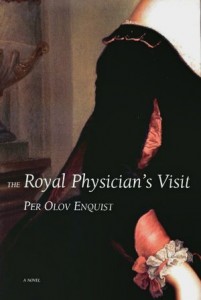 Palace intrigue of the highest order, conducted by courtiers and officials who will do anything to achieve their goals, makes this novel by Swedish author Per Olov Enquist both stimulating and thoroughly engrossing, and few who read it will fail to notice the similarities of the “normal” behavior one sees between these courtiers in their time and place and those “aides” or sycophants who surround other leaders of other countries in other times. The Danish court from 1768 – 1772 pulses with life as powerful personalities collide in their rush to fill the power vacuum resulting from the weakness of King Christian VII, a sensitive, half-mad 17-year-old boy, who married the innocent and unsuspecting Princess Caroline Mathilde, the 15-year-old sister of Britain’s King George III, just two years before the novel opens.

These are years of great intellectual ferment as the powerful new ideas of the Enlightenment, with their value on the individual and freedom, begin to threaten the feudal basis of the old, autocratic monarchies of Europe, and more frightening to the courtiers, their own power within their countries. The American Revolution against England is only a few years away, and the French Revolution by its own people will happen only a few years after that. Enquist brilliantly recreates the psychology of the sickly king, a puppet who desperately wants to please the courtiers and officials and is tormented when he does not, a bright but “ravaged child,” who from his earliest years was regularly flogged, ridiculed, beaten for casual conversations, forcibly separated from everyone with whom he developed attachments, shamed, and driven mad by his own courtiers.
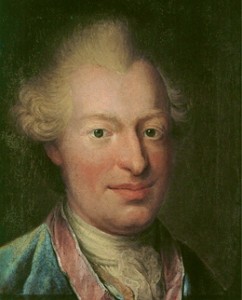 When the young king becomes interested in the enlightened ideas of Voltaire and Diderot and is celebrated by these philosophers on a trip around the continent, his nervous and threatened court decides he needs a physician to disabuse him of these “follies.” What they never expect is that the physician they engage, Johann Friedrich Struensee from Germany, will quickly establish a strong and genuinely caring relationship with Christian, share his enlightened ideas, and eventually become the de facto king and lover of the young queen Caroline Mathilde.
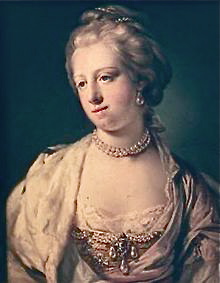
Bursting with dramatic scenes of Machiavellian court intrigue and the courtiers’ well-justified fear of the Enlightenment, the novel also includes powerfully moving descriptions of the deliberate psychological abuse of Christian VII. These scenes contrast with other instances of tenderness, passion, love, and genuine sadness, as the author turns the royal personages, courtiers, their allies, and Dr. Struensee into real people. Though the reader knows from the opening pages what the outcome of the court struggles will be, Enquist manages to endow this turmoil with an immediacy and tension which totally engage the reader, clearly illustrating the rage for power and the lengths some will go to gain and keep it. Few who read this novel will fail to recognize the common traits shown by powerful but desperate people, regardless of country, era, or the nature of the issues they are facing.
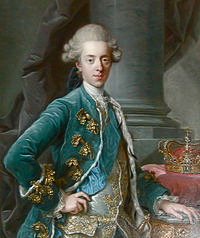 By focusing on the court, rather than on the populace itself, for his point of view, the author brings the Enlightenment and the revolutions it inspires throughout Europe to new life from a new perspective, and in creating this novel based on history, he brings to life both the sad and abused child-king Christian, and Struensee, the enlightened but politically naïve mentor forced to pay the ultimate price.
Note: Readers who become interested in this story will find in Wikipedia a wealth of additional information bringing the story of Christian VII, and especially that of the now nearly unknown Caroline Mathilde to its dramatic conclusion a few years after this novel ends.
Photos, in order: The author’s photo by Anders Roth/SR Bild is from http://sverigesradio.se
The portrait by Dr. Johann Struensee appears on http://www.skoletjenesten.dk/
Caroline Mathilde, the young Queen, is shown here: http://en.wikipedia.org
King Christian VII, with his crown resting on the table beside him, is seen on http://en.wikipedia.org
This book has been made into an opera, garnering rave reviews in Copenhagen and elsewhere. Here is the trailer:
 Dorothy Peabody, a spinster who has been working at a dead-end office job for thirty-five years, spends her life “smiling brightly all day at the office and being endlessly patient with her [bed-ridden] mother every evening.” Her mother, constantly complaining, seems to have some sort of mystical ability to know what is happening downstairs at night when Dorothy returns from work, asking from upstairs whether Dotty has dusted the mantelpiece, whether the tinned soup is in the right order, or if, heaven forbid, Dorothy has to get up in the night, whether she has remembered to switch off the light. Occasionally, after a difficult day, Dorothy relaxes at night by allowing herself two teaspoonfuls of brandy stirred into her warm milk.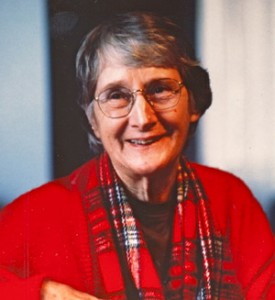
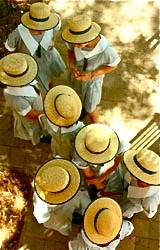 Dr. Arabella Thorne, a “person” whom Dorothy Peabody comes to know well though the correspondence, has been the headmistress of Pine Heights, a school for young ladies, for many years. Miss Thorne shares her apartment with Miss Edgely, a typist who “now inclines to make silly little mistakes. Not so long ago she put a C where a P should have been and left out an L and an E” for a paper going to a journal of higher education, leaving the article to read “the copulation in the pubic schools is increasing at an alarming rat.” Miss Thorne’s friend Miss Snowdon, the matron of Queens Hospital, is also a frequent visitor, and she, Miss Thorne, and Miss Edgeley, enjoy traveling together. When Miss Thorne, feeling sad for a student who will be left behind during a long vacation, invites this student to accompany the threesome on a trip through Europe, the full nature of the women’s relationship and its complications become clear.
 Winner of many prizes and much recognition in Australia, Elizabeth Jolley deserves to become far better known here, and few who have ever read her work have managed to stop at just one book – they are that seductive. This is my own second book by Jolley, after the unforgettable
  Originally from Belfast, forty-year-old Killian has tried to remake his life, having emigrated to New York City after spending his first twenty-three years in The Life in Belfast. A tinker, or Pavee, sometimes even referred to as a gypsy, Killian was involved in crimes of many varieties, including drugs, extortion, and even murder there, but he managed to get out of that life, learn to read, go to college, study history and the arts, and live a more “normal” life. Or what he sees as normal. He still adheres to his aboriginal values:
 Author Adrian McKinty, who grew up in Carrickfergus, Northern Ireland, before emigrating to New York City, where he lived for over five years, endows both New York and Ireland with life as he creates a sometimes likeable, though often violent main character, a man unable to abide by the rules set by governments for society, a man who, instead, lives by his own inner code and a more vengeful sense of honor and justice. Having not learned to read until he was an adult, he had no opportunity to study or explore the philosophical or academic origins of society’s laws, but


 This strange and sometimes eerie collection of short stories by Nobel Prize winner Mo Yan is guaranteed to stick in the minds of its readers, not just because it is wonderfully written by a man whose country is not as open to foreigners as this book is, but because its reality is so far removed from what any of us have experienced or even imagined. Seven short stories and one novella create a sometimes mystical or mysterious mood, oftentimes more akin to horror than to fantasy, a mood that is guaranteed to make readers sit up and take notice, even as they may be lulled by the “folky” and confidential attitude of several speakers as they reflect on their lives. Whether one should interpret some of the events described in this collection as dark humor, shocking dramatic irony, or simply as the reality of the various Chinese speakers and, one presumes, the author, is a question which readers will have to explore on their own. Though author Amy Tan, in a blurb on the book’s cover, suggests that “Mo Yan’s voice will find its way into the heart of the American reader, just as Kundera and Garcia Marquez have,” I suspect that many readers will react as I did – my heart was, in fact, aching, often shocked, and sometimes appalled at what passes for normal life in rural China. The residual feeling of this collection, at least for me, is not that of folk tales or fantasy, in which one can smile, amused, at the flights of imagination, but of the sometimes terrible realities which underlie these stories.
 ear the reservoir, rehabilitating it as a place for couples to have trysts, and painting it in camouflage paint. He rents it by the hour, with discounts for repeat visitors. When one tryst appears to go terribly wrong, he fears retribution and decides to confess to the authorities, with surprising and darkly comic results.
 “Iron Child” is the strange and even terrifying story of a child forced to live in a “nursery” while his parents are conscripted to work building a nearby railroad. When the job is complete, no one comes to claim him. He connects with a fantastic “Iron Child,” one who eats iron because there is no food, another image with symbolic significance. The child’s fate, as in other stories, shows again that the individual has little or no importance. “Love Story” suggests that there is only sex, not love. And “Shen Garden,” which is told as a love story set in Beijing, illustrates the idea that “not a single thing in this world is eternal.”
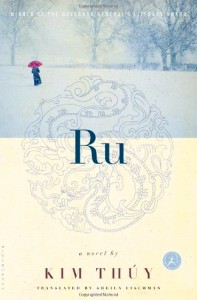 Timeless in its themes and completely of the moment in its narrative voice, Kim Thuy’s Ru brings to life the innermost thoughts of one of Vietnam’s “boat people.” The author, whose family emigrated from Vietnam to Canada when she was ten, has created a vibrant novel that feels much more like a memoir than fiction, with a main character whose life so closely parallels that of the author that her publisher’s biography for her is virtually identical in its details to the factual material in the novel. Few, if any, readers will doubt that the author actually lived these events – her voice is so clear and so honest that there is no sense of artifice at all.
 , loving experiences of a family’s life; descriptions of hardship and deplorable, even repulsive, conditions are balanced by the author’s ability to see beauty in small, even delicate, moments. The shocking contrasts between Nguyen’s privileged life in Saigon and her subsistence level existence upon her first arrival in Canada are presented with complete honesty and so broad a perspective that Nguyen is able to face her new life without rancor, resentment, or any sign of self-pity, and that becomes this novel’s biggest strength.