Note: This novel was WINNER of the Whitbread Award for Best Novel in 1996.
“[As the Titanic was being evacuated] the journalist stood and shook us both by the hand. ‘It’s been an interesting trip,’ he observed. ‘I doubt we’ll see another one like it.’ ”
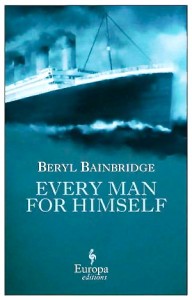 My mother was born on the day that the Titanic hit the iceberg – April 14, 1912 – and every member of our family has always known that the ship sank a few hours later, on April 15, 1912. When she died in 2010, four months after her ninety-eighth birthday, my mother had outlived every survivor of that wreck. With the centennial of the Titanic disaster now approaching, Europa Editions has re-published Beryl Bainbridge’s 1996 novel Every Man for Himself, the award-winning novel of the ship’s doomed voyage, a concise and “awe-full” story of life and death, primarily among the first class passengers, most of them super-rich industrialists and their heirs. A nephew of J. P. Morgan, recently graduated from Harvard, tells the story, providing a new, first person vision of the ship’s lively social life from April 12 through the ship’s demise on April 15. Fictional characters, who feel real, mix with real characters whose presence on the ship is well documented, as Bainbridge recreates the giddy excesses and the sense of entitlement exhibited by the top deck passengers.
 The speaker, an orphan who never knew his parents, has been raised by his aunt and his cousin Sissy, but he has always thought that he was special. “I don’t care to be misunderstood,” he avers. “I’m not talking about intellect or being singled out for great honours, simply that I was destined to be a participant rather than a spectator of singular events,” a statement that reveals more about his attitudes than he probably intends. After prep school and Harvard, and an active social life befitting a member of J. Pierpont Morgan’s family, he began work for Thomas Andrews, the naval architect in charge of the plans for the Titanic, and indirectly for his cousin J. P. “Jack” Morgan, one of the owners of the White Star line which commissioned the ship. Though his contribution was small, young Morgan, interested in the Titanic, makes the inaugural trip on the Titanic with friends, enjoying all the amenities of the first class passengers. Architect Thomas Andrews is present on board, as is J. Bruce Ismay, the chairman and managing director of the White Star line, though J.P. Morgan, Henry Clay Frick, and George W. Vanderbilt, who had planned to sail with the ship, had a change of plans before the ship sailed. Still, John Jacob Astor and his young bride Madeleine, Benjamin Guggenheim, Isador Straus and his wife, and members of the Rothschild and Widener family provide plenty of glamour.
The clear demarcation between the elite in first class and the lower, “ordinary” classes is obvious from the outset. As Morgan himself says, “I could pick out fifty or more men [here] that I’ve known half my life and Lord knows how many others I’ve shared a dinner table with in half the capitals of Europe. There isn’t a photograph taken from here to the Nile that doesn’t feature twenty or more of us lined up to watch the dicky-bird…Why half the older men here have even shared the same mistresses.” The classes never mix.
Bainbridge’s trademark wit and her perfect, pointed descriptions keep the novel moving, even as the biggest, most obvious drama remains in the future, and some issues regarding the ship itself are revealed – the seamen are required to work double shifts to keep the coal-fired engines running at peak in order to try to break speed records from Southampton to New York, something Morgan discovers on a trip to the hold to see a friend’s new car. A fire in the #10 coal bunker has been blazing for days in an area lined with iron and not reinforced steel. There are not enough lifeboats and the crew has had little or no practice lowering the existing lifeboats into the ocean. Still the party goes on, the passengers naïve and oblivious to these dangers.
 As the passengers engage in their own personal mini-dramas, Bainbridge provides sly descriptions of these characters, providing color and a cinematic quality to the scenes. A woman arrives at dinner, escorted by “a pink porpoise of a man.” The “unsinkable Molly Brown,” described here simply as “Mrs. James Brown,” wears a gigantic hat “on whose brim languished an entire stuffed bird.” Morgan describes dancing with one woman as being “like holding cut glass…she made him feel he left finger marks.” A man who expounds on the “two impulses,” hunger and sex, is put in his place when the speaker comments that “There is another impulse. Boredom. Which is never absent when you’re around.” In describing Chairman Bruce Ismay of the White Star line, Morgan notes that “unlike most Englishmen, he lacked apathy.”
 When the ship hits the iceberg, it is regarded primarily as a momentary interruption, perhaps even a hoax, and Bainbridge lets that feeling remain, even as Morgan is urged by a steward to leave his cabin and go up on deck wearing heavy clothes. “I swaggered rather than walked…How my aunt would throw up her hands when I shouted the details of my midnight adventure! Why, as long as I wrapped up well it would be the greatest fun in the world.” The fact that this took place at 11:40 p.m., after the first class passengers had spent the night drinking, goes a long way toward explaining some of the conduct which occurs in this emergency. The ship sank only two hours and forty minutes after it struck. Ultimately, the passengers, whom we have had a chance to get to know a bit (as well as one can know arrogant characters who obey their own private code) and their responses to the emergency become the main story, and readers will be appalled by the loss of lives which might have been saved, even at that late hour, had more care been taken to save those “below decks.” Bainbridge creates no scapegoats, however, and says barely a word about the behavior of the captain, Edward J. Smith (“What was Smith expected to do?”) or J. Bruce Ismay, the highest ranking White Star official aboard.
 Though some readers may be “Titanic’d” to death by the number of books and articles written about this disaster for its centennial, along with new National Geographic photographs and the 1997 film being released in 3D on April 3, 2012, Bainbridge’s contribution is a worthy and beautifully written study – witty, insightful, and consummately ironic. Here she recreates an elite group which includes a few passengers who may sense, if not believe, that “there was something dishonourable in survival.”
Also by Bainbridge: THE GIRL IN THE POLKA DOT DRESS
Also about the Titanic: THE MIDNIGHT WATCH: the Titanic and the Californian by David Dyer
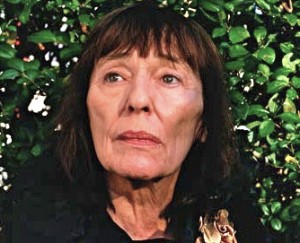
Photos, in order: The author’s photo appears on http://www.guardian.co.uk
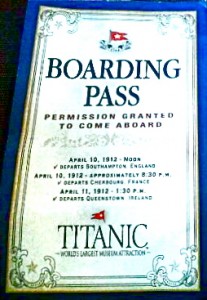
The boarding pass is from http://lifescoffeebreak.wordpress.com
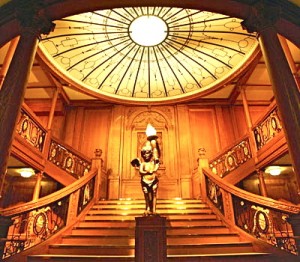
The Grand Staircase of the Titanic has been reproduced at the Raffles Hotel, Singapore: http://adventuresofprincessmitzi.blogspot.com
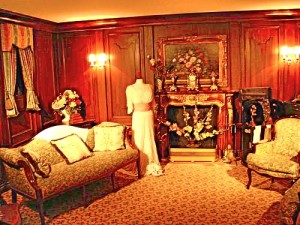
A first class cabin appears here: http://picturesofthetitanic.net/Titanic-Interior.html
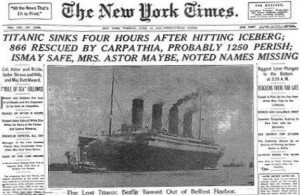
The headline from the New York Times is from http://findmaritimejobs.com
A list of all passengers on the Titanic and their fates may be found at the bottom of this Wiki entry: http://en.wikipedia.org
 Elsa Ahlqvist is dying, something she learned only six months ago. A seventy-year-old psychologist married for fifty years to Martti, a well-known artist, Elsa is being attended at home by her physician daughter Eleonoora (Ella) and her granddaughters, Anna and Maria. As each member of the family reacts to Elsa’s declining health, the entire family dynamic unfolds. Martti, for example, is sad about his accomplished daughter’s adult persona, that of a meticulous woman with an “almost expressionless determination on her face,” and he thinks, not for the first time, that “this woman [Eleonoora] had stolen his daughter from him, she was hiding the pigtailed, smiling Ella somewhere deep within her pragmatism. If Martti could just find some magic word from her childhood years, and say it, Eleonoora would be Ella again, jumping up and down in the doorway…”
 As the family surrounds Elsa with love in her final weeks, Elsa tries to keep the mood light, recreating the past and its happy memories. On one of Anna’s days with her grandmother, she remembers playing with the doll house and her mother’s old doll and dreaming about a magical future quite different from what she has experienced. When her grandmother playfully suggests that they play “dress up,” as they once did, Anna goes to the closet and discovers, not the dress she used to wear when she pretended to be “Bianca from Italy,” but one which she has never seen. Anna soon learns that it belonged to Eeva, a stranger to her.

 Those who prefer more subtle revelations of theme may tire of these personal pronouncements about the world, while others will find them helpful in expanding the focus on this family and the characters. My own biggest question lies at the heart of the novel: The story of Eeva took place more than forty years ago, and Elsa is a respected psychologist. Though she may believe that her granddaughter Anna has much in common with Eeva, it is difficult to imagine why she would, many years later, feel compelled to share Eeva’s story, which intimately affects other family members and not just herself. She knows how vulnerable Anna is, yet takes a chance with her future life, possibly telling her more than she wants or needs to know. Even though this is a novel and not reality, of course, it is presented as “true,” and I could not get past the feeling that in real life the sharing of this story would have been regarded as a violation of privacy from which some family members, including Anna herself, might not have benefited as much as Elsa thinks they would – not a legacy that most people would want to leave behind.
 Numerous authors, in recent years, have written about the settlement of Australia and the taking of aboriginal lands by white settlers, something the Australian government has recently tried to rectify through legislation and for which they have apologized. Kate Grenville’s
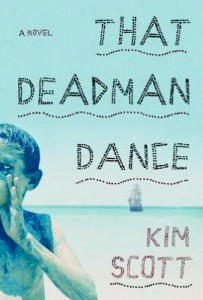
  Kim Scott’s That Deadman Dance is unique, however. The son of an aborigine (Noongar) father and white mother, Scott has written this novel from the Noongar point of view, bringing it to life through the stories surrounding Bobby Wabalanginy and his family, who are named for members of the author’s own family. From his earliest days, Bobby has been connected to whales, and he remembers Menak, the King of the Noongars (and his father), telling him about sliding inside a whale’s blowhole, warming himself beside its heart, and joining his voice to the whale’s roar, a story Bobby vividly imagines reliving himself. At one point, he even describes his mother acquiring him “when [a still live] whale came up on the beach.” All the people there had seen “the tiny shadow, that flickered in the water as the light died in the whale’s eye, and the old man—Bobby’s father—took hold of his stone knife and cut the whale.”
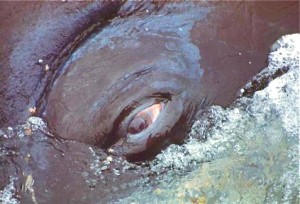 Now, at about age nine, Bobby travels between his own tribal group and that of the “horizon people” who have come to his land. The kindly Dr. Cross is teaching him to read at his own home, but Dr. Cross has the “coughing disease,” which has also taken the lives of many of Bobby’s people. By 1833 – 1835, Bobby has made several trips to sea as a “spotter,” with the whalers and settlers, his sensitivity to whales based on the fact that he “came from ocean and whales,” and can hear them breathing and catch their rhythm.
 “Laughing and loved, Bobby Wabalanginy never learned fear; not until he was pretty well a grown man did he ever even know it.” An enthusiastic dancer of folk dances, Bobby tells stories through his dancing, and in his interpretation, even the special Deadman Dance “was a dance of life, a lively dance for people to do together, each man dancing same as his brothers except for the one man on his own, leading them. It was a dance from way past the ocean’s horizon.” The whites with whom he associates and sometimes lives, are always enchanted by him when he and his people paint themselves for dancing, and Bobby can always win them over with his lively attentions to them.
 more property, and each time they do, they must take it from the Noongars. Noongar women are stolen, and both blacks and whites begin to deceive each other, provoking vengeance. By the time Dr.Cross dies, he is already worried about the future, but, still hoping that peace will prevail, he asks to share the grave of his close friend, Wunyeran, Bobby’s uncle.
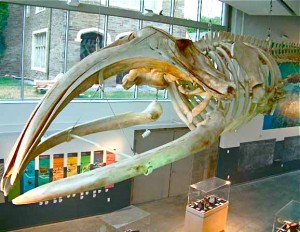 orizon lured him close and chased and speared and would not let him rest until (blood clotting his heart) [he] led them to the ones he loved, and soon he was the only one swimming.” Eventually, “there were no more of his people and no more kangaroo and emu and no more vegetable. After the white man’s big fires and guns and greed, there was nothing.” The symbolism of the whale is clearly articulated.
 ho has been the pilot and harbormaster, finds that running a grog shop is unprofitable when the whales run out and the whalers stop coming. The two black boys that Chaine has brought over as servants on the boat from England get tired of being considered inferior. And Jak Tar, who has jumped ship to be a sheep herder, misses the life of the sea. Tensions approach the breaking point.
 Cocky and self-confident on the surface, Neapolitan attorney Vincenzo Malenconico is a personal failure by most objective standards. His psychologist wife has left him, his sometimes troubled kids have their own lives and don’t want his “help,” and he lives in a lonely apartment. He has few, if any, clients and no private office, sharing office space with numerous other failures. He dithers, constantly imagining different outcomes for situations he has already faced, rewriting conversations which have ended badly for him, and perpetually reviewing his own past history. He makes hilariously ponderous philosophical observations and messes up his life royally. Though he has a new love with whom he shares passionate encounters, she seems far too clever to become involved with him and keeps him constantly worrying about the future. Now, for reasons known only to himself, he has decided to tell his story, but as he ponders what to say, he even imagines himself in the role of one of his own readers who might ask, “Why should we go to the trouble of understanding you? We don’t want to do your work for you. Why don’t you take us for an enjoyable ride someplace.”
 A genre-bending novel which focuses primarily on Vincenzo’s psyche, it also offers glimpses of both the Italian court system and the workings of the organized Camorra, which Vincenzo, in his wisdom, decides is better than the “nondescript grab-bag of criminals roaming the streets…deeply irresponsible, casually practicing a level of violence that’s absolutely disproportionate in terms of its criminal objectives.” He even comes to believe that the Camorra should “liberate the citizenry from the barbarity of disorganized crime…get back in the trenches, fight the good fight, make it safe to walk the streets again.”
 In this imaginative and unconventional novel, Irish author Kevin Barry creates an almost feudal, fictional city in the west of Ireland in the year 2053. The novel is in no way “futuristic,” as we have come to understand that term, however, seeming instead to be a throwback to simpler pagan times in which life is seen as the rule of the strong over the weak, with vengeance and its inevitable bloodshed a way of imposing control. Bohane, a tiny city on a peninsula, overlooks the water, its day-to-day life controlled by armed gangs and their bosses. Though Sweet Baba Jay (Jesus) is often mentioned and is accepted as a living force in the lives of some of the people, their behavior and actions in their dog-eat-dog world more closely resemble the ravening hordes which swept down in pagan times to wreak havoc on weaker tribes. As Logan Hartnett, leader of one of the local gangs, says, “When you [are] running a Fancy, regular demonstrations of rage [are] needed to keep the town in check and, just as importantly, the Fancy boys in trim.”