Note: Roy Jacobsen was WINNER of the Norwegian Booksellers Prize in 2009, the same year in which he was also SHORTLISTED for the IMPAC Dublin Award.
“Linda was not of this world, one day I would come to understand this – she was a Martian come down to earth to speak in tongues to heathens, to speak French to Norwegians, and Russian to Americans. She was destiny, beauty and a catastrophe…God must have had a purpose with her, a secret plan—but what?”
 Setting his novel in Oslo in 1961, author Roy Jacobsen tells the story of Finn, a small boy of about nine, and his divorced, and later widowed, mother as they cope with life’s hard realities. Extremely close, they struggle to make ends meet, his mother always making it a point to be at home when he returns from school, and working only part-time at a shoe store, for his sake. Finn’s “hard realities” become much harder when circumstances force his mother to rent out his room to a boarder. One interview with a potential boarder is so intense that she closes the door on Finn and conducts it in private – the woman is not a potential boarder but her ex-husband’s second wife, the mother of Finn’s half-sister Linda. She does not share any of this information with Finn, who does not know about the sister, and she is preoccupied and tense for weeks afterward. The long-term aftereffects of this mysterious meeting leave Finn perpetually “stealing furtive glances at her, my nervous, frightened of the dark but on the whole stable and everlasting mother, my bedrock on earth and my fortress in heaven, now wearing an unrecognizable face.”

In the ensuing weeks, Finn continues to wonder “how long a small boy has to [wait] for his mother to come to her senses and assure him that nothing has changed, irrespective of whether cosmonaut Yuri Gagarin has blown us all sky high.” When Finn faces an emotional crisis because of the unexpected distance that has developed with his mother, she finally admits that not only does he have a half-sister named Linda but that the little girl will be moving in with them immediately. Their boarder, Kristian, who has moved into the bedroom formerly belonging to Finn, has told Finn about King Sverre, a very short warrior-king from the twelfth century who achieved monumental historical stature for his deeds, but that will not be enough to solve Finn’s problems of identity as the household gets ready for the little girl’s arrival.
Telling the story which develops with Linda’s arrival from Finn’s point of view, Jacobsen recreates the tension-filled childhood of a boy who is unsure of who he is – and, more importantly, who his mother really is. Linda, he discovers, is virtually mute, living “quietly…wrapped up in her own eternity,” and Finn’s mother is desperate to help her, apparently believing that Finn is able to cope on his own. Linda’s inability to communicate with others limits Finn’s ability to consider her a real sister and severely affects the relationships he has, not only with his mother but with others, and when Linda starts school, he recognizes that he will have to protect her from other, crueler children.
Kristian, the boarder, occasionally reaches out to him, sharing books and a longed-for television set, but Finn still feels like an outsider, and when Kristian lends the family his tent on Haoya Island for a summer vacation, the scene is set for both pleasures and crises.
Finn’s point of view is straightforward – he wants answers, now – and the author represents this in an almost terse style, but Jacobsen faces a conundrum which affects the reader’s ability to identify with Finn and makes the mother a problematic character. Because Finn is a young child, he is unable to understand or draw valid conclusions about the mysterious events happening around him, and since his mother deliberately denies both him and the reader important information, Finn’s point of view is too limited to lead to real warmth or understanding of the family. Finn often acts completely out of control, and the reader, not being privy to important background details, often feels assaulted by him, just as Finn’s mother must have felt.
Throughout, the author emphasizes the extremes to which some people, including children like Finn, Linda, Finn’s friend Frank I, and Dundas, a school bully, will go to belong to a group – but some of the parents at the “estate” where they live, and Finn’s extended family, at Christmas, are not exempt from extreme behavior and insensitivity, either. Many times their feelings and behavior are the result of misunderstanding or lack of information, which, if shared might have helped avoid the problems. The final chapters  are a shock – a kind of tour de force – and though some readers might guess at some of the revelations, the author studiously avoids giving any clues to these events from the outward and obvious behavior of the characters before the crisis. When the author, almost as an Afterword, then advances the action to what has happened in the ten years from 1961 until after Finn finishes high school, he allows Finn to explain some of the choices that have been made but, wisely, does not try to justify them, proving ultimately how much Finn has grown, on his own, in recognizing the degree of power a person has or does not have to control his own life.
The novel does leave one question unanswered. Though I have not seen any interviews in which the author discusses whether this book is in any way autobiographical, I could not stop wondering about this. On one odd occasion, a character refers to Finn’s mother, very casually, as “fru Jacobsen” – and while that is not an unusual Norwegian name, one cannot help wondering why the author chose to use his own surname unless he is deliberately suggesting an autobiographical component. Certainly the use of “Jacobsen” might explain the author’s ability to describe so intimately the alienation which Finn feels, and it makes the author’s avoidance of judgment about the mother and other characters more understandable.
Photos, in order: The author’s photo appears on http://snl.no.
King Sverre, a 12th century king of Norway, was the subject of a discussion betweenKristian, the boarder, and Finn about bravery and history. This is a detail from a mid- to late-19th century painting by Peter Nicolai Arbo which appears in http://en.wikipedia.org
Yuri Gagarin, whose space walk in 1961 is the biggest milestone in history for the characters in this novel, and especially Finn, is seen here: http://www.eliteoftheworld.com
The photo of Haoya Island, where Finn begins his own coming of age, may be found here: http://travelingluck.com
In one of the book’s ironies, Finn sees a photo of his father standing in front of Vigeland’s “Wheel of Life” sculpture at Frogner Park. http://www.freewebs.com
 Gerard Woodward has been one of England’s most iconoclastic literary authors, rejecting all the polite expectations of writing and society by creating novels that seem, on the surface, to be about real families experiencing real life but which have a darker agenda. A poet with a fine eye, ear, and sense of pacing, Woodward uses these talents in unique ways to create dozens of scenes which surprise and shock and even repulse, all the while causing the reader to laugh uproariously, not from shock or embarrassment but from surprise and delight in his daring. Quietly showing his characters in absurd situations, he forces them to take unexpected actions which they could never have foreseen – and these actions then allow Woodward to enter new territory (such as the cannibalism seen above), forbidden to “polite” literary authors and readers. Amazingly, he does all this without any profanity or foul language.
 The opening pages of this novel, set during World War II, are alternately wickedly funny and darkly ironic, and graphically illustrate Woodward’s approach. Mrs. Head, a proper London widow is preparing dinner for her daughter Tory who is living with her and working for the war effort in a gelatine factory. Tory’s three children are safely ensconced in the rural countryside; her husband is missing in action. When a German bomb hits the butcher shop nearby, Mrs. Head explores. She has resented Mr. Dando, the butcher, for much of the war since he favors the younger, more attractive customers with steak while giving her tripe and liver. As she looks over the wreckage, she finds an absolutely perfect leg of pork. Quietly picking it up and wrapping it, for fear that someone will think she is looting the wreckage, she brings it home and roasts it for their first real dinner in ages, admiring the cracklings and the scent as it roasts. It is not until Tory returns home from work and asks, “Where’s Mr. Dando?” that the horror of what they are eating hits home.
 he does not even ask about his children and requests no food, clothing, or “care packages” from home. All he wants is for Tory to send him “a really filthy [letter], full of all the dirtiest words and deeds you can think of.” A meek little man until now, Donald Pace seems to have changed completely, but thinking of her “wifely duty,” Tory wants to oblige as much as she can. She is particularly upset as she imagines his German captors censoring her mail, wondering “What sort of impression is that going to give of our [national] moral health?” Her initial responses to Donald are answered with “NOT GOOD ENOUGH,” in capital letters, and, stymied, she stops writing for a while, only to return to this mystifying wifely chore. Donald then demands a nude photograph of her, even sending the name and address of a London photographer who will develop the smutty pictures he wants. Though appalled, she continues her research into “smut,” which takes her to places and introduces her to people she has never even imagined before.
 believes he deserves special treatment, but it is his own treatmentof his oldest son that leads to a crisis and the novel’s turning point. The novel never again returns to the ironic humor of Part I, preferring to remain in the no-man’s-land of domestic trauma and, often, poignant sadness.
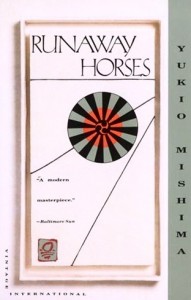 Yukio Mishima’s Sea of Fertility tetralogy, of which this novel is the second in the series, incorporates four novels set in four different time periods, illustrating Mishima’s extremely conservative attitudes toward the changes in Japan from 1912 to 1970. Born in 1925, Mishima had, throughout his life, mourned the loss of samurai ideals, including reverence for the Emperor. He lashed out against the westernization of Japan which he believed began with the Meiji Dynasty in the nineteenth century and continued to escalate throughout the twentieth century, and he was devastated by the defeat of Japan in World War II, the demeaning of the Emperor, and the Occupation by Allied troops. For the next twenty-five years after the war, Mishima practiced samurai ideals, until in 1970, having completed the fourth novel of this series, he and a group of five private militia men, who were also samurai, led a futile assault on the headquarters of the Japanese armed forces in an effort to stage a coup, then committed seppuku, the ritual suicide by disembowelment favored by the samurai.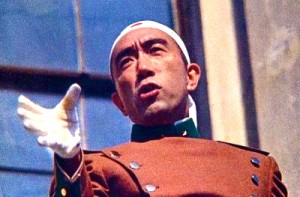

 Giving the lie to this statement, Pulitzer Prize winning author Jeffrey Eugenides creates a story, set in the 1980s, in which the entire novel incorporates and illustrates the marriage plot, with three main characters all pursuing the goal of marriage. These young students at Brown University are all conscientious, and all have real academic interests, but they also follow their libidos into sometimes new directions with the goal of experiencing a “full” and “satisfying” life. Madeleine Hanna, the English major of the quotation above has just discovered semiotics and the excitement of this esoteric academic subject, at the same time that she is experiencing passion of a new kind; Mitchell Grammaticus, who has loved and fantasized about Madeleine since he first met her, is fascinated by religion and philosophy and tries to subsume his passions for Madeleine into doing good works; and Leonard Bankhead, with whom Madeleine is passionately in love, wants most to “become an adjective,” a word for someone whose ideas are so well known that “Bankheadian” would become as understandable an adjective as Joycean, Shakespearean, Faulknerian, Chekhovian or Tolstoyan.
 Mitchell, who becomes the best and most sympathetic character, is particularly interesting to watch as he learns that the purely unselfish life is not possible or even wise for some people, while for others the giving up of one’s personal desires provides new opportunities for inner growth and satisfaction. After graduation, Mitchell, with no pressing love interests except for Madeleine, who has other plans, follows his religious interests on a trip throughout the world with his roommate Larry—to Paris, Barcelona, Venice, Greece, and eventually India, where he works at the hospital set up by Mother Teresa. Leonard, by contrast, has had major problems for years with what was then called manic depression (now called bi-polar disorder), and he has accepted a research fellowship at the Pilgrim Lake Labs in Provincetown, Massachusetts. His psychiatric problems become intense for the reader and for his friends as he reveals his first bout of depression as a high school student: “He wasweeping, unstoppably, his head like the chandelier in his grandparents’ house in Buffalo, the one that was too high for them to reach and that every time he visited had one fewer bulb alight. His head was an old chandelier, going dark.” He is accompanied to the labs by Madeleine, whose own academic pursuits have been put on the back burner while she helps Leonard.
 Norwegian writer Jo Nesbo’s latest novel is a stand-alone, not part of his Harry Hole series, and it provides yet another example of Nesbo’s immense talent as a story-teller. Nesbo never “writes the same book twice.” Even the five Harry Hole novels currently available in the U.S. are very different from each other.
  opportunities and by corporations seeking the perfect new president, is a loathsome human being, but he is as close to a “hero” as one gets in this page-turner. He has powerful enemies who are at least as clever, at least as opportunistic, and certainly as amoral at he is. By limiting his focus to these characters, however, Nesbo frees himself from the limitations of a police procedural and can take his story in new directions, omitting the law entirely from almost all of the action, and creating a plot in which Roger Brown and his enemies essentially play a game in which the “king of the chessboard” is the person who survives.
 Criminal Interrogations and Confessions by Inbau, Reid, and Buckley (1960), a book he uses as his “bible,” Roger regularly elicits important personal information from the wealthy and successful executives he interviews for new positions. Then, playing on their psyches, he learns what their artistic tastes are and the nature of their investments in art, where they live, and when they are at home. At his leisure, he arranges to have the artwork stolen from their homes and fenced. No one ever suspects him.
 emotional aftereffects. Lotte, a “timid whelp, small and scruffy with fearful, brown puppy eyes,” another victim, is used and discarded. Still, Nesbo’s focus remains primarily on the plot and its twists, and his deadpan descriptions of outrageous (and truly unforgettable) scenes will keep readers smirking throughout, even as they are saying “E-e-w-w-w.”