“There has not been a day since [my father’s] sudden and mysterious vanishing that I have not been searching for him, looking in the most unlikely places. Everything and everyone, existence itself, has become an evocation, a possibility for resemblance. Perhaps this is what is meant by that brief and now almost archaic word: elegy.”
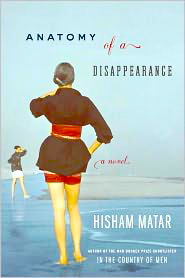 Libyan author Hisham Matar draws on his own life to provide insights into this story of a son’s yearning for the father he loved but who vanished when he was fourteen. In real life, Matar’s father Jaballa, once a member of the Libyan delegation to the United Nations and, after Muammar Gaddafi’s coup, a political dissident, went into exile in Egypt in 1979, when his son was nine. He was kidnapped in 1990, when his son was twenty. The only word the family ever received from him came in 1992, when they received two letters from him indicating that he had been kidnapped by the Egyptian secret police and handed over to the Libyan authorities where he was jailed in the notorious Abu Salim Prison in Tripoli. He was never heard from again, though word filtered out to his son that he had been seen in prison as late as 2002.
This fraught background provides the structure of Matar’s novel, which takes place in an unnamed country. Nuri el-Alfi is a young boy whose mother dies rather mysteriously when he is nine, while the family is living in exile in Egypt, and he and his father, a dissident and former minister of the government under the king, become “two flat-sharing bachelors kept together by circumstance or obligation.’ His father had refused to let his son return to their country to live with his wife’s sisters after his mother died, but he apparently feels guilty about his inability to be more of a father to him: a “tenderhearted sympathy, raw and sudden, would rise in him at the most unexpected moments, and he would plunge his face into my neck, sniff deeply and kiss, tickling me with his mustache. It would set us off laughing as though everything were all right.” When Nuri is fourteen and in boarding school in England, his father and his much younger, new wife Mona meet Nuri in Switzerland at the Montreux Palace Hotel, and it is on this vacation that his father is abducted. The Swiss police have no leads.
All this information about Nuri is given in the first five pages of the novel, and as the author continues Nuri’s story from that moment up to age twenty-four, the bare bones outline of his life at the time of the kidnapping gradually broadens and gets filled in, and his life as an exile, without family or country, takes shape. Through flashbacks and reminiscences, the reader also comes to know more about Nuri’s younger life and his father’s role as a dissident in exile.
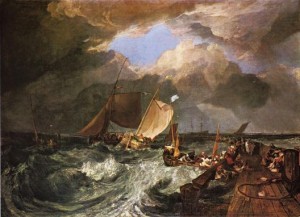
This painting by J.M.W. Turner was one of his mother’s favorite paintings, according to his father, when the two visit the National Gallery.
Scenes throughout the novel, as Nuri’s life unfolds, are abbreviated – almost lacking in description, in the sense that the author tells how people act and what they say – but the reader is required to supply images from his/her own experience. As a result, a curious kind of detachment prevails in the story-telling as the details of Nuri’s life unfold. His teenage “crush” on his stepmother, who is twenty-six when he is fourteen, is full of passion, but that passion does not translate into feelings that the reader can share, and though his sense of angst is “told about,” it does not feel “recreated” in the sense that could make scenes come alive. The closest Nuri comes to showing any real human feelings of loneliness and abandonment occurs when he is seventeen and, while on vacation from school in England, he remarks poignantly that “more than anything else, I wanted to be expected, waited for, welcomed.” He never even mentions “loved.”

Nuri’s father disappears while they are visiting the Montreux Palace in Geneva.
Nuri persists in trying to act like a grownup at a boarding school which does not encourage him to show feelings. His personal life outside of school also has no outlet for his feelings. His father’s friends from the past have not been there to provide him with any emotional guidance, and, without a close family, this boy, living in a foreign land far from where he grew up, has no one with whom he can share anything. Even when he reaches college age, he tells us that “I kept a small radius of friends, mostly from university, with whom I shared what I imagined some siblings share: a warm alliance that still assured the necessary distance…They did not know much about me except that I came from Egypt – a fact in itself untrue. A certain kind of English temperament suited me because I was never one given to confession.”

Nuri and Hass, his attorney, go to the Federal Palace in Bern, seeking information about Nuri’s father.
It is not until he observes a man who has fallen into the water trying desperately to hang on until he can be rescued – a symbolic scene – that Nuri, at age twenty-four, starts to become “human.” The novel’s most successful scenes follow that, one of them a scene in which Nuri meets the woman from whose apartment his father was kidnapped, and learns her story. Since both of them have shared the shock of the father’s dramatic disappearance, this section, and the section in which Nuri returns “home” to Egypt for the first time in many years, have the kind of feeling that is missing in the earlier sections of the novel, perhaps indicating a belated coming-of-age.
The novel is cleanly written and straightforward, but despite the surprises in the novel, I longed to see Nuri acting like a real boy and showing a need for closeness – with someone, anyone – and especially with the reader. His stiff upper lip, in the face of the dramatic events of his life, make his narrative seem almost journalistic, and I felt excluded from his life when I wanted to share it.
Note: At one point, Nuri describes his father’s decision to go into exile, claiming: “Eighteen months after my parents employed Naima, our king was dragged to the courtyard of the palace and shot in the head. Father was a government minister by this stage, and, instead of risking ill treatment, detention or even death, he decided to flee to France.” Some critics have suggested that the author is using Iraq as his model for the unnamed country in this novel. (The king of Libya, King Idris, died in exile in Egypt at age 94.)
ALSO by Matar: THE RETURN
Photos, in order: The author’s photo by Diana Matar appears with an interview in http://www.metro.co.uk
While Nuri is on vacation with his father, after the death of his mother, they visit the National Gallery in London. His father stops and studies J. M. W. Turner’s “Calais Pier,” (1803) and, moved, tells Nuri that his mother would have loved that stormy painting, one of the only times (sadly) that he ever reminisces about his wife with Nuri after her death. http://www.paintingall.com
Nuri’s father disappears while the family is vacationing at the Montreux Palace, in Switzerland, seen here: http://www.expedia.com
After his father’s disappearance, Nuri and Hass, the family’s lawyer, go to the Federal Palace in Bern, shown here, to talk with representatives of the Federal Department of Home Affairs for information about the investigation. http://switzerlandinformation.blogspot.com/
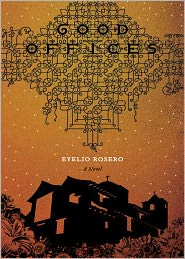 The acolyte Tancredo, the tormented main character of this wicked satire by Colombian author Evelio Rosero, has a terrible fear of becoming an animal, especially on Thursdays. A young hunchback from Bogota, Tancredo has been living in the rectory of a Bogota church since childhood, when he was taken in by Fr. Juan Pablo Almida and given an education with the idea that he would one day enter the church. The biggest problem for Tancredo, however, is that Fr. Almida works him so hard he has little time for study, especially since he has been assigned the task of running the church’s Community Meals outreach program, Monday through Friday. Each day serves a different congregation – prostitutes on Mondays, the blind on Tuesdays, street kids on Wednesdays, and families with children on Fridays. Thursdays, however, are “a living hell,” the day that “crowds of old people start pouring in from the four corners of the city, Bogota spitting them out by the dozen.”
 The arrival of Fr. San Jose Matamoros del Palacio and the departure of Fr. Almida and his sacristan for their meeting with Don Justiniano set the stage for the novella’s turning point, both hilarious and horror-filled. Fr. Matamoros is very different from Almida and Machado, singing the Mass and inspiring the congregation with his passion. Passersby, lured by the music to enter the church for the service, some for the first time, agree with the ladies of the Neighborhood Civic Association that the service was so “lovely” that “For a moment we thought it wasn’t an earthly one. The Reverend who celebrated it must be…a special person.” When Fr. Matamoros concludes the service, the Lilias persuade him to stay the night in the presbytery, and when all the electricity goes out, those who have worked much of their lives in and for the church make their confessions, suggesting indirectly some of the sins of Fr. Almida and Celeste Machado.
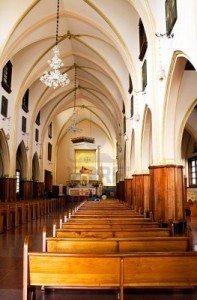 From the powerfully descriptive (and darkly comic) opening pages, in which Tancredo must handle the problems of his elderly patrons at the Thursday Community Meals, to the later pages in which the full effects of Fr. Matamoros’s Mass are shown in the lives of the servants of the church, Rosero creates dramatic moods and atmosphere, showing the hypocrisies of every person in the novel. His dark satire is not leveled at the church itself so much as it is at the fallible human beings who represent it, the harshest satire leveled at those in positions of power who mock the vows they have made by abusing the trust of the people who work for them and believe in them. The pacing is perfect. Even when describing the action behind the scenes in the church “household,” he keeps his story moving, filling it with mysteries, ironies, and hints of wrongdoing. His imagery of darkness, from his description of Machado to the power failure after the Mass and his later description of the Lilias’ black shawls is consistent and thematically revealing.
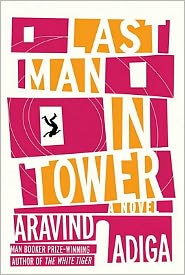 With a breezy, irreverent point of view and a fine eye for the kinds of details which make characters and scenes memorable, Aravind Adiga tells an often humorous morality tale about life in an area of Mumbai undergoing residential redevelopment. And just as his Booker Prize winning novel,
  money to maintain their building and its infrastructure. Residents never know when they will have hot water, and the electricity is sometimes unreliable. “After four decades of monsoons, erosion, wind-weathering, air pollution, and the gentle but continual vibrations caused by the low-flying planes, Tower A stands in reasonable chance of complete collapse in the next monsoon.”


 On the opening page of this emotionally overwhelming novel, Lilly Bere, age eighty-nine, begins the grand story of her seemingly insignificant life, a story in which she speaks directly from her heart, begging to know “How can I get along without Bill?” her grandson who has just died following the First Gulf War in Kuwait (1990 – 1991). Each of the next sixteen chapters is one more numbered day “without Bill,” and we soon learn through flashbacks that Lilly and her family have suffered deaths connected to three earlier wars – the Great War (1914 – 1918), the Irish War for Independence (1919 – 1921), and Vietnam (ca.1965 – 1975). Though all the men she loved did not necessarily die in combat, their deaths were all inescapably war related, and Lilly becomes, in many ways, the prototypically devastated wife of Tadg Bere (in the Irish Revolution), sister of Willie Dunne (the Great War recruit previously featured in The Secret Scripture), mother of Ed (in Vietnam), and grandmother of Bill (in Kuwait). As their mourner, she is equally a victim of the wars that have taken her men.

 Barry’s “ordinary,” much shorter descriptions are just as memorable: Lilly’s husband Joe “in his civvies…was all spark and tornado”; at one point Lilly’s heart “lifted like a pheasant from scrub…its wings utterly opened in fright and exulting.” Lilly’s own attitude toward her life is that “My years have no width or length, have no dimension at all, just the downturn of a bird’s wings. So quick.”
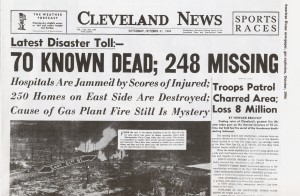
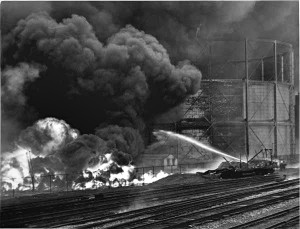 Barry’s scope is enormous, despite the very personal focus on Lilly, who tells us, among other things, that her friend Mr. Dillinger’s mother and sister died in Dachau. Her best friend, Cassie Blake, with whom she worked, has suffered life-long prejudice for her race, and the death of Martin Luther King is a reference point here. The death of a U. S. senator, shortly thereafter, provides another reference point. The abuse of servants, especially blacks like Cassie, often considered to be mere property, is matched by moments of great kindness by Mrs. Wolohan, who provides a home for Lilly. The huge East Ohio Gas Company Explosion of 1944, which killed one hundred thirty people, is a major turning point, and at another point, the elegance of the Hamptons contrasts directly with the lure of Las Vegas.
 As a woman sings these ironic lyrics from “Real Heroes” to a throbbing bass, Driver, the main character of the film version of James Sallis’s novel
  scarred from some unspecified trauma in the past, Driver is cold, unflappable – just what a career criminal wants in his getaway driver. Opening with a robbery scene followed by a high octane chase scene, as Driver and two robbers avoid the police and two helicopters, the film then shows Driver returning to his almost bare apartment and meeting pretty Irene (Carey Mulligan) in the hallway. Irene is vulnerable and charming, the mother of a young boy, whose husband is in prison for having run afoul of gangsters to whom he is in debt, with the debt contining to rise exponentially. Eventually, Driver decides to help both Irene and her husband get clear of the mob, but soon the mob is pursuing Driver, with Irene and her child being used as the trump cards if Driver does not cooperate.
 Dramatic scenes, chases, shootings, and all kinds of mayhem follow, but as the film develops, the viewer comes to see that Driver has his own bizarre sense of ethics, and a real desire to help Benicio, Irene’s young son. Driver, however, has no idea how to communicate in words and the first fifteen minutes of the film consist of action without a single word spoken by Driver. Scenes between Driver and Irene are also nearly silent – Driver reflects his interest in her with his eyes and facial expressions and Irene is shy – and married. Yet Driver also has a strong streak of uncontrolled violence, which breaks out occasionally, most notably toward Blanche (Christina Hendricks), a woman hired as a lookout during a robbery; Bernie Rose (Albert Brooks), a career criminal who needs Driver; and Nino (Ron Perlman), a thug with connections to the Philadelphia mob.
 a level of complexity and insight into personality which is missing in the film, a much more straightforward enterprise. Ryan Gosling is receiving much-deserved praise for his role as Driver, as he conveys both a subtle vulnerability and a hidden strain of violence just looking for an excuse to explode. Veteran actors Albert Brooks and Ron Perlman are suitably frightening criminals, with Perlman also reflecting a kind of blind stupidity which makes his sudden violence even more terrifying.
 Drive is a dark and violent but complex literary novel. As a film, it is also violent but far more earthbound, with few subtleties except in Gosling’s acting. Author James Sallis indicates in an