“She is no longer frustrated to have lost a sense, the appeal of which she has forgotten. What is sight, exactly? To know what everyday objects look like? A table, a chair, a mirror? But she knows [what they look like] better than anyone, in her own way, and this way suits her….With time, she has persuaded herself that sight is an illusion that leads the other senses astray, renders them ineffective. Whereas hers are always alert.”
 When three-year-old Maria Theresia von Paradis (1759 – 1824) goes suddenly and completely blind one night as she sleeps, there is no dearth of physicians willing to treat her. Empress Maria Theresia of Austria immediately provides all the resources of the court – and of her court physicians. The child’s father, Joseph Anton von Paradis, is Her Majesty’s Secretary and has named his only child for the Empress. By the time the child is a teenager, she is a piano prodigy, and still blind, though she has already undergone years of medical experiments, all unsuccessful, painful, and often traumatizing. By age seventeen, Maria Theresia, only three years younger than her friend Mozart (who reportedly created his Concerto #18 in B Flat for her), has grown accustomed to her blindness. Not wanting to endure any more physical and mental torment to correct a condition which she does not regard as a problem, she secures her father’s promise to end all further treatments and experimentation.
French author/journalist Michele Halberstadt creates an intriguing study of Maria Theresia, whose blindness has been diagnosed by court physicians as amaurosis, a form of blindness “that appears suddenly without any malfunctioning of the optical system. Its onset is either toxic, congenital, or nervous.” Certainly there is a chance that this is a kind of hysterical blindness, caused by some trauma, perhaps within her family, but Sigmund Freud and his theories are still a hundred years in the future, and there appears to be no way, at that time, to discover what it is that is blocking her sight. Receiving an annuity from the Empress, Maria Theresia is able to live comfortably, study the piano (she eventually learns over sixty concertos by heart), perform in concert, and compose new works.

When Maria Theresia is eighteen, Franz Anton Mesmer, meets her father. Mesmer, married to a very wealthy widow whose husband had been the Secretary of Finance for the Empire, is an urbane and charming man who lives on an enormous estate in Vienna, “a small Versailles on the Danube” and the hub of Viennese intellectual and cultural life. Mesmer has been devoting himself, in recent years, to the study of medicine, under Prof. Stoerk, the Empress’s private physician, though he has already received his doctorates in theology, philosophy, and law. Fascinated by the case of Maria Theresia, he is interested in exploring the use of “magnetic healing” on her. The only problem is that her father has promised Maria Theresia he will not to pursue any more treatments. The idea for the treatments will have to come from Maria Theresia herself. Knowing that she must get out from under her father’s complete domination of her, she finally accepts Mesmer’s invitation to come to his estate where he operates a clinic, though she will stay for a few weeks in the house while the four or five other patients will stay in a different building.
 It is at this point that the author stops “telling about” the life of Maria Theresia from known facts, as a journalist or researcher would, and, instead, finally “shows” the action, recreating the sexual coming-of-age of Maria Theresia inside the home of the forty-three-year-old Franz Anton Mesmer, whose wife is away traveling. As she is treated with his hands-on magnetic healing, she responds miraculously, not only to the treatment for her blindness but to Mesmer himself.
Here the novel, unfortunately, becomes less a biography and more of a romance, filled with romantic clichés, both in description and in action. “Have faith in me,” Mesmer says, as the treatment continues. Soon she is “less in a rush to get better than she was eager to be with him,” because “No man had ever awakened her senses in this fashion.” She believes that “he is interested in the person she really is.” And he, of course, “felt the passion pulsing through him.” The “dazzling” seduction is described in the cringe-producing language of a modern romance novel.
What makes the novel interesting is not the possible love story between Maria Theresia and Franz Mesmer. It is the imagined response of Maria Theresia as she begins to see. Most of us, I think, would regard the restoration of the sense of sight as a miraculous and wonderful experience, yet Maria Theresia finds that it so changes all aspects of her life, especially her piano playing, that she is frantic about how to handle a future with sight. She can suddenly see her hands moving when she plays the piano, and finds that so distracting that she cannot concentrate on the music itself. She also becomes so dependent on Mesmer as her savior, during her recovery, that she cannot imagine leaving him for a career. “Music has ceased being my dream world,” she notes, yet she has no other world to take its place. Her parents find her new independence alarming, and Mesmer, who created the problem in the first place, suddenly recoils from the possibly career-ending rumors swirling at court.
 For those who have never heard of Maria Theresia von Paradis, this is a fascinating story, despite the romantic clichés involved in the imagined love scenes. As the author continues the stories of Maria Theresia and Franz Mesmer up to their deaths, one can only wonder how much truth there might have been to the love story described here. Lacking a trove of letters and documentation, no one can ever know for sure the real reasons for the sudden ending of Mesmer’s treatments, and whether his magnetic healing might have led to further medical and psychological discoveries if they had continued. A good summer read for those interested in music and in pre-Freudian treatments for emotional disorders.
Photos, in order: The author’s photo appears on http://rentree-litteraire.com.
The pianist’s hands are by Ricardo DeAratanha, http://www.latimes.com
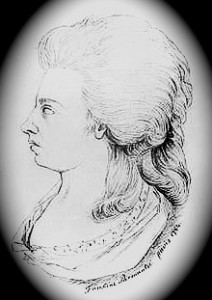
The only known portrait of Maria Theresia von Paradis appears on http://en.wikipedia.org . Another portrait widely reproduced and said to be of Maria Theresia, showing a performer in a state of partial undress and holding a viola da gamba, is from the previous century and is of composer Barbara Strozzi, according to researchers.
The poster is for a 1994 film directed by Roger Spottiswoode. Alan Rickman won the Award for Best Actor at the World Film Festival, Montreal, for his role as Mesmer.
 The structure of the folk song, as author Monika Fagerholm describes it here, explains the overall structure of this novel, with many repetitions through time and space, through past and present, and through new generations and old. Points of view constantly change among the many characters as the chronology moves between 1967, 1989, 2004, and 2012 and back. Bits of information are provided about one character in one section at one moment in time, contradicted in another section, and denied completely in yet another. Different characters go to the same places at different times and perform the same actions, but the results may be different, depending on who is telling the story.
 another’s point of view. At other times, she also resembles writers of fantasy in her use of mysterious forces and in the nightmarish quality of some of the memories her characters reveal. A literary award-winner for every one of her novels, including The American Girl, the predecessor of this one, which won Sweden’s premier literary award in 2005, the author is widely recognized for her complex, challenging, and even mystifying style. Ultimately, she creates her own version of reality in this long, minor-keyed “folk song” of life in Hango (Hanko), Finland, though she may, occasionally, lose her reader in the swirl of memories and retold tales.
 The story begins in 1967, on the southernmost tip of Finland, when Eddie de Wire, the American Girl, falls or is pushed from a cliff into the Bule Marsh, “the abode of suicide,” where a whirlpool sucks her so deep into the water that her body is not discovered for days. Her teenage boyfriend Bjorn commits suicide shortly afterward. Eddie de Wire, The American Girl, has also spent time with Bjorn’s much younger stepbrother Bengt, however, and Bengt’s story has not been told, nor have the stories been collected from the other children, some of them witnesses, who know aspects of Eddie de Wire’s story. By 2004 – 2006, when this novel opens, Ulla Backstrom, an artistically gifted young girl living in the wealthiest part of Hanko, is acting out stories about the American Girl on her private balcony, where she has been observed by local children. At the school for theatrical performance, she is working on Project Earth, a story inspired by the myth of Orpheus and Eurydice, and making music with her band, The Screaming Toys.
 Murders, suicides, death by accident, and disappearances dominate the various time frames, though some who die may have met completely different fates from what has been reported by a character – and may not, in fact, even be dead. As events are finally revisited by characters in 2012, the contemporary lives and deaths of many characters are revealed, though the reader’s reactions are colored by new insights gleaned from bits of information dropped in and out of time. At times, the reader may have no clue who various characters are and where they come from, only to discover later. Some characters – Johanna, in particular – disappear for long periods of time, only to resurface later.
 , and Eddie de Wire, the complexities of Solveig’s life in childhood, and her own role in the events of 1967, along with surprising new information about characters once thought peripheral to the action. The looseness of the thematic development, which might otherwise have given the reader some “hooks” on which to hang the many seemingly random episodes involving death and love, especially the adolescent love which permeates the novel, limits the reader’s ability to feel rewarded with new insights at the end of the novel. Ultimately, the closest I came to finding a statement of purpose came from the dead American Girl, Eddie de Wire, with a somewhat selfish assessment: “Inside each of us there is that eternal YOUNG that wants to glitter, be loved, BE LOVED mercilessly.” I was hoping for a broader, more universal conclusion.
 Claudia Hampton, an iconoclastic, sometimes imperious, often maddening, and completely liberated seventy-six-year-old woman, lies in a nursing home awaiting death—very reluctantly. Having worked as a reporter during the Cairo campaign in World War II, and later as a popular historian, she sees no reason why she should not continue her work as she awaits death. ‘Let me contemplate myself within my [own] context,” she says, “everything and nothing. The history of the world as selected by Claudia: fact and fiction, myth and evidence, images and documents.”
 “In life as in history, the unexpected [always] lies waiting, grinning from around the corners,” and as Claudia remembers and dreams, she continually calls a spade a spade, recognizing the absurdities in her life at the same time that she sees the genuine joys and sadnesses. She gives remarkably insightful (though not necessarily polite) commentary on the people around her (at one point farting loudly when her meek sister-in-law comes to visit her in hospital), always trying to see how people became who they are and how they fit into the grand scheme of things. “Time and the universe lie around in our minds. We are sleeping histories of the world,” she asserts. And God has had little or no positive impact on it, she believes.
 know that she has never married, that she has a daughter named Lisa whose father is Jasper, that she has been close to her brother but does not have anything in common with his wife Sylvia. We learn that, as a child, she was a problem to her teachers who believed that “Claudia’s intelligence may well prove a stumbling block unless she learns how to control her enthusiasms,” yet she goes on to Oxford to study history. She writes popular history books, and then, from 1940 – 1944, when she is nearly thirty, she is in Egypt, at one point cadging a ride to the desert front so she can report on the war and write feature stories, and where she meets an attractive soldier. The plot itself is obviously not the main focus.
 Author Penelope Lively makes every sentence a cause for celebration here. By turns humorous, thoughtful, satiric, wonderfully philosophical, and consummately literary in its observations and allusions, this novel is an absolute treasure, one that will appeal to every lover of serious themes presented in new ways. Claudia, at seventy-six, will strike a chord with many readers, and as she contemplates the meaning of her own life and the connections she may have with the historical past, she comes alive and becomes deeply human. Brilliant in its analysis of end-of-life issues, it is also remarkably personal in its examination of love and what it means.
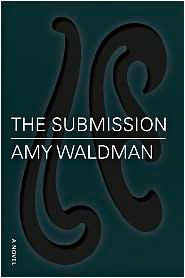 their loss and the entire country trying to cope with their loss of innocence, a competition is held to design the memorial which will be constructed at Ground Zero. Representatives to the selection committee are chosen from all levels of society, including a woman who has lost her husband in the attack, and their task is to choose the best design from all of the “blind” submissions, designs lacking all personal references, including the names of the architects, to avoid favoritism. In the final tumultuous voting between two completely different designs, Claire Burwell, the woman widowed by the attack, favors the design of The Garden, a place of peace and contemplation, with the names of the victims on the walls around the garden. Other committee members are swayed by Ariana, a famed sculptor, who favors a stark, monumental creation called “The Void,” which Claire finds cold.
 The novel moves quickly, as Waldman sets up her conflicts, which are often aggravated by the ever-present press corps, and those who feel that journalists sometimes go too far in their pursuit of a story will find ample evidence here that the author agrees with this accusation. Petty politics is equally repulsive, and the tendency of politicians to keep their eye on the next election, rather than what is right, rears its ugly head throughout. So, too, does the violence committed by hot-heads who have no insight into real issues, just those they think show them to be victimized. When headscarf-pulling incidents graduate to much worse, and local mosques have to hire additional security, the scene is set for a showdown.
 Set primarily in the late 1990s in Sierra Leone, a time in which a brutal Civil War is being waged and over fifty thousand people killed, this novel comes as a surprise. Telling two tales of love in two different generations, the author is mightily challenged to be true to her setting and time periods while also allowing the love stories to develop naturally within this fraught environment. She accomplishes this, largely, by referring to the war only obliquely for most of the novel, with flashbacks by individual speakers providing details of the war and explaining how the memories of war have affected the behavior of characters whom the reader has come to know. A flash-forward which takes place in 2003, after the end of the war, occurs at the end to reconcile elements of the plot and themes.
 Babagaleh, for much of the day, he is a patient of Adrian Lockheart, a British psychiatrist who has left his wife and daughter behind in England while he works for six months in the hospital near the university. Adrian quickly discovers that the dying Elias has memories that he is impelled to share about his life in the 1970s, many of these involving Saffia, the wife of Julius Kamara, a young professor. Old-fashioned story-telling conveys episodes from Elias’s memories of his much younger life, and the author emphasizes from the beginning that it is with these three characters that the entire story really begins—Elias Cole, Julius Kamara, and Saffia. “Perhaps we three would each put the beginning in a different place, like blindfolded players trying to pin the tail on a donkey,” Elias notes. But just as there are three different beginnings, so, too, will there be “three different endings, one for each of us.”
 A parallel narrative, with different main characters, takes place sometime around 2001, near the end of the war, with flashbacks to events of the late 1990s. Kai Mansaray, a brilliant surgeon who lives a significant distance from the hospital, sometimes “crashes” for a few hours in Adrian’s apartment, and the two become friends. Kai is single but has family, including a young nephew who adores him. These relatives live outside the city. On one trip to visit them, Kai brings Adrian, whose life is changed dramatically by an event which happens when he recognizes a former patient who has left the hospital without being fully treated. When the war stories which have dramatically affected this patient’s life—and that of Kai’s family—are revealed, along with the lives of those who have had to spend two years or more in refugee camps, the brutality of the attacking soldiers is almost beyond belief. As Kai says, “[We are] a nation devouring itself.”