Note: This novel, published in Australia as Diamond Dove, was WINNER of the Ned Kelly Award for Best Novel in 2007.
“Boys brawling over a flaccid football, girls bouncing a basketball in a cloud of dust, young men working on a car, pensioners chewing on the cud. A bare-arsed tacker raced past pushing a pram wheel with a length of wire….The Moonlight Downs community.”
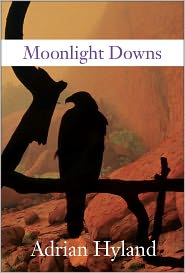
Part white and part aborigine, Emily Tempest has always had “a foot in both camps.” As a child living with the aborigines at Moonlight Downs in the Australian Outback, while her white father worked at the Moonlight cattle station, Emily was a happy member of the community until she was fourteen, when her natural curiosity and tempestuous nature led her to violate a strong community taboo. Immediately, she was sent off to boarding school in Adelaide, her best friend, and partner in the violation, facing a worse penalty within the community.
After attending college, where she started three degrees (including law) and finished none, “I headed off overseas,” she says. “Deckhanded on a yacht across North Africa. Ran a bar in Turkey. Travelled through Rajasthan – on a bloody camel, half the time. Spent six months wandering along the silk Road itself. I w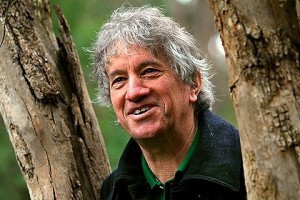 as running so hard it never occurred to me that I was lost.” Eventually, however, she finds her way back “home” to Moonlight Downs for the first time in twelve years, just as Lincoln Flinders, the father of her best friend and the leader of the community, is found murdered. There is no dearth of motives.
The aborigine community has recently had its rights to ancestral lands upheld by the Australian courts after whites had appropriated it for cattle grazing and development. Now, resentful whites have been trying to buy or lease it back. Racial tensions and cultural conflicts underlie whatever relationships exist between the whites and the “blacks,” and some of the aborigines’ most sacred sites have been deliberately destroyed by whites. Aborigine youth who have lived in Bluebush, the nearest community, no longer feel the ties to the land that their parents and ancestors have had, and the community’s future is threatened. “Rust was seeping into the soul of the community,” Emily observes. Determined to find out who murdered Lincoln Flinders, she is in a unique position to do so, but she also has her own enemies, both inside and outside the aborigine community.
Australian author Adrian Hy land, who won the Ned Kelly Award for this atmospheric and dramatic first novel, creates a narrative that moves at warp speed, filled with action and excitement. At the same time, he also invites contemplation of the natural world and the lives of the aborigines who identify with nature on a visceral, even mystical, level. Their needs are basic, their lives are not pretty, and their land is infertile, making their ability to be happy because of their culture and beliefs significant by contrast.
Hyland’s dialogue is earthy, filled with aborigine and white slang (for which there is a glossary in the front), and he is often profane, preferring to show his characters and their lives as they really are, instead of the way an “overcivilized” reader might wish them to be. H is remarkable ability to recreate the seemingly bleak North Australian landscape and the people who consider it “home” puts the reader in touch with life’s most basic needs and the aborigine culture which has developed there. Despite its movie script ending, this is an unusual and captivating mystery, one that sticks in the memory long after the book ends.
ALSO by Hyland: GUNSHOT ROAD
Photos, in order: The author’s photo appears on http://www.smh.com.au.
The author has said that he has modeled the town of Bluebush on both Alice Springs and Tennant Creek, The bleak landscape of Alice Springs is seen here: http://members.virtualtourist.com
In the bottom photo, Dianne Stokes, an elder of the Yapa Yapa clan, and her daughter, Sky in Muckaty, are among the clan members opposed to a 2007 plan which would put a nuclear dump in the Outback and require transit of materials through their ancestral lands. “if it is so safe, why don’t they put it in Sydney?” she asks. http://www.smh.com.au
 In his fourth novel featuring Dr. Quirke, a Dublin pathologist at the Hospital of the Holy Family, Booker Prize-winning author John Banville, writing his mysteries as “Benjamin Black,” reveals yet another grim side of Dublin life in the early 1950s. An orphan who was sent to St. Christopher’s Orphanage when he was a child, Quirke had the good fortune to be adopted by a wealthy man who eventually put him through college and shared his life and family with him, but Quirke has never been able to enjoy family life of his own. A lost soul who has lost even more of himself in drink, Quirke is a loner, so unsure of who he really is that he is unable to trust relationships on anything more than the superficial level.
 t wound, too far away to hear the gunshot. His sister, also in jodhpurs and riding boots, is reclining on the sofa and has apparently no curiosity at all when Quirke arrives at the house. Both have been drinking, causing Quirke to wonder, “Who were these women, really…and what was going on here.”
 t at the same time everything seemed to be racing along like a river in spate and carrying all before it.”
 duit for information to reach Quirke which he would have no other way of learning. Quirke, in turn, can relay it to the police, who have no entrée to these social circles. Throughout, threats and unexpected violence occur regularly, and twists and turns occur, but as the reader has no idea what the motivation is behind the death of Jewell until the end of the novel, the novel seems to bog down a bit and go on too long to maintain the high level of suspense with which the novel starts. Banville is terrific in exploring character and setting, however, and his picture of Dublin in the 1950s is memorable. Ultimately, the reader will agree with one character who says, “You think you’ve seen the worst of the world, but the world and its wicked ways can always surprise you.”
 ny book, closer to a short story than to a novella, was the last piece of fiction by author Joseph Roth (1894 – 1939), and was published posthumously in 1940. As such, it becomes a particularly poignant study of Roth’s last days as he waited for the death he knew was coming. Born in Galicia, at the junction of Ukraine, Poland, and Czechoslovakia, Roth left home to attend college in Vienna, then served in the Austro-Hungarian army during World War I, later mourning the loss of the Habsburg Empire and all it represented. Moving to Berlin, he began writing as a journalist and working on fiction, reaching what many consider the apex of his career with the publication of
 Nissen has never left Progrody and has always yearned to see the ocean where his corals live, and when a young sailor comes home on leave from Odessa, he persuades the sailor to take him back with him when returns to port. Thirsty for knowledge and completely bewitched by the magic of the ocean, he stays for three extra weeks, living the life of a sailor, drinking, whoring, and neglecting his religious duties before reluctantly returning home. There he discovers that a new coral seller has set up shop in the next town, undercutting him in prices and leading his former customers to believe that Nissen has been cheating them.
 When he meets the new merchant, he finds that “Powerful and intoxicating scents emanated from him and one wondered what part of his frail body could possibly be home to all these scents. His hair was blackish-blue as night. And while his dark eyes appeared gentle enough, they glowed so powerfully that a strange redness appeared to flare up in the midst of all their blackness. Under his curled black mustaches, Lakatos had a set of dazzling white and smiling mouse teeth.” Nissen’s world dramatically changes as he comes to know this stranger, and one day he makes a fateful decision which changes the world as he knows it.
 any, between free will, God, the devil, and chance are left to the reader to decide as the conclusion resolves the surface issues. Book club readers should have a field day discussing exactly what Nissen’s final actions connote—triumph or failure, a deliberate decision or a desperate impulse, a resolution or a resignation to fate. In the meantime, this touching, allegorical story gives insights into Roth’s final days and some of the issues which may have been haunting him.
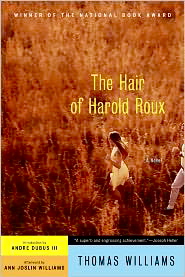 In this supremely literary and exciting prize-winner from 1975, newly reprinted by Bloomsbury, Thomas Williams, an almost forgotten author, creates a novel about fiction writing and its relationship to the “immensities” with which every human being must contend, for better or worse, during his lifetime. Telling the story of a novelist who is writing a novel in which a character is also writing a novel, Williams creates, first, Aaron Benham, a professor at a small New England college in the 1970s. Benham is writing a novel entitled The Hair of Harold Roux, in which the “thinly disguised” hero is twenty-one year-old Allard Benson, who is a college student on the G. I. Bill just after the close of World War II. Allard Benson does not believe in violence, but he would “kill the world for girls like Mary Tolliver,” an especially innocent, eighteen-year-old freshman who has had a very protected and very Catholic upbringing, and whom he is trying to seduce.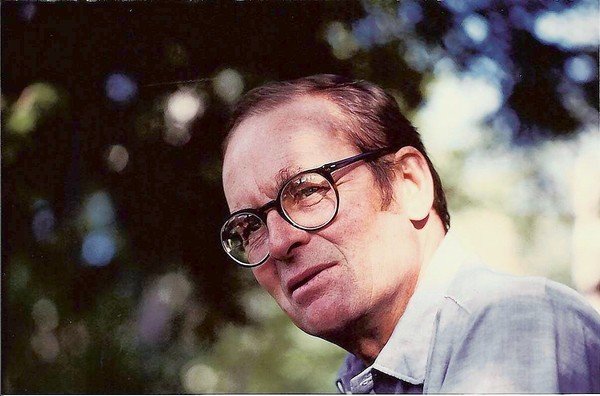

 While writing this novel set in the 1940s, Prof. Aaron Benson is also living his own life in the 1970s, five years before the end of the Vietnam War. Many of his students are active in the culture of “turn on, tune in, drop out” and in radical politics. The competitive, internecine maneuvering within college departments dealing with tenure and the “publish or perish” requirement have made the life of at least one of Aaron’s friends a misery, while exerting pressure on Aaron himself. His need to write his novel has created some problems in his marriage, and he is feeling “itchy,” often inventing fantasies about what he has missed with regard to other women. When he goes deep sea fishing with a group of drunks one weekend, he discovers life at one of its lowest levels, “poor, deformed organisms” whose casual cruelty reveals Aaron’s own “fascination with the abomination.” But it is the sometimes frightening stories he creates for his children, ages six and eight, that reveal his preoccupation with the dramatic effects of fiction. Cuddling with them on the couch as he spins his stories, he literally “feels the story with their reality,” an event so full of emotion that “he loses his voice.”
 Within this rough outline of the novel, Williams writes some of the best and most excitingly sensuous descriptions ever. Both Aaron Benham and his creation, Allard Benson, love motorcycles, and both have scenes here in which they express the feeling of freedom they achieve as they fly down the road, Aaron indicating that he “feels the symmetry of having made something out of chaos” simply by arriving home safely. When Allard meets Mary Tolliver’s father, he notes that “Mr. Tolliver’s skin was yellow-brown, his glasses tinted sepia like an old rotogravure. The skin of his face and neck hung as though draped over his head and tacked here and there, at the corners of his eyes and where his ears were attached to his head.” When Allard visits the home of Col. Immingham, inside a miniature village which the Colonel has made to honor his wife, he rides on a hand-crafted railway with a 1/6 scale locomotive from the Prussian State Railways of 1880. Sporting “three brass lanterns on its front end…the engine seemed to peer straight ahead with the powerful
  yet slightly moronic, clownish intensity of a cyclops.” He believes that the little village is obviously “someone’s ideal place, [and] that a segment of another world had been created here,” a fiction made from wood and metal rather than words.
 estranged brother and father. Gabrielsson has said many times, and repeats often throughout this book, that she is not personally interested in the enormous sums which the posthumous sales of his Millenium Trilogy have generated—forty million books sold, plus rights to audiobooks and films, including three Swedish films and one American film not yet released. As dedicated to social causes as Larsson was, she is fighting, instead, for control of his literary legacy, especially alarmed because “a myth has sprung up: the ‘Millennium Stieg’…[which] casts him as the hero of the trilogy…[though] Stieg didn’t wait for the Millennium books to be what he was.”
 Constantly emphasizing Larsson’s causes and his philosophical and political beliefs throughout her book, Gabrielsson does not really tell much about their lives together, except within the context of their shared beliefs, and neither of them truly comes alive here. Gabrielsson’s descriptions of her grief at his sudden death certainly ring true, and her grieving process, as described, was long and arduous, but much of this grief was also connected to their devotion to causes, some of which began to languish after his death.
 Does Gabrielsson, in fact, really hold the “ace” in this high-stakes game of Larsson’s legacy—the mysterious computer? That is never clear. She says the computer was returned to Expo magazine the day Larsson died (because Expo owned it), and that it remained there, unsecured, for at least six months. Expo denies that they have it. In an interview Gabrielsson has also said that she is determined that the fourth book, if it exists, not be completed—she wants no ghost writers involved in Larsson’s work. Even more confusing is this statement from Gabrielsson’s own co-writer, Marie-Francoise Colombani in the Foreword: “If Eva’s request [for control of Larsson’s literary estate] is granted, she will clear up the mystery shrouding the fourth novel…As for enemies of Lisbeth Salander and Mikael Blomqvist—let them tremble, for this fourth book will be entitled The Vengeance of God. And they should know this: Eva, tempered in the fires of adversity, is poised to write the final words of their fate and lead a dance on their graves.”