“Look, collusion worked all ways, all directions…Loyalists supplying Republicans with fake DVDs and Ecstasy tablets. Republicans wholesaling laundered diesel and bootleg vodka to Loyalists…And the killings. How many of our own did we set up for the Loyalists to take out? How many of their own did the Loyalists set up for us?”
Set in Belfast and focusing on the long-term hatreds between Catholics and Protestants, and among governmental agencies in both Northern Ireland and the Republic of Ireland, this complex and violent noir mystery shows all the hatreds and rivalries involving many departments of the police, the British Army, the SAS (Special Air Service), MI5 (one of the UK’s Military Intelligence services), the UVF (Ulster Volunteer Force, a paramilitary group) , the UDA (the Ulster Defense Association, another Loyalist force), and various Catholic paramilitary forces.
Jack Lennon, a Catholic who has joined the RUC (the Royal Ulster Constabulary) in order to try to form a bridge among the various law enforcement factions in the city, had been on the Major Investigation Team, until he tried to fix a speeding ticket for a man to whom he owed favors and was busted. Lennon, a loner, has tried to stay on the straight and narrow in an environment in which everyone has an angle and is willing to bend the rules to accomplish his own ends. He has no family on which to depend–they abandoned him fifteen years ago when he joined the RUC, and he is now able to see his mother only because she is so debilitated by senility that she does not remember who he is.

The novel opens with a vividly described assassination, in which the action is told from the point of view of three shady Loyalist victims as they realize they are about to die at the hands of people they do not know but who seem to be part of the police. Other assassinations are recalled involving other victims, the killers still not identified or apprehended. Two sadistic assassins are hired to deal with the crimes, soon find themselves stalking each other, even as many different agencies are stalking them. At the heart of the novel is Marie McKenna, a criminal capo’s daughter who is also the mother of his child, Ellen.
Rave reviews have accompanied the release of this dark novel of criminal worlds colliding with sectarian hatreds. A sequel to Stuart Neville’s debut novel, The Ghosts of Belfast, featuring many of the same characters, Collusion continues their stories and further develops the characters while expanding the action from the first novel. As someone who has not read the first novel, however, I found it nearly impossible to keep track of who the characters were, what their history and motivations were, and what, exactly, was behind all the violence which unfolded on almost every page. Though I kept notes as characters were introduced and began to interact, the author did not help new readers to any great extent by providing and explaining background. It was not until the halfway point that I began to appreciate how all these characters were connected and to begin to empathize with some of them, including, ironically, one of the assassins.
Though the novel is firmly focuse d on nonstop action, much of it grim and gruesome, the author is also a fine writer of description, with an ear for dialogue that makes his characters come alive, even when the reader is not quite sure why they are behaving as they do. The large cast of characters allows the author to explore many different facets of influence in Belfast, showing the compromises the police make to maintain the peace, the ability of the criminal underworld to make their own rules, and the difficulties of those, like Jack Lennon, who try to navigate the no-man’s land between and among the powerful, often criminal, brokers of influence in the city. As Lennon says to one of his opponents, “The collusion, it goes all ways, all directions. All the likes of you ever cared about was lining your own pockets. You didn’t give a shit about any cause, did you? Just so long as you were making money.”
Photos: The author’s photo appears on his Amazon Author page.
The photo of a cell in Maghaberry Prison, the site of several scenes in this novel, is from www.independent.ie.
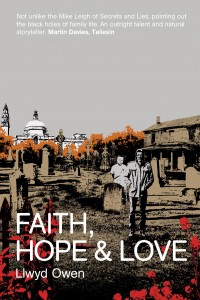 unusual and often dark novel, Faith, Hope & Love is billed as an urban thriller, but it is far more the psychological study of an unusual anti-hero than it is a mystery. In fact, the biggest mystery of the book is why the main character is in prison in the first place, a question which does not get answered until late in the novel. The Prologue, entitled “The Beginning of the End,” raises additional questions concerning a car crash, which is described there, and the identities of the people in the car—again, issues which are not addressed again till late in the novel. In between the Prologue and the resolution of these questions, however, the novel is study of Alun Brady and his family, much more a sensitive domestic drama than an action thriller, a study of identity and reality—personal, familial, cultural, and religious—as revealed through a series of unrelenting ironies in which God, fate, and free will do battle.
 , brother Will volunteers that Al’s “always been a proper little mummy’s boy,” someone who is now “nearly thirty, he’s never left home, he’s never had a girlfriend…I mean, if he’s not gay he must be a girl. Are you a girl, Al?” Though his mother roars at Will in fury over this attack, Alun dissolves into tears and runs from the room, making no effort to defend himself and leading the reader to wonder what, on earth, someone so sensitive could have done that would lead to a three-year prison sentence. Ironically, Alun regards Will as the “black sheep” of the family.
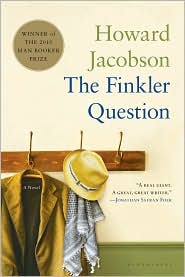 uly a separate genre known as a “Jewish novel,” then this novel would have to be its crowning achievement. An expansive and wide-ranging novel about the many facets of being Jewish (or “Finklerish,” as Treslove sees it), The Finkler Question examines the lives of three friends: Julian Treslove, a now forty-nine-year-old Gentile, has always been fascinated by all things Jewish, including women. A romantic who has never been able to maintain a relationship, however, Julian has been abandoned by all of the women he’s known in the past, including the two who bore his sons. Sam Finkler, Julian’s former classmate, writes wildly popular (and popularized) editions of philosophical ideas “for all occasions.” Sam is a widower who lost his young wife early, leaving him with three older children. Libor Sevcik, almost ninety, their former teacher, who eventually became a commentator on the entertainment business, is also a widower, having just lost his devoted wife of over fifty years, and his former students have been trying to see him more often because he feels so lost.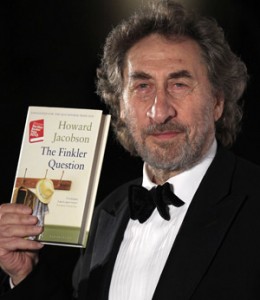
 In another plot line, the feckless Julian meets Hephzibah Weitzenbaum, Libor’s great-great-niece, and he believes that he may finally have found his soul-mate. Working on a Museum of Anglo-Jewish Culture, she emphasizes what the Jews have achieved in England, rather than what they have undergone, and she persuades Julian to help out, He begins to study Jewish thought by reading Maimonides (with enormous difficulty) and though he starts thinking of himself as Jewish, he cannot seem to enter the “club.” “It was like being a child among adults; not unloved but unlistened to. At best humoured. He wasn’t the real McCoy, that was what it came to. Not only wasn’t he a Jew, he was a jest to Jews. The real McGoy.”
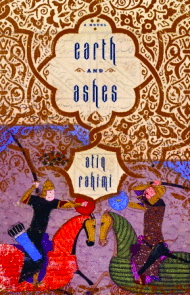 Earth and Ashes, a small novella, packs more feeling and more power into its few pages than most other books do in hundreds of pages, and few, if any, readers will emerge from it unscathed. Author Atiq Rahimi, an Afghan national now living in France, has recreated the Afghanistan he remembers when it was occupied by the Russians (1979 – 1989). He was seventeen at the time, and life has not improved much for the populace since then. Only the enemies have changed, and they now include many factions from within. Rahimi’s bleak picture of life in the farming village of Abqul includes the occupiers’ casual murder of individuals, the decimation of families, the annihilation of villages, and ultimately the obliteration of whole cultures going back to ancient times. Without preamble or any lengthy setting of the scene, the author introduces a main character who is faced with a family crisis from which he may never recover, then tells that story in plain, direct, and straightforward language which gains impact from its very simplicity.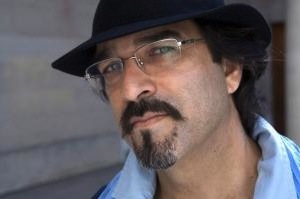
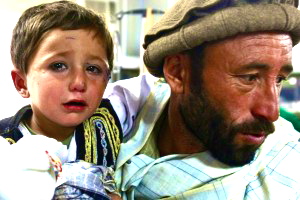 antly through the miles, he takes a distanced view of himself, referring to himself always as “you.” “To whom are you speaking?” he asks himself. “To Yassin? He can’t even hear the sound of stones, let alone your feeble voice.” He imagines meeting with Murad at the mine and has nightmares which combine ancient stories with the events of his village. And when a shopkeeper tries to be friendly, Dastaguir has to remind himself to respond–“You wanted to talk to anyone about anything. Now, here is someone who’ll listen to what lies in your heart, whose look alone is a comfort. Say something!”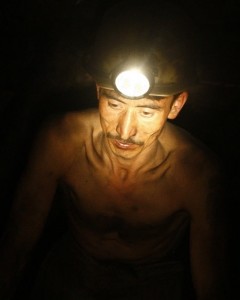
 r James Church takes his series of mysteries set in North Korea in new directions with this surprising fourth novel. Church, a former intelligence officer with the U.S. government, has spent much time in Asia, and presumably North Korea, and he makes a foray here into speculative fiction–not speculating on life in North Korea in the far distant future, but in the very immediate future. When this novel opens, it is 2016, and Inspector O, the iconoclastic officer who has been the fascinating main character of the three previous novels, has been happily retired from action and living in blessed isolation on a mountain top, working with his precious woods. Suddenly, he is visited by officers he cannot refuse to accompany and is brought back to Pyongyang. He is needed for a special assignment.
 ries, O is not always sure about what is going on, and his very ignorance and confusion, as seemingly unrelated actions take place, parallel those of the reader. Church uses O’s ignorance throughout the series, in fact, to show how little most of us know about North Korea, a monolithic government shrouded in secrecy. With so many other powerful countries also wanting a piece of the North Korean pie, this novel is particularly complicated, but as O becomes more human than he has ever been in the past, he is a more sympathetic character, more able to keep the reader interested and committed to knowing the outcome.