“What [Piaf] could do, as few others could, was to tear you away from your own life, out of yourself, and whisk you to the land where dreams come true. She could make soldiers win battles, give virtuous women the lovers they had always longed for; she could make the poor forget their misery and the wealthy their boredom. And having done all this, having reached a state of exaltation, she would fall, long and hard.”
 First published in English in 1981, and republished in 2008, after the film “La Vie en Rose” created a whole new generation of passionate Piaf fans, Monique Lange’s biography of Piaf comes closer to capturing her personality and explaining her behavior than any other biography that I have read. An editor, writer, actress, and scriptwriter, Lange associated with some of the same Parisians who adored Piaf, especially Jean Cocteau, who persuaded Piaf to act in one of his plays. Though she does not indicate that she ever met Piaf, Lange seems to understand her and appreciate how she became who she was. Often sympathetic to Piaf’s problems, Lange never forgets that Piaf was just as often impossible to deal with–her own worst enemy. Writing in the conversational style of a feature article for a magazine or newspaper, Lange “gets inside” her characters, draws conclusions about Piaf’s life, and provides many pages of candid photographs.

Ultimately, Lange decides that “She was Our Lady of Love, but also Our Lady of Masochists …When she [sang of happiness], the audience knew it was fleeting, soon to be taken from her. Therein lay her major deceit. Ultimately she was cruel and spiteful, yet her supreme weapon was the ability to make her public cry.”
Lange assumes that the outlines of Piaf’s life are already well known by most of her fans, and she wastes little time rehashing the well-worn details. She does, however, often add new insights. Piaf’s incompetent mother used to give the infant Edith wine to make her sleep; later, her father gave her brandy so she would not feel the cold at night, two habits that might have made her more prone to alcoholism. Mobster/club owner Louis Leplee was so touched when he met her that he changed her name from Edith Gassion to “Kid Piaf,” or “Little Sparrow,” introducing her at Gernys for the first time by saying he had discovered her singing on the sidewalk. “I was moved. Overwhelmed. I wanted to share this girl, this Paris child, with you. She doesn’t own an evening dress, and if she knows how to take a bow, it’s because I taught her how yesterday.”
 Inspiring total commitments from the many people who eventually surrounded her, Piaf enjoyed the attentions of Raymond Asso, who was madly in love with her and wanted to make her a star; Paul Meurisse, who co-starred with her in a Jean Cocteau play, and introduced her to the finer things in life; Yves Montand, “one of her own kind,” who traveled with her on the road, until he began to be more of a sensation than she was; and many others, most of whom became her lovers. Following the death of boxer Marcel Cerdan (treated superficially here), Piaf generously moved his wife and four children into a house in Boulogne, taking care of them lavishly, until, after four months, she suddenly sold the house! She used men who wrote songs for her, sometimes locking them into rooms and refusing to let them out until they wrote a song she liked. She could be generous, and at one point was supporting fifteen people with whom she had no contact at all. Money meant nothing to her—she gave most of it away—and she died with a mountain of debts.
Her friendships with women were rare. Momone, a friend from childhood was insanely jealous of Piaf, and very dangerous, encouraging Piaf’s worst habits. Marlene Dietrich was a genuine friend, though they saw each other seldom. And it was Andree Bigard, her business manager, who, as a member of the French Resistance, actually set up the opportunities for Piaf to help the war effort by singing for French prisoners in German prison camps and eventually smuggling out about a hundred. (Most other bios attribute this effort solely to Piaf.)

An alcoholic and drug abuser, Piaf survived a terrible car crash, numerous operations, a bleeding ulcer, stomach surgery, an intestinal occlusion requiring surgery, and hepatic comas. Even in poor health, however, she could not help being Pygmalion to young stars, and at the end of her life she determined to make a star of Theo Sarapo, a singer twenty years her junior. A year before her death, Piaf and Sarapo married, and a year after that, at the age of 46, Piaf died—on Oct. 11, 1963, the same day as Jean Cocteau.
Lange’s biography has the advantage of “feeling real,” as if it were written by someone who knew Piaf, whether or not that is truly the case. She draws many conclusions about Piaf’s life and behavior and makes sense of it—as much as anything involving Piaf can make sense. Song lyrics, letters written by Piaf, and dozens of unusual photographs, some of them given full-page treatments, add poignancy to the text and provide new insights. If I were going to have only one biography of Piaf, it would be this one.
Notes: Author Monique Lange, a cousin of novelist Marcel Proust, Emmanuel Berl, and the philosopher Henri Bergson, is a fascinating person in her own right. Her photo, Publiée le 2010-11-17 08:10:31 par lormari is here: http://www.babelio.com. A writer of Jean Genet’s biography, she also worked on films considered “psychological dramas,” or “psychological thrillers.” Her obituary is here: www.independent.co.uk
The grave of Edith Piaf is shown here: http://en.wikipedia.org Theo died seven years after Piaf, at the age of 34, following an automobile accident, having worked for most of the time since Piaf’s death paying off the debts he inherited from her.
A video recording of Theo Sarapo and Edith Piaf singing “A Quoi Ca Sert L’Amour,” in a live performance, is here:
The lyrics in English are here. Pay particular attention to the last three stanzas. http://lyricstranslate.com The image of the cover of this vinyl recording is here: http://rateyourmusic.com/artist/edith_piaf_et_theo_sarapo
The same song, not live, but with much better sound, is here: www.youtube.com. A really terrific video of Theo singing alone: www.youtube.com.
A video of Piaf singing “J’ai Qu’a L’Regarder,” a song of all her past loves, is here, complete with photos of those those many lovers: www.youtube.com
Also: Another biography of Piaf by David Bret: PIAF: A PASSIONATE LIFE, is reviewed on this site. That review has different links to other songs and Piaf sites in the Notes.
For a review of the film of LA VIE EN ROSE with Marion Cotillard, CLICK HERE.
 e who see this film are probably already well familiar with the story surrounding Lisbeth Salander, the unlikely “heroine” of the trilogy by Swedish author Stieg Larsson. Director Daniel Alfredson, who also directed The Girl Who Played with Fire, apparently also assumes this, as he spends little time giving background, instead showing quick cuts of a few scenes from the two earlier films and allowing Lisbeth’s background to unfurl through her trial for murder. Beginning the film at about the halfway point of the final novel, Alfredson also omits most of the danger represented by her father, Alexander Zalachenko, a Russian defector who is trying to kill her in the hospital where they are both patients recuperating from life-threatening injuries. Zalachenko (Georgi Staykov) has only a cameo role here.
 When Lisbeth is finally released from the hospital for trial, Rapace plays the role to the hilt, and her close-ups in the courtroom are stunning–her eyes going dead, her slight grimaces, her blank expressions, her palpable vulnerability. Represented in court by Mikael Blomqvist’s sister Annika Giannini (played with wonderful subtlety by Annika Hallin), she appears to be everything that the uncompromising legal system abhors, and she does nothing to help herself. As in the past, Michael Nyqvist plays the role of Mikael Blomqvist, the caring writer/publisher of Millenium Magazine who wants to help her. As he and the staff of Millenium investigate the circumstances surrounding Lisbeth’s assignment to a mental institution at the age of twelve, and the accusations of abuse which she has made, the contrast between their commitment and active involvement in her future and the lack of affect that she shows toward her own future is dramatic and moving.
 Unlike the previous films, there is very little dramatic violence here, though Lisbeth’s confrontation with her giant brother Ronald Niedermann (Micke Spreitz), who is unable to feel pain, is one of the film’s high points. There are no graphic sex scenes, and the only sexual abuse is done off-camera. The Swedish setting–and the mood–are dark and cold, paralleling the life of Lisbeth Salander. The final scene, subtly different from the novel, consists of Lisbeth uttering one word–a word that had as much long-term dramatic effect for me as the word “Rosebud” does in Orson Welles’s Citizen Kane. Ultimately, the viewer feels a kind of peace at the end of the film, a sensitive and satisfying conclusion to this trilogy.
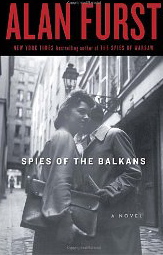 vents in the Balkans leading to the occupation of Greece by the Nazis in April, 1941, form the structure of this complex novel, which begins in Greece and ranges through Albania, France, Yugoslavia, Bulgaria, Hungary, and Turkey, as small, vulnerable Eastern European countries try to stave off both the Italians and the Nazis. Alan Furst, famous for his carefully researched espionage thrillers focusing on events from 1940 and 1941, recreates the confusions and the complications of the Balkan countries in early 1941, as they try to maintain some semblance of sovereignty against the massive war machine of Nazi Germany. With their different political systems, languages, and cultural sensibilities, their best chance for individual survival lies not within their own, often impotent, governments but within a loosely connected group of individuals from many European countries who may have access to information. Exhibiting little sense of trust of each other, some are associated with police and intelligence agencies, while others are committed private citizens who want to help the Jews escape the onslaught of the Reich. All want to stop Hitler, but all also have separate, private goals.


 ed writer is hired by a friend who works with the human rights office of the Catholic Church of an unnamed Latin American country to edit and proofread eleven hundred pages of testimony—“the memories of the hundreds of survivors of and witnesses to the massacres perpetrated in the throes of the so-called armed conflict between the army and the guerrillas.” During the 1970s and 1980s, the army declared that the indigenous Indians who had lived in remote Mayan villages for hundreds of years were anti-government leftists, and soldiers conducted widespread genocide wiping out hundreds of villages and killing over a hundred thousand people. Now, many years later, the human rights office at the cathedral plans to publish the survivors’ testimonies for the first time. One section of the report, detailing how the army intelligence services operate, is considered so explosive that this section will be added to the finished book the day it goes to press, when it is too late to stop it. Writing in the first person, the writer/editor, an atheist, confesses that he is concerned about the relationship between some members of the church hierarchy and members of the army, who may have directed the massacres, and he trusts no one.


 es Church,” a career diplomat with years of experience in Asia, including, one assumes, North Korea, sets his second mystery starring Inspector O of the Ministry of People’s Security, in the country’s capital of Pyongyang. Though O is an Inspector, he, like those he works with, has no idea who is really in charge of the investigations to which he is assigned. His Ministry is constantly locking horns with SSD, the State Security Department. Turf wars often erupt over jurisdiction and competition for credit is fierce when a case is solved successfully, since budgets depend on solving problems. The Traffic Division has its own interests, and unnamed people from unknown departments of the army or the government sometimes assume control without warning and manipulate outcomes. For Inspector O, the best approach has always been to keep his head down, do what he is told, try to laugh at the absurdities, and close his eyes to the atrocities.
 O quickly discovers that someone, somewhere, is controlling his access to information, and he realizes that he and the Ministry are being set up to fail. One of the robbers, thought to be from Kazakhstan, has been hit by a bus and killed while removing a silk stocking from his face as he crosses a busy street. Though the morgue denies that they have the body, O is able to obtain the silk stocking the man was wearing. Private guards, not government security, have been on duty at the bank, and one of them has left immediately before the robbery. Strange characters who seem to be involved in a local bar called Club Blue, where a murder takes place, also seem to be connected to people at the bank. The bank manager is not cooperative. Nothing there was insured. The government says it wants the foreigners who use the bank—people involved in necessary business and trade with the country—to have their sense of safety and security restored, but O cannot obtain any information to help him solve the case.
 mor and violence, Hidden Moon recreates the frazzled and frantic life of a mid-level bureaucrat in the country’s capital and casts light on a life that offers little hope of improvement.