“Looked at from outside, [the] guests—in this dead-and-alive dining room, of this dead-and-alive house, of this dead-and-alive street, of this dead-and-alive little town—in the grey, dead winter of the deadliest part of the most deadly war in history—thus seen from a detached point of view, they presented an extraordinary spectacle.”
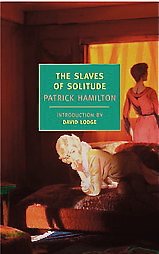 Described by the [London] Daily Telegraph as “a criminally neglected British author,” Patrick Hamilton wrote nine novels from the 1920s through the early 1950s, along with the famous dramas of ROPE and GASLIGHT, and though he earned the admiration of a host of famous authors, from Graham Greene and Doris Lessing to Nick Hornby, he never achieved the popular success he deserved, either in his own time or throughout the twentieth century. In this decade, however, virtually all his novels have been reprinted in both Europe and in the US, and he is finally beginning to be recognized for his astute observations about his times and for his insights into the minds of his characters. Though TWENTY THOUSAND STREETS UNDER THE SKY is the most recognized of his books (thanks to a BBC mini-series), and HANGOVER SQUARE is often considered his masterpiece, my personal favorite is SLAVES OF SOLITUDE.
During the Blitz, the setting of this novel, many Londoners cleared out of the city at night, taking daily trains to temporary quarters in the countryside for safety. Timid Miss Roach, a woman of thirty-nine who is a secretary for a London publisher by day, lives at the Rosamund Tea Room, now a boarding house, in Thames Lockdon. Here, she and her fellow boarders take their meals and try to live “normal,” peaceful lives during the night-time bombing of 1943. Some of the long-time residents of the house, however, subject newcomers to psychological warfare, similar to the real war they are trying to escape—with skirmishes, sneak attacks, and deliberate sabotage of each other’s personal space.
Miss Roach, who does not use her first name, is new to the residence, and she has become the focus of an ongoing attack by Mr. Thwaites, a man in his sixties, “a lifelong trampler on the emotions of others” who regards mealtimes as “torturing time.” For him, the Rosamund Tea Room is “a sort of compulsory indoor game in which he perpetually held the bank and dealt the cards.” As a result, Miss Roach lives in “plain fear, fear of life, of herself, of Mr. Thwaites, of the times and the things into which she has been born, and which boomed about her and encircled her everywhere.”
When Miss Roach,  in frustration, escapes the house to the movies one night, she meets American lieutenant Dayton Pike, who, with a friend, has recently had dinner at the Rosamund Tea Room. Within three weeks, she and he become friendly, and her life changes. The arrival of Vicki Kugelmann, a German-born friend, turns her life upside down. Vicki “plays” on Mr. Thwaites, teaches him card games and flirts, and he loves it, regarding her as an ally. Unfortunately, she behaves the same way with Miss Roach’s lieutenant, being far more aggressive, drinking to excess, joining them at the bar, using slang that Miss Roach finds coarse and common, and even calling Miss Roach not-so-joking names to her face.
Patrick Hamilton’s sense of satire and natural wit turn the Rosamund Tea House into an ironically depicted microcosm of 1943 life. Here he lays bare the inner lives of his characters, not through interior monologues but through their behavior, their revealing conversations, and their interactions with others. No character recognizes that any other character might inhabit a completely different inner world from the world that is visible in day-to-day behavior. All of them are seen as “slaves of their own solitude,” and in their lonely lives, shown in poignant detail, they become sympathetic—and human—rather than truly laughable. Stiff upper-lip-ishness may be the watchword for “ladies” like Miss Roach and “gentlemen” like Mr. Prest, another of the boarding house residents, but that characteristic, while “civilized” or “polite,” simply adds to their sense of isolation.

Thames Lockdon was modeled on Henley-on-Thames, pictured here.
Hamilton can do virtually anything with prose. His ability to create sympathetic characters, while also conveying sense impressions, moments in time, and unique, visual observations about ordinary life is unparalleled. His description of the “bench companionship” which arises among elderly denizens of parks, for example, includes references to “the semi-tottering parade of death-in-life in the winter sun.” Mr. Thwaites has “that steady look with which as a child he would have torn off a butterfly’s wing, [or] with which as a boy he would have twisted another boy’s wrist.” And Mr. Prest, playing golf, “having the treacherous faculty at certain intervals of being able to hit the ball squarely off the middle of the club-head four or five times in succession…would exhibit the curious caution… of packing up his clubs and going home only when such an interval had just occurred and remained unmarred by disaster.” Hamilton has finally found his audience in England, thanks, in part, to the BBC series based on TWENTY THOUSAND STREETS UNDER THE SKY. Here’s hoping that more Americans who love brilliant prose and memorable characters will soon join them. (On my All-Time Favorites List)
Notes: Also by Hamilton: TWENTY THOUSAND STREETS UNDER THE SKY and HANGOVER SQUARE
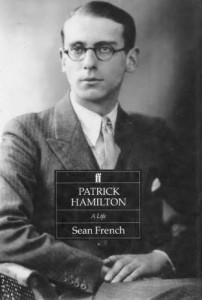
The author photo appears on the cover of his biography by Sean French, published by Granta in 1995.
Though Hamilton says that the Rosamund Tea Room is not based on any particular boarding house or former tea room, it might have resembled the Alushta Guest House: http://www.lodging-world.com
That house is in Henley-on-Thames (http://www.thames-path.org.uk) also pictured, which was the town on which Thames Lockdon was modeled.
 ars after Henry Smart became one of the heroes of the Easter Rising in Dublin in 1916, the most significant rebellion of the Irish against British rule in over a hundred years, Henry is in Hollywood, where he is an “IRA consultant” to director John Ford, a second-generation Irishman from Maine who plans to make a film about Henry’s life. The making of this film and its aftermath become a major focus of this final novel in the “The Last Round-Up” trilogy by Roddy Doyle, who had intended the trilogy to reflect Ireland’s history from its independence to the present day.
 is from Maine, wants to celebrate Ireland’s beauty by removing all references to the War for Independence and the IRA. “I couldn’t have an Irishman shoot an Irishman,” Ford says. That doesn’t happen in Ireland. No one gets shot in the back. No one gets shot at all”—at least in the Ireland which Ford thinks the public will pay to see.
 of this atmospheric, often nail-biting, story, the reader knows that s/he is in the hands of a mastercraftsman, a writer at the peak of her powers who is able to involve the reader in a story of escalating tension and heart-quickening suspense. After only one page, I was completely caught up in the action, holding on for dear life and “riding the dragon” as Miyabe introduced her unusual characters and their even more unusual problems.
 plot often feels like a bad dream from which the dreamer cannot escape. As in dreams, many disparate elements come together in unusual ways. People who don’t seem to belong together somehow do, and plot elements which seem unrelated somehow connect. The reader feels empathy with the characters, and even compassion toward the psychic teenagers. The reader wants Shinji to be real, but at the same time feels sorry for him for having this paranormal power. Shogo, too, is a vibrant character with problems of his own, many of them romantic.
 ver, is the constant apologizing by seemingly strong characters, the need to blame themselves when events involving other people do not turn out as expected. Even when a character has no way of preventing a calamity, the character genuinely feels guilty and apologizes profusely for the unexpected.
 on people in Scandinavia have seen this film, making it the first film in Scandinavian history ever to break the $100 million mark for European ticket sales, and US fans of Stieg Larsson’s bestseller of the same name may propel the film to similar records here. The R-rated film tells the story of Mikael Blomqvist, a disgraced journalist for Sweden’s Millenium magazine who accepts an invitation from an elderly businessman to investigate the disappearance of his niece Harriet, thirty-seven years ago. No trace of her has ever turned up, and the old man fears that a member of his family may have murdered her. While Blomquist is gathering information and storing it on his computer, he realizes that someone is hacking into his files. That person is Lisbeth Salander, a disturbed young woman living under the guardianship of the state, having spent time in a mental institution. Working together, they discover information about the Vanger family’s Nazi connections and their association with extreme religious groups.
 n Oplev’s dark and atmospheric cinematography establishes an ice-cold mood from the outset, with the action taking place in winter on an isolated island where the sun never seems to shine. Outdoor scenes are mostly black, white, and gray; interior scenes are full of clutter and of dark wood of almost claustrophobic heaviness. Michael Nyqvist (as Mikael Blomqvist) conveys the sense of loss, even betrayal, that his character feels after losing a libel case in a miscarriage of justice, and his vulnerability makes him the perfect foil for Noomi Rapace (as Lisbeth Salander).
 Rapace conveys not only the toughness and emotional dissociation resulting from abuse Lisbeth has faced, but also, in two memorable scenes, the feeling that behind the seemingly ironclad façade, there beats a real heart. Her role in the film is bigger than it is in the novel, and when she is on screen, it is impossible to look at anyone else. Nyqvist seems to recognize this, conveying Blomqvist’s support for her through body language, gesture, and facial expressions, and remaining more in the background. The supporting actors, though their parts are far less developed, are equally committed to the film as a whole.
 its shocks continuing throughout the film, and not a single “dead spot” appears, an extraordinary feat for a film that is more than two-and-a-half hours long and depends upon subtitles for dialogue. Even people familiar with the book will be jolted by the sudden visual shocks as they hit. Horrifying scenes of physical and sexual violence often make the film very difficult to watch, the sounds of the violence making the visual effects even stronger. There are some scenes of nudity. Every aspect of this film is integrated into the whole, however, and it is difficult to imagine any adult fan of the book being disappointed in this production.
 amaican narrator of this novel goes on to declare that if the reader does not like her style, “then be on your way, for there are plenty books to satisfy if words flowing free as the droppings that fall from the backside of a mule is your desire.” July, an elderly former slave, is writing her story for her son Thomas, who grew up away from “home” and became educated and trained as a printer in England. July wants him to understand the story of her life – her slavery in Jamaica – and in this way come to know her and their heritage better.
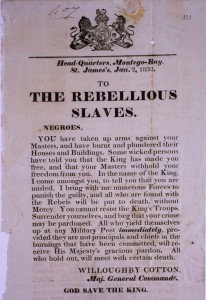 On July 31, 1838, slavery is officially ended, by order of the Queen of England, and in the second half of the novel, July’s narrative becomes less the story of slavery and its effects in general and becomes more personal – the story of July as an adult – free, but dependent – as she uses her beauty and talents for her own ends. Ironically, Caroline, too, is also dependent – on July, on her husband, and on the workers who will no longer accept the plantation’s demands regarding their hours, the number of days a week they must work, and, eventually, the rents they are charged for their houses and provision grounds. Full-scale rebellion by the freemen is inevitable. Though the plantation owners are desperate to harvest their crops, the workers do not understand the economy in which they suddenly find themselves. For both groups, the issue is power, and no one can win.
 Though July’s point of view is colorful and engaging, the author sometimes needs to convey information which July has no way of knowing, and this creates some problems regarding the consistency of voice. In addition, when July’s son Thomas makes suggestions regarding her finished narrative and suggests that July fill in missing information, she is sometimes frivolous and invents “facts.” Sometimes, Levy herself fills in the blanks, in one case including Thomas’s own (necessary) history as an “excerpt” from a story written by his adoptive mother and published in a Baptist pamphlet in England, a device that, unfortunately, feels like a device. The novel is well-researched, however, with dialogue which conveys all the emotions one would expect of conflicted characters. Ultimately, The Long Song offers a view of Jamaican history which Levy’s fans will celebrate.