“As the ragged cavity [caused by the on-going removal of the temple at Abu Simbel] expanded, as the gaping absence in the cliff grew deeper, so grew Avery’s feeling they were tampering with an intangible force, undoing something that could never be produced or reproduced again. The Great Temple had been carved out of the very light of the river, carved out of a profound belief in eternity.”
Eleven year s after the publication of Fugitive Pieces, her only other novel (and winner of the Orange Prize), Anne Michaels has published a monumental philosophical novel which is also exciting to read for its characters and their conflicts. Complex and fully integrated themes form the superstructure of the novel in which seemingly ordinary people deal with issues of life and death, love and death, the primacy of memory, the search for spiritual solace, and the integrity of man’s relationships with the earth and the water that makes the earth habitable—huge themes and huge scope, reflecting huge literary goals. And Michaels is successful, not just in dealing with the big issues and themes affecting mankind itself, but in bringing them to life through individuals who muddle along, seeking some level of personal connection with the world while trying to appreciate life’s mysteries.
Avery Escher is a young engineer in 1964 when he and his wife Jean travel to Abu Simbel, where he is charged with the task of helping to remove the Great Temple of Abu Simbel and reconstruct it in the cliff sixty feet higher. Gushing water, which will be released when the Aswan Dam is finished, will flood the area where the temple lies, and the new Lake Nasser will cover all the land downstream. The reconstruction is planned to be so seamless that no one will be able to tell that the temple and its ancient monuments have been taken apart, block by block, and put back together again. Yet, as he works on the site, slowly and  meticulously, Avery feels ashamed, feeling that “Holiness was escaping under the [workers’] drills,” and he wonders “Can you move what was consecrated?” Surprised at his own response, because he had expected that the salvage would be an “antidote” to the “despair of dam-building,” he comes to believe, instead, that “the reconstruction was a further desecration, as false as redemption without repentance.”
All the Nubian people who have lived in the area below the dam for tens of generations have been relocated (or more accurately, dislocated) to a site a thousand miles away, along with their animals and all their possessions, but they are bereft. They have not been able to take with them the places where their dead are buried, where they have loved and worked the land, where they have worshipped, and where their memories and their very souls reside. The new cement-block village, erected in a dry, treeless plain, bears no resemblance to the home where they have always had their roots. All of Nubia has been displaced by the damming of the Nile and the building of a lake, named for a modern political leader, which has destroyed their own ancient history.
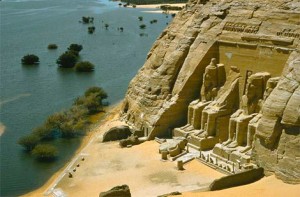
Abu Simbel Temple
This is not the first time Avery has been exposed to the dislocation of long-time residents through the building of dams and lakes. His father, William Escher, was an engineer on the Canadian project to build the St. Lawrence Seaway from the Atlantic Ocean to the Great Lakes, which involved the flooding of ten Canadian villages through the building of Lake St. Lawrence. Stories about the Eschers’ displaced family friends are touching and bring the thematic development—and the sadness—down to a more intimate personal level.
A third thread involving man’s desire to honor and preserve the past, though the present has changed it irrevocably, takes place in Warsaw, following World War II, after the departure of the German and Russian occupiers. The city decided to rebuild its central historical core to look exactly the way it did before the war, using plans hidden and preserved by polytechnic students during the war and historical artifacts scavenged from the rubble. The reconstructed city, thought “successful” by its builders, never felt real to many of the people who lived there, however—its heart was missing, as were its memories—along with almost all its Jewish people. As one Polish character mourns, “I do not know if we belong to the place where we are born or the place where we are buried.”
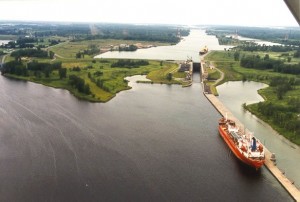
Eisenhower Lock, St. Lawrence Seaway
Within this fully developed thematic framework, filled with symbols, Anne Michaels creates a passionate love story between Avery Escher and his wife Jean, and a generational saga about Avery Escher and his family and friends, alternating their personal stories and their personal relationships to earth and water with the grand stories from Egypt, the St. Lawrence Valley, and Poland. Avery and his family have lived along the St. Lawrence River and its subsequent Seaway, empathizing with those displaced, though Avery’s father actively contributed to it. Jean has faced personal displacement following the deaths of her parents. A botanist, Jean collects seeds and seedlings, transplants the garden that once belonged to her mother, grafts trees to preserve them, and, during a particularly difficult time in her relationship with Avery, plants flowers at night in public places where they will surprise visitors who have not expected them.
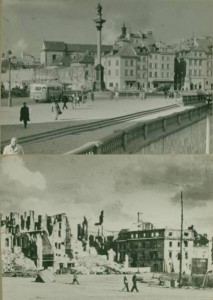
Reconstructed Warsaw
While Avery is dealing with technology and man’s desire to improve nature and reconstruct the past artificially, Jean is preserving and growing new life in the land which nurtures it. Not surprisingly, their love is tested to the limits by their different understanding of man’s relationship with nature and the interconnections of land and water to memory, the past, and ultimately the present and future. “I think,” Avery says early in the novel, “we each have only one or two philosophical or political ideas in our life, one or two organizing principles during our whole life, and all the rest falls from there.” Fortunately, mankind—and individuals—are capable of learning and changing. “Regret is not the end of the story,” we learn. “It is the middle of the story.”
Michaels’s talent as a poet is obvious in her gorgeous ruminations about the meaning of love and life, and in her evocative, unique imagery, but the beauty of the language is matched by the richness of the novel’s underlying concepts, which give depth and significance to this challenging and satisfying novel. Raising fascinating questions, Michaels piques the imagination and guides the reader into new realms of thought.
Notes: The author’s photo appears on her Amazon Author page.
The photo of Abu Simbel comes from http://travel.nationalgeographic.co.in
A ship enters the St. Lawrence Seaway system through the Eisenhower Lock at Massena: http://www.bcnys.org
The final photo shows Warsaw during its destruction in the bottom of the picture and after reconstruction at the top: http://www.unesco-ci.org
 lram Halwai, describing himself as “The White Tiger, A Thinking Man, And an Entrepreneur” in Bangalore, has decided to tell the story of his short life to Premier Wen Jiabao of China, who is about to visit the city. Jiabao, according to the local radio station, is on a mission–“He wants to know the truth about Bangalore,” with its burgeoning population of entrepreneurs. Balram decides that “if anyone knows the truth about Bangalore, it’s me.” In a long letter to Jiabao, written over the course of a week, Balram describes his childhood, his escape from the rural Darkness to the city, his slow journey from poverty into a servitude which pays him enough to survive, and ultimately his successful entrepreneurship in Bangalore. He is a “white tiger, that rarest of animals, the creature that comes along only once in a generation.” He is also a wanted man.
 als, school administrators, large business owners, lawyers, judges, doctors and hospital administrators, embassy employees, and “public service” officials, all of whom (in this novel) enhance their salaries by extortion, the private sale of public property, and/or the acceptance of bribes. Dealing harsh and sometimes fatal penalties to the Small-Bellies who refuse to pay them in exchange for “favors” which they have often worked tirelessly to achieve, these criminals are among the most successful “entrepreneurs” in the country.

 1957, Joseba, the speaker who opens the novel, and his friend David Imaz are both eight years old when they introduce themselves to the new teacher at their Basque school in Obaba, near Guernica, Spain. David, sometimes called “the accordionist’s son,” is, like his father, an accordionist–an “artist” at his craft–and almost instantly, he finds himself perched on top of a desk, playing for his delighted class. Forty-two years later, the accordion is put away, and Joseba is visiting David’s widow, not in Basque country, but at Stoneham Ranch in Three Rivers, California, where David’s uncle once lived, and where David has been raising thoroughbred horses for more than twenty-five years. Joseba has been visiting there for a month, overseeing David’s epitaph, which is written in three languages–Basque, Spanish, and English—and coming to know his American wife Mary Ann, his two young daughters, Liz and Sara, and the completely different life that David chose for himself after he left Obaba when he was in his mid-twenties.

 eral pages of this Spanish gothic melodrama might be enough to discourage even the most intrepid reader—overblown prose, trite imagery, clichés, self-conscious attempts to play on the reader’s heartstrings, and an undeniable straining for “effect.” Then in a twist, the reader discovers that this excerpt is merely the beginning of a manuscript about a child murder written by Luisa Davila, the main character in the larger novel. And just as the reader is saying “Whew,” at the thought of having escaped three hundred pages of such writing, the author introduces us to Luisa, a Madrid single mother who has written several successful mysteries starring her two detective heroes, psychoanalyst Carmen O’Inns and her partner Isaac Tonnu. Luisa, aged fifty-two and gifted with a “rampant imagination,” has just moved into a new Madrid apartment with her eleven-year-old daughter Elba, named for the island where Luisa, then aged forty, conceived her while on a “mating trip.” The new apartment will allow Elba to attend the private English High School which Luisa attended as a child.
 constantly together, until Antonio fell, broke his neck, and died, an accident that Luisa has still not fully reconciled. She also discovers that Miguel, the third living member of the group, now the survivor of four marriages, has a son Miguel (“Miki”) who is also in the same class at school. When Miki dies soon afterward in a similar fall at school, Luisa’s imagination works overtime as she tries to remember all the details about Antonio’s death and then tries to find out more information about the similar death of Miki.
 es Church,” a former western intelligence officer with “decades of experience” in Asia, including, presumably, North Korea, provides a stunning and profoundly interesting portrait of “real life” in this secretive and sometimes paranoid country. Inspector O, the main character in Church’s novel, works for the North Korean Ministry of People’s Security, but even at the level of inspector, he has no idea why he is assigned many of his tasks, nor does he know why he is often sent from the capital, Pyongyang, to outposts like Manpo and Kanggye on the Chinese border. All he knows is that his camera never has batteries that work, that finding a cup of tea is sometimes impossible, and that he does not rate a thermos. He expects to be tailed and spied upon, and he is accustomed to having his living quarters searched. He can trust no one, and he must constantly watch his own back to ensure that he does not accidentally discover information about crimes that he does not even know exist.
 ment, and Kim, from Joint Headquarters, with O’s Ministry of People’s Security continues throughout the novel, and O is caught in the middle, never sure whether he can trust anyone, even Pak, his superior in the ministry. Nor does he really know what is at stake for any of the players in the other departments which are contesting for influence.