“Even when you think you know what the law says, some smart-arse in a wig finds a new wrinkle in an old rule and you watch some sniggering thug waltz out of court. When the Law is a bouncing ball on a spinning wheel, all that a righteous man can aim for is order.”
Bringing ord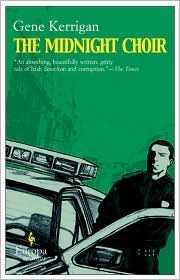 er to Dublin is Garda Detective Inspector Harry Synnott’s specialty. A man married for fifteen years and divorced for six, he is too busy to spend much time with his teenaged son. His whole life is wrapped up in trying to see that order prevails—either order recognized as justice by the courts or the order that Harry and his Garda officer pals bring about themselves, when their evidence of a felon’s guilt does not meet court standards.
Despite his willingness to ignore the niceties of law, Harry Synnott has a conscience, however, and he is shunned by many of his fellow Gardai because he testified against his fellow officers in the brutal beating of a prisoner. “It wasn’t the prisoner’s welfare that mattered to Harry Synnott. What was working away inside his gut was the blatant use of violence…the assumption that membership of the force automatically tied him into that shameless wielding of unbounded power.”

In clear prose which often contains bits of black humor and a great deal of irony, Irish author Gene Kerrigan sets the primary story in Dublin, and the secondary, companion story in Galway, until they overlap. New information discovered during the Galway case brings about a devastating conclusion which shakes Harry to the depths of his soul.
The Galway story seems simple enough: Garda Joe Mills and Garda Declan Dockery go to the roof of a pub where a man is threatening suicide. They save him from suicide only to discover that the man’s clothes are covered in blood. He will not tell his name, later discovered to be Wayne Kemp, and the only statement he makes is an enigmatic, “I’d never hurt a woman before.” Kemp’s only connections with Dublin are that he once worked for a Dublin security firm, and that his sister is a Dublin resident, and Kemp is so disturbed that he can provide no useful information for the Galway Gardai.

Garda station, Dublin
In Dublin, Harry Synnott is treading the minefield of police politics, moving from station house to station house, until he is finally recommended for a job with Europol, to start when his current case load is finished. As the novel moves from a Wednesday to the following Tuesday, the inexorable unfolding of events in several of Synnott’s cases leads to a crisis and grand climax, both in terms of the action and in terms of Synnott’s character. Synnott and Det. Garda Rose Cheney are investigating allegations of rape and abuse brought by Teresa Hunt against Max Hapgood, the son of a wealthy businessman with top-notch lawyers and public relations people. As he contemplates the fact that “justice” for the wealthy is far different from that of the poor, Synnott is also trying to get help for Dixie Peyton, a poor junkie, sometimes an informer, who has robbed a tourist couple with a syringe as a weapon. A businessman with an indeterminate business, having spent weeks monitoring activity at a jewelry shop, commits a robbery and a man dies, and the Irish mob enters the picture, too. As the details of these cases unfold during the space of one week, one of Synnott’s old cases, the “Swanson Avenue” case, casts its long shadow and eventually raises serious questions about justice, responsibility, and guilt.

The charming streets of Galway
In this intriguing police procedural, Kerrigan keeps the action crisp and fast-paced, with plenty of complications to keep the reader busy. What makes this novel different from so many of this genre is that he is also outstanding at creating characters with whom the reader develops empathy—Synnott, Dixie Peyton and her son, and eventually Det. Rose Cheney. Synnott, himself, is likeable and basically good-hearted, but he is busy, and he is easily distracted by events in which he is directly involved. He fails his ex-wife and son, even as he is trying to help poor junkie Dixie Peyton. His final recognition of his failings comes dramatically and brutally, and the reader is left to ponder whether he will be able to deal with his self-realization.
Dark and sad in its vision of humanity, even with the bleak humor that is scattered throughout, this dramatic and tense novel questions the relationship between freedom and responsibility, between order and justice, and between principles and expediency. The title, from a poem by Leonard Cohen, epitomizes Synnott’s dilemma: “Like a drunk in a midnight choir/ I have tried in my way to be free.”
Notes: Also reviewed here: Gene Kerrigan’s LITTLE CRIMINALS, THE RAGE, and DARK TIMES IN THE CITY
The author’s photo is from http://www.zonelivre.fr
A Dublin garda station may be seen here: http://ireland.archiseek.com
The wonderful photo of Galway is one of many equally good photos by David Robertson on his website: http://davidpj.wordpress.com
 elationship with the Nazis, from World War II to the active neo-Nazi movement of the present day, infuses this thriller with dramatic action scenes which develop increasingly powerful impact as Inspector Harry Hole tries to protect the motorcade of four world leaders who have come to Norway for a conference. President of the United States Bill Clinton, Vladimir Putin of Russia, Yasser Arafat of the PLO, and Israeli Prime Minister Ehud Barak arrive in Oslo for talks in an atmosphere filled with neo-Nazi speeches and the sensational trial of Sverre Olsen, a neo-Nazi leader, who blames every problem Norway has had since 1945 on enemies of National Socialism. Olsen is currently urging protection of the Norwegian “race” against Mosque-builders.
 The long-term resentments of these now-elderly Norwegian veterans of the Eastern Front who were branded traitors to their country in 1945, combine in 1999 with the ultra-conservative political agendas held by many Norwegian young professionals, and the still-flourishing neo-Nazi party, all of which join to create an explosive political and social environment which award-winning Norwegian author Jo Nesbo develops into a thriller full of hatred, violence, and mayhem. Creating parallel narratives, Nesbo alternates the battles and interactions of Norwegian soldiers on the Eastern Front, with the everyday battles of Inspector Harry Hole to preserve order in Oslo against those who sincerely believe that “In His wisdom God so ordained it that an inferior creature is never happier than when serving and obeying a superior creature.” All who believe this creed, of course, consider themselves the “superior creatures,” and they therefore feel no compunction about twisting or ignoring the law to suit their own “superior” ends, believing that they obey a higher law.
 Creating lively characters from the two different chronologies, Nesbo creates an almost infinite series of vibrant, interconnected mysteries. Five repeating characters from the war—Gudbrand Johansen, Daniel Gudeson, Sindre Fauke, Edvard Mosken, and Hallgrim Dale share their stories and their tragedies as they try to decide whether to take a chance on abandoning their commitments to a losing cause by going over to the Russians, sticking it out, or trying to get to France or the Allies. Some of them have the help of women they love, and they are spurred on by the starvation, the bitter cold, and lack of supplies. Most are still alive in Norway in 1999, when the novel opens, and they are full of resentments, angry at the direction they see the country taking, and close enough to death that they have little to lose in obeying their desire to justify their lives in a final act or acts.
 clearly differentiated, and some of them are sleazy enough that the reader actually hopes for their defeat. When a rare Marklin rifle is used in several shootings, Hole takes note and begins his search for the killer, dealing with elements of the international arms markets, which further complicates the mystery.
 aimed Belgian author Amelie Nothomb reminisces in this novel about her life in Japan in 1989. She was twenty-one that year, a recent college graduate seeking her emotional roots, and she had just returned to Japan, where she was born and lived with her diplomat parents for the first five years of her life. To earn some money while she studies business, she posts an advertisement offering language classes in French. She is immediately hired by Rinri, a twenty-year-old college student whose French is at the beginner level, despite several years of teaching by Japanese teachers. Before long, their teacher-student relationship becomes more intimate, and Amelie is learning more about Japanese culture than she ever expected.
 s whom she has not met before, she knows that “the weather, an ideal topic for people who have nothing to say to each other, is the primary and obligatory topic of conversation in Japan. To meet someone and fail to talk about the weather is to betray a lack of manners,” yet she persists in trying to get to know them better and to find a subject of common interest for conversation, even though she may be intrusive.

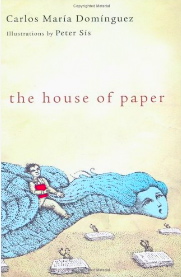 ary novel explores themes which academicians have discussed for generations–the relationship between language and reality, the belief that creating a library is akin to creating a life, the idea that books can take on a life of their own, and the obsessive collection of books and reverence for them. Creating an allegory of the literary world and its complications, author Carlos Dominguez tells what appears to be a simple story–part mystery, part satire, and part quest.
 Pedro Reissig, the father, had, like his son, studied for his PhD at Berkeley, where he became politically active, and where he also wrote a novel, still a cult favorite, filled with symbols. In order to find out more about his father and the myth that has grown up around him, young Pedro has returned to Rio Fugitivo in Bolivia, having been granted a one-semester research sabbatical by his university, and he is staying with his Uncle David Reissig, the only one of the seven people at the meeting to have survived the massacre. Now an alcoholic, David is a man who writes cryptograms and dreams of inventing a radio that will capture the voices of the dead. In his spare time he works at identifying the many symbols that fill Berkeley.
 Shortly after he returns to Rio Fugitivo, Pedro Zabalaga is asked to evaluate the memoirs of Jaime Villa, the drug kingpin of Bolivia, who is awaiting extradition to the United States, a man who was once his father’s close friend and who sees himself as a Robin Hood-like hero. Several of the revolutionaries Pedro Zabalaga befriends in Rio Fugitivo are also involved in the media, one of them working for a television station. A popular contemporary rock band, named “Berkeley,” conveys revolutionary messages through its videos. In one of the book’s cleverest ironies, the author of this novel himself employs the clues of Uncle David’s cryptograms as a way of conveying the history of the revolution to readers of this book.