“Three men, brothers, saved as many Jews during World War II as Oskar Schindler, and organized a military force that killed hundreds of enemy soldiers, nearly as many as did the fighters of the Warsaw ghetto uprising….In the sixty years since, only a few books have detailed their achievements and hardly a plaque bears their names.”
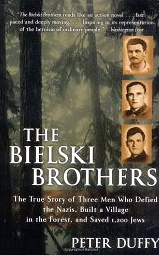 When the Germans finally retreated from Belarus in the summer of 1944, almost twelve hundred Jewish survivors of the Holocaust shocked the world by materializing from the forest where they had lived in hiding during the German occupation. Some of these survivors had lived in the forest for more than three years, part of a community established by Tuvia, Asael, and Zus Bielski, three brothers who had chosen to take their chances on survival in the forest rather than submit to the Nazis and their many collaborators. Author Peter Duffy places this extraordinary story of survival in context by describing the Bielskis’ lives and experiences, quoting from Tuvia Bielski’s previously unknown journal, and revealing the sociopolitical history, including the anti-Semitism, of Belarus, a region south of Lithuania.
Beginning with the story of the Bielski grandparents, Duffy describes their lives and work as mill-operators, and details the laws which denied them the rights of other Russian citizens during the anti-Semitic rule of Tsar Nicholas II. Required to live in a particular area of Russia and not allowed to own property, the resourceful Bielski family found a gentile friend to act as the “s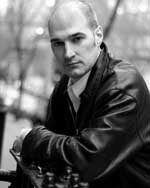 traw” owner of their mill so that they could continue to operate it and support their family while enduring lives they were powerless to change. Because they lived in the countryside, rather than the city, they were isolated from much of the violence directed, over the years, against Jews in the city, though they were often distrusted and discriminated against by people in their community. When the Germans invaded Belarus during World War II, the ensuing Holocaust was even worse for their grandchildren than anything the grandparents could have imagined.
Tuvia, Asael, and Zus Bielski, leaders of the family in the early 1940’s, found life impossible under the German occupation, but they also realized that it would not get any better if they co-operated with the authorities in any way. Leaving their home under cover of night, they daringly escaped into the forest behind their mill, where they intended to live out the war, if they could. Soon, however, they began bringing others to the forest encampment, and as the community grew larger, Tuvia Bielski required its members to go back into the ghetto to rescue others: “Those who refuse to go into the ghetto [to rescue other Jews] will be the first to go [from this community]. If they do not do it, they do not have any place here with us.”
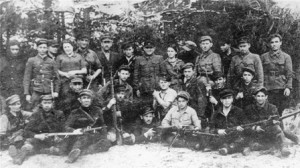 Constantly moving the community to new forest locations to avoid detection over the years, the Bielskis found themselves fighting “wars” on four fronts. Their immediate threat was from the Germans and the local police, but they were also in danger from local peasants, many of them collaborators, who were willing to turn them in, rather than supply them with food. They also had to be constantly on the alert, once they made connections with the Russian partisans, that they appeared sufficiently “Communist” and did not reveal their adherence to Jewish traditions, which would have made Tuvia’s important relationship with the partisans suspect. Most of all, they had to guard again
 st internal dissension. This was no “utopian community of enlightened democratic and egalitarian governance,” and many readers may cringe at the extremes to which the leadership occasionally resorted in order to eliminate dissension and ensure the survival of the group as a whole.
At its height, the Bielskis’ forest village consisted of long, camouflaged dugouts for sleeping, a large kitchen, a mill, a bakery, a bathhouse, two medical facilities, a tannery, a school, a jail, and a theater. Tailors, seamstresses, shoemakers, watchmakers, carpenters, mechanics, and experts in demolition provide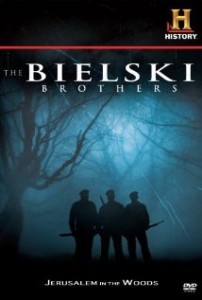 d the 1200-member community with necessary skills, and about sixty cows and thirty horses provided food and transportation. Many of the men served as part of the armed contingent which secured food and engaged in sabotage and even the murder of Germans officials, while many others, including the women, the elderly, and the handicapped received the benefits of the community which protected them, despite the difficulties they presented when it was necessary to travel to new locations. Breaking the narrative into six-month installments, he details the progress of the war throughout the region, along with the cold statistics
In the epilogue, Duffy tells what happened to each of the main characters and their families after the war, showing how they adapted after leaving the forest. Though they saved at least as many people as Oskar Schindler did and caused enormous damage to the German war machine, none of the Bielski brothers ever received any real recognition for their spectacular wartime achievements. Duffy here attempts to rectify this historical omission, and his story of their courage will resonate with readers, illuminating at last the heroic efforts and achievements they made on behalf of Jews throughout the region.
Notes: The author’s photo appears on http://www.bookbrowse.com
The photo of the Bielski partisans appears on the Seattle University website as part of an article by Amanda Rinkel: http://blog.su-spectator.com
The Belarus woods, from the website of the Bielski Foundation: http://www.bielskifoundation.org
The story of the Bielskis was made into a film in 1993.
 on just two climactic years, 1913 – 1914, Frederic Morton recreates Vienna in all its splendor during the last days of the Austro-Hungarian Empire. The vibrant social, intellectual, and cultural life of Vienna is examined within the context of the seething nationalism of the Balkans, the Machiavellian intrigue among the political rulers of the European nations and Russia, and the human frailties of the seemingly larger-than-life national leaders, which assure that the twilight of the empire will eventually be overtaken by darkness.
 their grievances—and do so in this novel, too—they now have a new weapon, the computer. Now it is possible for the resistance and revolution to be conducted in cyberspace, and hackers are the front line in the waging of the new war.
 ating on just ten months of Viennese history between July, 1888, and May, 1889, Morton dissects the life of Vienna vertically, revealing its brilliance and its contrasts–its magnificence but ineffable sadness, its political gamesmanship but resistance to social change, its “correctness” of behavior but its anti-Semitism, and its patronage of the arts and sciences but its refusal to acknowledge true originality. He carefully selects details with which the modern reader can identify to create a full picture, both of the historical characters and the constricted settings in which they try to live and breathe.
 on their creativity are artist Gustave Klimt, writers Arthur Schnitzler and Theodor Herzl, musicians Arnold Schonberg, Gustav Mahler, and Anton Bruckner, and psychiatrist Dr. Sigmund Freud, whose detailed stories of frustration run parallel with that of the Crown Prince and enhance it. Only Baroness Mary Vetsera, age 17 and full of life, is able to escape the bonds of Viennese “correctness,” attracting Rudolf, having a brief affair with him, and eventually succumbing with him in a suicide pact at Mayerling.
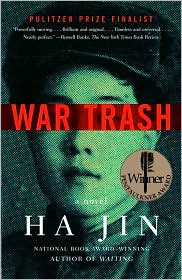 in, who was born in the People’s Republic and lived there until he left to attend college in the United States in 1985, offers a unique perspective on Chinese culture, different from that which appears in most “Chinese” novels written for an American audience. Setting this novel primarily in a POW camp in South Korea, where Chinese and North Korean troops, captured by US and South Korean soldiers, have been separately interned during the 1950s war, Ha Jin focuses on the different attitudes each group has toward home, country, and each other. Through Yu Yuan, a young soldier from the Chinese Communist army, Ha Jin shows how differently Yuan evaluates his life and his obligations but how similarly he holds to ideals of friendship, justice, honor, and love.
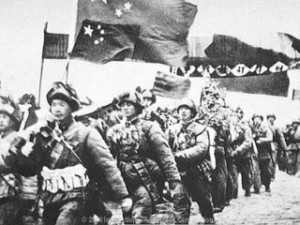 eturn to their families on the mainland after the war. The Nationalist Chinese, allies of the Americans, have been given almost free rein to try to bully the mainland Chinese to go to Taiwan, instead of returning home. Those who agree not to be repatriated to their homes in China get twice as much food, better clothing, and more blankets. Those who still insist on returning home are subjected to fully described water tortures, murders, unremitting beatings, the tattooing of anti-Communist statements on their bellies, and the (even worse) cutting out of the flesh containing these slogans if the men continue to refuse to go to Taiwan.