“I’ve told you before and I’ll tell you again: Justice ought to be a bottom-line proposition…It’s misguided when we worship musty old words in a text at the expense of innocent people’s suffering. Thomas Jefferson and Learned Hand and hearsay rules ought to come into play if we don’t know the truth or if it’s a close call…We should be concerned with how the soup tastes and not so damn worried about the particulars of the chef’s hat.”
In th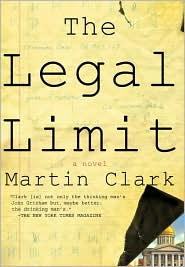 is absorbing fictionalization of a real murder case from 1984, author Martin Clark, a Virginia circuit court judge, explores the increasingly fraught predicament of a rural Virginia Commonwealth’s attorney, Mason Hunt, who makes the only decision that makes sense to him as a naïve young man. He must then live with that decision and re-examine its consequences for the next twenty years.
In the opening pages, Mason is still a law student when he accompanies his 27-year-old brother Gates to a party at the trailer belonging to Gates’s girlfriend. Despite their age difference, Mason and Gates have forged a close bond, built on Gates’s protection of Mason from their sadistic father. Gates, at 6’ 5” tall, has never hesitated to go toe to toe against his father, who is, for him, the symbol of a hostile outside world. By the time his father has abandoned the family, however, Gates is so filled with rage and so damaged that he believes the world owes him, big-time, for the abuse he has suffered. At twenty-seven, Gates is still living at home with his mother, lacking ambition, unable to hold a job, and finding escape in drugs and alcohol.
Mason, on the other hand, has taken advantage of his opportunities, winning scholarships which have allowed him to attend law school, but he has never forgotten that it is Gates who has made much of his success possible. At the party that fateful night, Gates argues with Wayne Thompson, who has had a brief relationship with Denise, Gates’s girlfriend, but it is not  until Gates, drunk and high on drugs, leaves the party with Mason much later that the issue escalates into a confrontation and violence and Gates shoots Wayne Thompson, leaving him dead beside the road. There are no witnesses—except Mason, who moves instinctively to protect his older brother from self-destruction. The two escape into the night, with Mason crafting an alibi for himself and Gates by stopping at various places, making phone calls, getting rid of the murder weapon, and then acting as if nothing has happened.
Examined in detail, Mason’s decisions that night, impaired by his unaccustomed drinking, become the crux of the increasingly complicated novel which ensues. Years pass in which the case remains unsolved, and Mason goes on to become a lawyer and eventually a Commonwealth’s attorney, while Gates ends up in prison on another matter. Inevitably, however, Mason must pay for his mistakes, and justice must be served.
Clark tells a lively tale which moves along so speedily that I read the first hundred pages one night when I had intended to read only the first chapter, and then stayed up till well past midnight the following night to read the remaining two hundred fifty pages, unable to put the book down. His characters, often quirky, leap off the page in their realism, and the reader identifies with them and their problems, even though they may deserve the conseque nces which await them. By inserting carefully observed details of natural behavior into his scenes, Clark creates “real” people who actually behave like real people. Nothing is simple, we see, and no decision is ever made in a vacuum or can remain in one.
The real murder case at the heart of his novel occurred in Stuart, Virginia, the small, rural community where author Martin Clark lives. Situated on the Virginia border, about twenty miles north of Winston-Salem, North Carolina, Stuart is so vibrantly described here that it becomes the equivalent of a character. The author’s affection for Stuart and appreciation of its way of life, removed from the hurly-burly mainstream, shines through, despite all the economic problems inherent in any remote, rural location. Stuart “makes sense,” as Clark depicts it, and the novel’s characters, their way of life, and their values are natural outgrowths of life there.
As in his two previous novels, The Many Aspects of Mobile Home Living and Plain Heathen Mischief, Clark examines justice as a relative term, complicated by each character’s understanding of right and wrong, innocence and guilt, theological sin and salvation, and real-life success and failure, all of which affect their values and beliefs about what is “right.” The author explores the consequences that result when someone commits a short term wrong in order to achieve what he believes is a long-term right, sharing this exploration with the reader, along with the far-reaching consequences. (On my Favorites List for 2008)
ALSO by Martin Clark: THE SUBSTITUTION ORDER, and PLAIN HEATHEN MISCHIEF (posted on another website in 2004)
Notes: The author’s photo appears on http://www.randomhouse.com
The Patrick County Courthouse in Stuart, Virginia, appears on http://en.wikipedia.org/
 the story of Lisbeth Salander which he began in
  building have no idea what she really looks like or who she really is. Gradually, the reader becomes familiar with her background, her family, the reasons for her institutionalization as a young teenager, and the horrifying abuse she faced at the hands of her legal guardian, a lawyer supposed to protect her. A woman who believes devoutly in an eye for an eye, she has exacted her revenge upon him in ways he does not dare share with anyone else.
 Three different investigations into the murders begin, and all center on Salander, whose fingerprints are found on the murder weapon. She, in self-defense, uses her computer skills, once again, to read e-mails and the contents of Blomqvist’s and others’ computers to stay ahead of the investigators who are seeking her for murder.
 en Mrs. Palfrey, a genteel, elderly widow, arrives with her possessions at the formerly elegant Claremont Hotel in London, she expects “something quite different.” Planning to stay at least a month, possibly permanently, she prefers her independence in this aging London hotel to living in Scotland near her daughter, who prefers to ignore her. A variety of elderly eccentrics call the Claremont home, and though the residents put up a good front, their loneliness and boredom are obvious–no one visits them, they rarely leave the hotel, and nothing in their lives changes very much.
 close relationship, Mrs. Palfrey teaches Ludo by example about love and its pleasures, and he, having failed in past relationships, begins to understand what love means, blossoming under her attention. As Mrs. Palfrey reminisces, he takes notes for a story he plans to write about her life and her experiences at the Claremont, where the informal motto is “We Aren’t Allowed to Die Here.” As time passes and life becomes more complicated for both of them, their relationship is tested.
 f a million copies in Europe, this clever novel, newly released in the United States, may make Muriel Barbery as much of a literary phenomenon here as she is there, despite the novel’s unusual philosophical focus. The first narrator, Renee Michel, is a fifty-four-year-old woman who has been working for twenty-seven years as concierge of a small Parisian apartment building. Describing herself as a “proletarian autodidact,” she explains that she grew up poor and had to quit school at age twelve to work in the fields, but throughout her life she has been studying philosophy secretly, insatiable in her quest for knowledge about who she is and how she fits into the grand scheme of life.
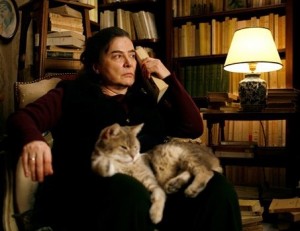 She has, however, given herself an “out.” She believes that beauty can elevate humans, and she is seeking “whatever is beautiful enough to give life meaning…If I find something, then I may rethink my options: if I find a body with beautiful movement or, failing that, a beautiful idea for the mind, well then maybe I’ll think that life is worth living.”
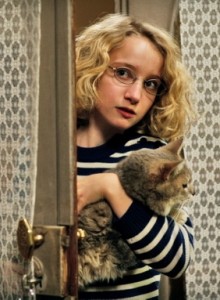 Neptune, a dog who lives in the apartment house, is observed by both Renee and Paloma as he discovers kairos, “the perfect moment”—when he mates vigorously with the whippet belonging to another resident, to the horror of the stodgy residents.
 the reader understands both the characters and the forces that have made them the people they are, hoping at the same time that all will manage to find happiness. Motifs from Japanese film and the novels of Tolstoy combine with images celebrating the perennial beauty of flowers (especially the camellia) and the connection of beauty with death, adding universality to the stories of these characters and connecting them to broader themes. Thoughtful, ironic, and often darkly humorous, the novel creates moods which bring the characters vividly to life, even as they are contemplating the deepest of life’s mysteries. (On my
  tralia’s most honored contemporary writers, creates his most dazzling novel yet with this send-up of the art world, filled with satire about dealers, auction houses, compulsive collectors, forgers, conservators and technicians, art researchers, catalogue writers, those who crate and ship paintings, and even the artists themselves. At the same time, he creates two splendid characters through whose limited vision this world is viewed—Michael “Butcher” Boone, a successful avant-garde artist from Australia, now experiencing hard times, and his “slow” brother Hugh, a 220-pound giant with little control over his emotions and a penchant for breaking the little fingers of people who get in his way.
 The story of how Butcher is drawn into a complex scheme to defraud is told in alternating chapters by Butcher himself and by Hugh, who sees himself as his brother’s “helper,” not “manservant,” though he often inveighs against Butcher and his attitudes. Hugh is earthy—he sees Van Gogh as “mad as a toilet brush”—and his “take” on the characters and action lead to hilarious commentary. Butcher, never able to escape the responsibility for Hugh, is also trying to recover his reputation by creating a new set of masterpieces, and he is soon preparing for a show Marlene has set up for him in Tokyo—if he can figure out how to find a caretaker for Hugh. Totally devoted to his artwork, and eventually to Marlene, Butcher is a brawling innocent, completely over his head as he begins to move in international art circles in Tokyo and New York.