Explosive–and heart-rending for what was lost.
 When the monsoon rains wash a whole village of massacred babies, men, and women down the swollen river and past a small, peaceful community on India’s border with the newly created Pakistani state, the residents of the village are aghast. When whole trains of newly slaughtered Sikhs and Hindus, not a passenger still alive, start arriving in their village from Muslim Pakistan, they hastily cremate and bury the remains, then retire to the temple in shock. When their own Muslim friends from the village are forcibly evacuated to Pakistan on ten minutes’ notice, the villagers know that the fabric of their lives is changed forever.
With the immediacy of an on-the-spot observer to these events of 1947 and the passion of a sensitive writer impelled to tell a story, Singh mourns the seemingly permanent loss of compassion and tolerance which accompanied the separation of the Indian subcontinent into Hindu/Sikh India and Muslim Pakistan. His novel, written less than ten years after some of the events which are chronicled here, is filled with vibrant and realistic characters sometimes forced to make impossible decisions, characters who reflect the horrors of religious intolerance, which flourished when artificial boundaries were set up to divide India by religions. The book cries out against the losses of civility, tolerance, and life itself.
With his love story of a Sikh dacoit and a Muslim weaver’s daughter, told within an elegaic  portrait of peaceful village life suddenly altered by religious strife, Singh draws the reader into the world of Mano Majra and its contrasts. He peppers the narrative with manipulative and grasping government officials and police, and outside agitators preying on residents’ insecurities. The small world he creates so vividly becomes a microcosm through which the reader gains knowledge of the wider issues.
Most remarkably, Singh holds himself above the ethnic and religious fray, reflecting his equal abhorrence of the Muslim atrocities and the Sikh response, “For each Hindu or Sikh they kill, kill two Mussulmans.” Singh, writing this book in 1956, dramatically foreshadows the violence which has continued in this area to the present day. He makes us feel the sadness and the permanent loss to all the participants on all sides of this tragic conflict.
Notes: The author’s photo accompanies a story in the New York Times about the newest edition of this book, including sixty-six pictures by famed photographer Margaret Bourke-White, the edition shown here in the book cover. http://www.nytimes.com/
 n 1937, when the Depression was still affecting all aspects of the farming community, this powerful novel depicts the lives of migrant workers–grim, pessimistic, and offering little hope for an improved future. Focusing on two characters who arrive in the Salinas Valley during peak season, Steinbeck creates touching scenes between Lenny, a big, severely limited worker who does not know his own strength, and George, a whippet-thin man who serves as Lenny’s constant companion and protector.
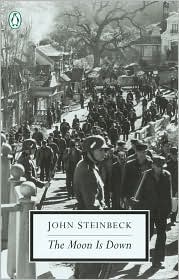

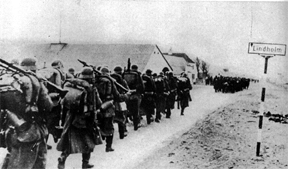 Though the novel was published in 1942 expressly for “propaganda” in Europe’s occupied countries (where it was quickly translated and disseminated secretly), it is a good story which transcends its original purpose and, as a result, it continues to find an audience.
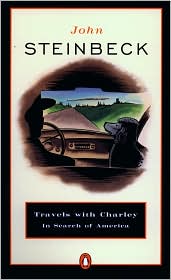 ohn Steinbeck obeys a life-long urge to drive from coast to coast in 1960, he little anticipates the variety of the “American experience.” Beginning in Maine and traveling along the northern states through Wisconsin, the Badlands, Montana, and all places in between, to Washington and Oregon, Steinbeck then decides to visit his childhood community of Salinas, in northern California. After meeting with friends there, though many have died, he then drives southward through the length of California and then eastward through the southwest desert to Texas, Louisiana, and eventually up to Virginia before returning to New York.
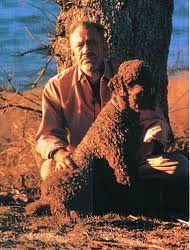 and ways of life. From the terminally gloomy waitress in Maine to the evil-looking mechanic in Oregon (who turns out to be the kindest and most generous of men), Steinbeck explores attitudes toward life (and strangers). Steinbeck’s high school buddy (who almost comes to blows with him) shows him that you really can’t go home again, and “the cheerleaders” of New Orleans, a group of white-supremacist women who taunt and scream obscenities at a tiny black girl integrating one of their schools, shows him how much work the human race still has left to do.
 ten in 1897, Bram Stoker’s Dracula is a classic of British fiction, fascinating for its subject matter and still the subject of films a hundred years later. Count Dracula, the epitome of evil, is exotic enough to keep even the most jaded reader of his exploits interested in their outcome, and grounded enough in the reality of evil to make even doubters wonder whether evil can be transmitted from one person to another against one’s will.