Note: The Kite Runner was WINNER of the South African Boeke Prize in 2004. It was also VOTED the Reading Group Book of the Year for 2006 and 2007.
“I became what I am today at the age of twelve, on a frigid, overcast day in the winter of 1975,” Amir, in the opening lines.
A successful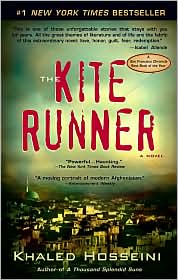 novelist now living in Fremont, California, Amir receives a phone call from his father’s former business partner, Rahim Khan, now in Pakistan. Rahim had stayed behind in Afghanistan when Amir and his father escaped to America in 1981, and he is now dying. An intimate part of the family, Rahim has long been aware of a childhood betrayal committed by Amir, one which had catastrophic consequences for others and which has tormented Amir for his entire life. “There is a way to be good again,” Rahim Shah tells him, and Amir immediately sets off for Pakistan to see him for the last time.
In flashbacks, Hosseini recreates the day-to-day existence of Amir and his father, a highly successful merchant in Kabul in the 1970’s, creating a warm and emotionally involving story of childhood and its traumas and stressing the importance of family in times of trouble, as he follows the lives of Amir and his father until Amir is in his late thirties. But this is more than the story of Amir and Baba. It is also the parallel story of Hassan and Ali, their servants, who represent an entirely different world. Amir and Baba are Pashtuns, while Hassan and Ali are Hazaras, descendants of the Moguls who are also Shi’a Muslims, and it is in these parallel tracks that we come to see the variety of life in Afghanistan, its mores, traditions, and its hierarchies.

As infants, Amir and Hassan share the same wet nurse, both boys having lost their mothers within a week of their births, and this shared experience proves to be prophetic of their close relationship. Just as Baba and Ali have been closer than most masters and servants, Amir and Hassan grow up together, are best friends, and even get into trouble together. Hassan, however, always knows he is Amir’s servant, and he is often cruelly mocked by others who consider him inferior because of his ethnicity, his Mongoloid features, and his unrepaired hare-lip.
The best “kite runner” in Kabul, Hassan is often first on the scene to capture prized kites when their lines are cut during kite-flying competitions, a huge spectator sport in Kabul. During one of these competitions in which Amir is participating, Hassan captures a particularly prized trophy. Emerging from an alley, he finds himself confronted by several fierce bullies, and when he refuses to give in to them and hand over the trophy kite, he is beaten, tortured, and severely injured. Amir, chancing upon the scene in time to prevent some of the damage, runs away in fear instead, setting up a series of betrayals which cause him pain throughout his life.
Six years later, after a C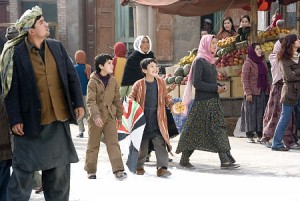 ommunist coup in Afghanistan, Baba uses his wealth and connections to escape with Amir to Pakistan and eventually the United States, where he works in a gas station, and on weekends sells goods at a public flea market so that Amir can go to college. In this middle section of the book, the relationship between Amir and his father changes dramatically. Away from the roles demanded of them in Kabul, they are on a more equal footing as they explore their new lives in America. Remaining part of the close Afghan community where they live, they maintain traditions and values in their relationships with other Afghans, while finding their new roles in America. When, twenty years after leaving Kabul, Amir gets his call from Rahim Khan, he returns to Pakistan and eventually to Afghanistan, where he has a chance to relive circumstances similar to those in which, many years before, he betrayed Hassan, this time discovering a way to “be good again.”
Hosseini’s narrative is fast-paced, and his sensitive portrayal of childhood with all its fears and tensions is particularly striking. The glimpses of Afghan family life and values are captivating, particularly because they have been virtually unknown in American fiction, but it is the author’s focus on the humanity of the characters that gives the novel its universality and great appeal. Hassan’s nobility in the face of his trauma, born from both his unwavering acceptance of his role as a servant and his genuine affection for Amir, gives him a saintly aspect which never cloys. Baba is almost larger than life, and though he never knows exactly what it is that Amir has done, he is sensitive enough to be disturbed by it when it occurs, especially since he fears that it may signal weakness. It is only much later that Amir discovers that Baba, too, has kept some secrets.
Afghan cultural traditions, which stress pride, honor, and a sense of hospitality toward strangers, add color to this narrative, and when scenes involving the Taliban are presented in the last part of the book, the true horror of their repression of a living culture, in addition to their repression of individuals, becomes obvious. By following two families, one in the U.S. and one in Afghanistan, the contrast becomes even clearer.
This dual focus, however, creates a few structural problems as the author tries to figure out a way to connect all his characters. Relying heavily on coincidence (and in the case of the diplomatic officials, on stereotypes), he ties up the loose ends and resolves the conflicts. Some of the coincidences are not necessary and do not advance the story line, however–Amir’s meeting an old beggar, who turns out to have been a university teacher who knew Amir’s mother as a young woman, for example. Despite some narrative clumsiness, however, the novel is a moving, dramatic, personal, and compelling read, fascinating in its setting and in its development of the father-son relationship. I was totally engaged by its characters–and by its considerable charm.
Notes: The author’s photo appears on http://www.purdue.edu.
A family leaving for a kite-flying contest appears on http://ncowie.wordpress.com
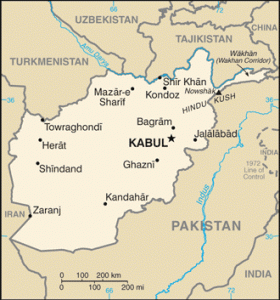
The map of Afghanistan is from http://commons.wikimedia.org
 5, The House of Mirth offers a blistering social commentary on the lifestyles and behavior of super-rich American society. Having grown up in this society, author Edith Wharton evaluates it here as an insider, and her trenchant observations give this early novel a liveliness and verisimilitude not characteristic of “aristocratic” novels written by outsiders. Set at a time in which the old, moneyed aristocracy was being forced to admit newcomers who had made their recent fortunes through industry, the novel shows moneyed society in flux, the old guard ensuring their exclusivity against parvenus who are not the “right type,” at the same time that their sons and daughters were often securing large fortunes through marriage into some of these new families.
 As Lily tries to negotiate a good marriage and future for herself, she is aware that the competition is fierce. Women “friends” pounce on the latest gossip and spread rumors to discredit rivals, and Lily’s reputation is tainted with hints of impropriety. Her opportunities for a good marriage begin to dwindle. Complications always arise for Lily, and they continue here in this melodrama.