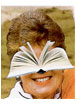
Main character Eduardo, who has a college education, has been assigned to work for a year with people who cannot read, either for physical or emotional reasons. Seven families are assigned to him, and he must read to each of them for one hour each week. His biggest problem is that he gets tired of reading shortly after he starts each book, and his listeners, disinterested in the selections chosen for them, become bored as he is. The characters include a ventriloquist and his brother, a deaf family with children who can hear, a crippled woman who prefers Daphne du Maurier to Henry James, and a host of others who select different books from those chosen for the program. Poetry becomes a turning point for some, including Eduardo, as all try to deal with the social and political changes in Cuernavaca, where crime is on the upswing. Full of energy, humor, literary references, and themes about why we read and what we read, this book also includes a love story (or two), death, and personal growth – something for everyone. This book is WINNER of Mexico’s highest literary award.
Read Full Post »
Delightful, playful, clever, and humorous, Spanish author Juan Gomez Barcena’s debut novel is also consummately literary, telling a story on several levels at once but doing so while maintaining the atmosphere of a college prank. Two university students who are also members of the moneyed elite in Lima, Peru, in 1904, are anxious to obtain the newest book of poetry written by Juan Ramon Jimenez, a much-admired twenty-four-year-old writer in Spain who has been publishing lyrical poetry to international acclaim. Though twenty-year-old Carlos Rodriguez and Jose Galvez consider themselves poets, too, they have been writing to no acclaim; few others from their college find their work interesting or original. Poet Jimenez eventually goes on to win the Nobel Prize for Literature in 1956, while no one now remembers the names of Carlos Rodriguez and Jose Galvez, except for their possible creation of a letter-writing hoax regarding the world-famous poet Jimenez, the hoax described in this book. In the course of the novel, one of the writers of the letters – and the reader – come to a new recognition, stunned by the power of narrative and poetry to affect lives on many levels in a novel which started as fun and concludes in serious contemplation about writing and its power.
Read Full Post »
In deciding to explore the complex and agonizing story of her brother’s life, Cuban author Cristina Garcia abandons her usual prose and writes in poetry, a form more appropriate for the intense feelings she bears toward her brother, a sick and broken man who was routinely victimized by his family as a child. Tracing her brother’s life from his birth in 1960, when the family became one of the first families to escape to New York from Castro’s Cuba, she recreates his life through poetry, up to 2007, when this book was first published. The short poems in free verse require the reader to fill in some blanks, and as one does, the growing horrors of this child’s life; the author’s own feelings of guilt for being unable (for whatever reason) to stop the torments her brother endured; her intense resentments against her parents, especially her mother; and her abiding sadness for the shell of a man her brother has become threaten to overwhelm the reader in the same degree that they must have overwhelmed the author.
Read Full Post »
I can honestly say that I have never sat down before with a new book of poetry and found myself so engrossed that I have read the entire book in one leisurely sitting. Sure, as a student, I may have come close to imitating that experience during an all-nighter with a paper due the next morning, but then I didn’t experience the poems’ pleasure, and probably didn’t read the whole collection, preferring instead to pan for nuggets I could quote for credit. This collection by Andrea Cohen is different—special—so fresh, so accessible, and so exciting in its imagery, irony, humor, and honest sentiment, that time became irrelevant for me when I was reading. In the course of three hours, I was laughing, smiling in knowing agreement at new insights, loving the “a-ha” moments when I finally “got” what the poet’s image was all about, weeping at the unvarnished treatment of death in some poems which evoked sorrows of my own, and loving the intimacy of sharing so many events with a woman I had never met but now know better than some of my “closest” friends. (On my list of Favorites for 2009)
Read Full Post »
In this rich, iconoclastic novel about poetry and the writing life. Paul Chowder, the speaker, has achieved modest success by writing “plums…That’s what I call a poem that doesn’t rhyme…We who write and publish our non-rhyming plums aren’t poets, we’re plummets.” Chowder has just compiled an anthology of poetry which he hopes will, one day, be used as the comprehensive anthology for college students and as a source of pleasure by all those who savor the music of language. Choosing the poems for the anthology was, for him, “like [being] that blond bitch-goddess on Project Runway,” and he must now write the forty-page introduction. His publisher is desperate for it, and Chowder has writer’s block. In a voice so “human” he sounds like an alterego for author Nicholson Baker, Chowder demystifies poetry—and plums—making often hilarious comments about the structure of language, the history of poetry, the lives of famous poets, and about his own struggles. Chock full of “a-ha” moments, the novel is a treasure trove of information and observation about poetry and poets, told with robust humor. (On my Favorites list for 2009)
Read Full Post »