Note: Thomas Keneally was WINNER of the Booker Prize for Schindler’s List (1982). He is a two-time WINNER of Australia’s highest award, the Miles Franklin Award in 1967 and 1968, and has been WINNER of the Peggy V. Helmerich Distinguished Author Award in 2007.
Keneally’s 2003 novel proves prescient of Middle Eastern events.
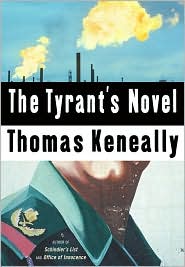 In this novel within a novel, Australian author Thomas Keneally returns to the political themes which won him prizes for The Chant of Jimmie Blacksmith, Voices from the Forest, and Schindler’s Ark. Keneally has always been at his best depicting ordinary people facing extraordinary pressures, especially from governments bent on totalitarian rule, and this contemporary allegory is no exception. Taking place in an unnamed oil-rich country in the Middle East ruled by a tyrant who calls himself Great Uncle, the novel centers on a man named “Alan Sheriff,” a short story writer given one month to write an “autobiographical novel” for which Great Uncle will take full credit. Sheriff, we learn in the opening chapter, is telling his story to a western journalist at a detention camp in an unnamed desert country, where he has languished for three years.
Keneally increases the impact and universality of the story through his clever use of western names. As Alan Sheriff tells the journalist, it is important for his credibility in the west that he be like a man you’d meet on the street, which is much easier with a name like Alan–“not, God help us, Said and Osama and Saleh. If we had Mac instead of Ibn…” Alan believes his “saddest and silliest story” will interest Americans, despite the fact that his country and the US are now enemies.

Through Alan’s story, the reader meets Mrs. Douglas, whose nephew, not careful enough of the pH level of Great Uncle’s swimming pool, has been shot and hanged from the ramparts; Mrs. Carter, whose son has been missing for six years; Alan’s beloved wife, Sarah Manners, an actress who has become unemployable; Matt McBride, another writer who becomes head of the Cultural Commission, where he works for Great Uncle; and Louise James, an American who would like to get Sheriff to come to Texas as a visiting professor. All these characters contribute to a stunning conclusion as Sheriff tries to write the required novel.
Easily the best Keneally novel in over a decade when this was published in 2003, this serious and thoughtful novel, with some satiric overtones, has significant political ramifications. The characters are “ordinary people,” much like the rest of us, caught in extreme situations, and Keneally builds up enormous suspense as the long tentacles of the tyrant grab everyone in their path. Though most readers will recognize the unnamed country and the tyrant, it is a tribute to Keneally that their specific identities are totally irrelevant to his themes and plot. The author makes it clear that a government’s manipulation of the people’s perceptions through staged events is not limited to the Third World.
Also reviewed here: Keneally’s SCHINDLER’S LIST, VICTIM OF THE AURORA, CONFEDERATES, DAUGHTERS OF MARS, NAPOLEON’S LAST ISLAND
Photo credit: The author’s photo accompanies an interview from http://www.guardian.co.uk